• Join
  • Sign In with my.TI Login
Texas Instruments
  • Products
  • Applications
  • Tools & Software
  • Support & Community
  • Sample & Buy
  • About TI
Sample & Purchase Cart Sample & Purchase Cart
  • Search
  • Advanced
TI E2E™ Community
  • Support Forums
  • Blogs
  • Groups
  • Videos
  • 简体中文
  • More ...
TI Home » TI E2E Community » Support Forums » Amplifiers » High Speed Amplifiers » High Speed Amplifiers Forum » THS3202 AC transform characteristics analysis
Share
High Speed Amplifiers
  • Forum
  • Announcements
  • E2E Wiki
Options
  • Subscribe via RSS
Check out
Analog Wire blog
  • $core_v2_blog.Current.Name

    This amplifier doesn't exist...now what!?

    Posted 1 day ago
    by Xavier Ramus
    Sometimes it’s impossible to find an amplifier with the...
  • $core_v2_blog.Current.Name

    Cable equalization 101 – Automating your design

    Posted 3 days ago
    by Hooman Hashemi
    Judging by the number of views on a post related to numerical...
  • $core_v2_blog.Current.Name

    RS-485 - Who says you can't teach an old dog new tricks?

    Posted 8 days ago
    by Neel Seshan
    Would you agree that RS-485 has turned out to be one of the most...

THS3202 AC transform characteristics analysis

THS3202 AC transform characteristics analysis

This question has suggested answer(s)
Eric Lo63813
Posted by Eric Lo63813
on May 29 2012 21:43 PM
Intellectual310 points

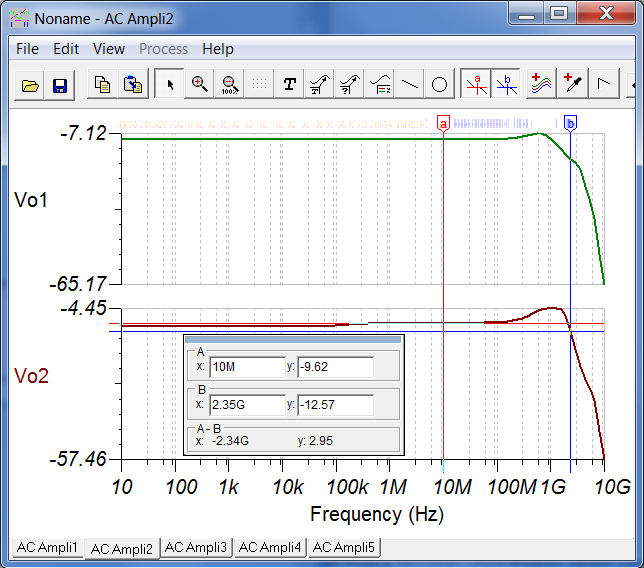
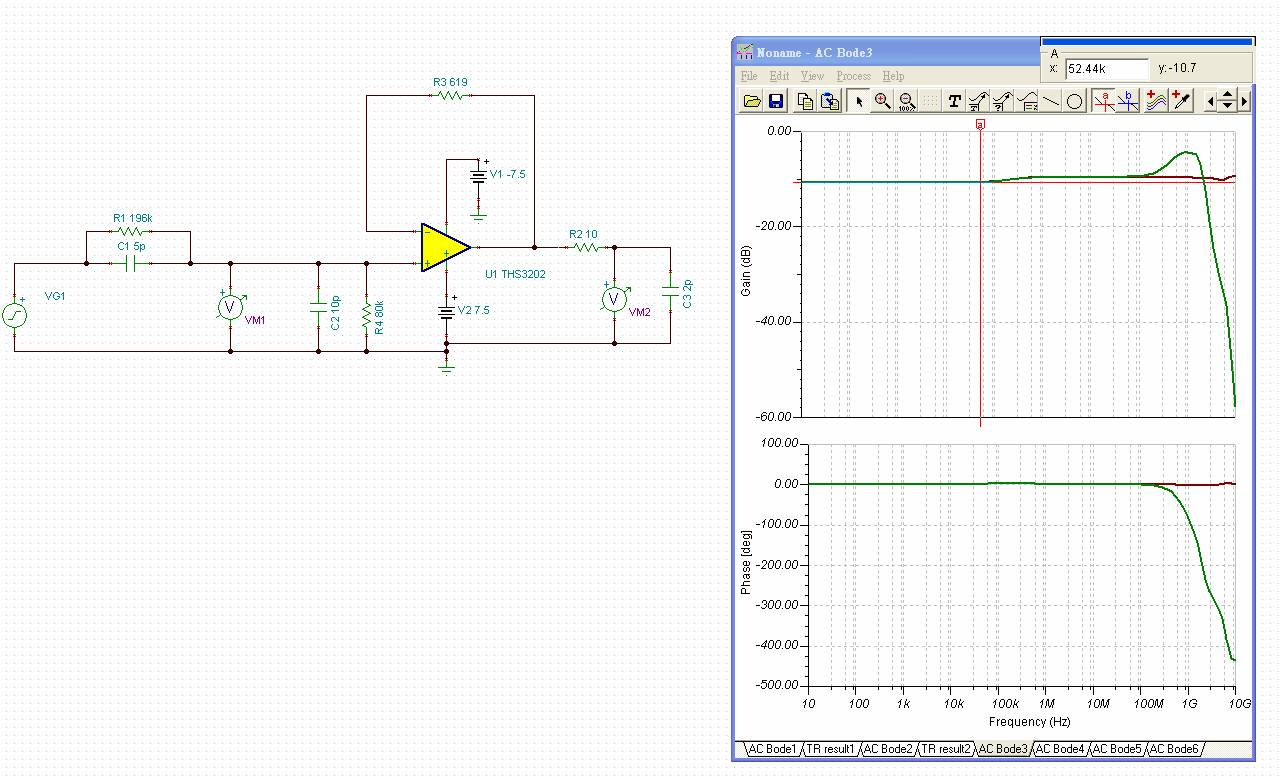
We used AC transform characteristics to analyze the circuit below and the result as right side. How could we identify the bandwidth of this circuit configuration.

Another circuit configuration, the divided-by-3 constructed before the Vin+, the DC divided-by-3 result could not be met. It seemed that the Vin+ input impedance affected the DUT, could you help do the simulation to clarify the issue? Thank you.


Report Abuse
  • Reply
You have posted to a forum that requires a moderator to approve posts before they are publicly available.
All Replies
  • Luke Lapointe
    Posted by Luke Lapointe
    on May 30 2012 17:29 PM
    Suggested Answer
    Expert4200 points

    Eric,

    The bandwidth of your circuit can be seen by measuring the -3dB point in your response. This is approximately 1.44GHz and 2.35GHz for each circuit respectively.

    One thing to note is that the input impedance of the THS3202 is 750kΩ. As you increase the size of the input voltage divider, the input impedance of the amplifier will start to have an effect. Try reducing the size of the input divider to get the same attenuation in your passband. For example, 10kΩ and 20kΩ should be small enough.

    Also note that the 5pF at the input is acting as a high pass filter which could be affecting your frequency response if the resistor divider is too large.

    Let me know if this resolves your issue.

    Regards,
    Luke LaPointe
    High Speed Amplifiers

    Report Abuse
    • Reply
    You have posted to a forum that requires a moderator to approve posts before they are publicly available.
TI E2E™ Community
  • Support Forums
  • Blogs
  • Videos
  • Groups
  • Site Support & Feedback
  • Settings
TI E2E™ Community Groups
  • TI University Program
  • Make the Switch
  • Microcontroller Projects
  • Motor Drive & Control
Other Communities
  • Deyisupport
  • Designsomething.org
  • beagleboard.org
  • TI on Element 14
  • TI on TechXchangeSM
Other Technical & Support Resources
  • WEBENCH® Design Center
  • Product Information Centers
  • Technical Documents
  • TI Design Network
  • TI Technical Articles
  • TI Training

All content and materials on this site are provided "as is". TI and its respective suppliers and providers of content make no representations about the suitability of these materials for any purpose and disclaim all warranties and conditions with regard to these materials, including but not limited to all implied warranties and conditions of merchantability, fitness for a particular purpose, title and non-infringement of any third party intellectual property right. TI and its respective suppliers and providers of content make no representations about the suitability of these materials for any purpose and disclaim all warranties and conditions with respect to these materials. No license, either express or implied, by estoppel or otherwise, is granted by TI. Use of the information on this site may require a license from a third party, or a license from TI.

Content on this site may contain or be subject to specific guidelines or limitations on use. All postings and use of the content on this site are subject to the Terms of Use of the site; third parties using this content agree to abide by any limitations or guidelines and to comply with the Terms of Use of this site. TI, its suppliers and providers of content reserve the right to make corrections, deletions, modifications, enhancements, improvements and other changes to the content and materials, its products, programs and services at any time or to move or discontinue any content, products, programs, or services without notice.

Follow Us Texas Instruments on Facebook Texas Instruments on Twitter Texas Instruments on LinkedIn Texas Instruments on Google+
TI Worldwide | Contact Us | my.TI Login | Site Map | Corporate Citizenship | mobile m.ti.com (Mobile Version)

TI is a global semiconductor design and manufacturing company. Innovate with 100,000+ analog ICs and
embedded processors, along with software, tools and the industry’s largest sales/support staff.

© Copyright 1995-2013 Texas Instruments Incorporated. All rights reserved.
Trademarks | Privacy Policy | Terms of Use