• Join
  • Sign In with my.TI Login
Texas Instruments
  • Products
  • Applications
  • Tools & Software
  • Support & Community
  • Sample & Buy
  • About TI
Sample & Purchase Cart Sample & Purchase Cart
  • Search
  • Advanced
TI E2E™ Community
  • Support Forums
  • Blogs
  • Groups
  • Videos
  • 简体中文
  • More ...
TI Home » TI E2E Community » Support Forums » Digital Signal Processors (DSP) » OMAP™ Processors » OMAP-L13x, AM1x and C674x Processors Forum » AM1707: power consumption on +1.8V power rail
Share
OMAP™ Processors
  • Forums
  • Announcements
Options
  • Subscribe via RSS
Resources
  • OMAP-L1x DSP+ARM9™-based Processors Product Folder
  • OMAP3525/30 DSP+ARM Cortex™-A8-based SOCs Product Folder

  • Top OMAPL Wiki Links
  • OMAPL3x Schematic Review Checklist
  • OMAPL13x Boot resources

  • OMAPL Document Resources
  • OMAPL137 Technical reference manual
  • OMAPL138 Technical reference manual
  • OMAPL Boot loader App Notes
  • AM1707: power consumption on +1.8V power rail

    AM1707: power consumption on +1.8V power rail

    This question is not answered
    tung ngo
    Posted by tung ngo
    on Jun 14 2012 05:39 AM
    Prodigy210 points

    Dear,

    AM1707: What is the power consumption of +1.8V rail in three case below:

    1. Using USB2.0 OTG only
    2. Using USB2.0 OTG & USB1.1
    3. USB functions are not used.

    Thanks

    Tung

    Report Abuse
    • Reply
    You have posted to a forum that requires a moderator to approve posts before they are publicly available.
    All Replies
    • Mukul Bhatnagar
      Posted by Mukul Bhatnagar
      on Jun 14 2012 13:47 PM
      Mastermind24420 points

      Hi

      You should be able to deduce this by going through the power consumption summary wiki and the power estimation spreadsheet for AM17xx

      http://processors.wiki.ti.com/index.php/AM17x_Power_Consumption_Summary

      If you do not have USB in your design, you will not need a 1.8V supply as except for USBs, all other IOs are 3.3V.

      Regards

      Mukul


      Don't forget to verify answers to your forum questions by using the green "Verify Answer" button.

      Report Abuse
      • Reply
      You have posted to a forum that requires a moderator to approve posts before they are publicly available.
    • tung ngo
      Posted by tung ngo
      on Jun 14 2012 23:39 PM
      Prodigy210 points
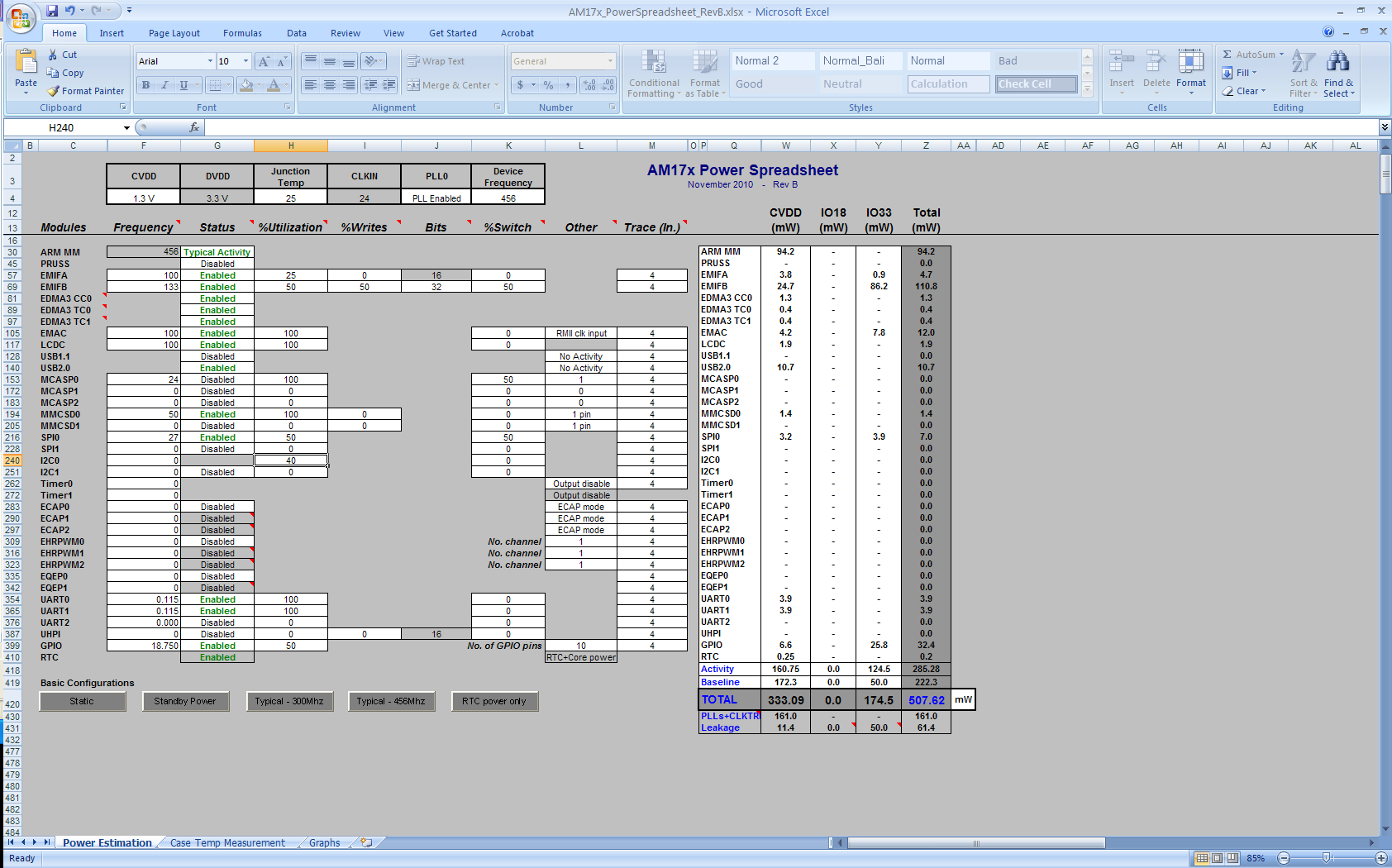
      AM1707_Power_Consumtion.bmp

      Hi Nuku,

      In our design we use 1 USB0 (USB2.0 OTG), but in power spreadsheet I don't see the power consumption on +1.8V rail.

      Picture attachment is power spreadsheet that I calculated, please have a look.

      Thanks

      Tung

      Report Abuse
      • Reply
      You have posted to a forum that requires a moderator to approve posts before they are publicly available.
    • Mukul Bhatnagar
      Posted by Mukul Bhatnagar
      on Jun 15 2012 08:18 AM
      Mastermind24420 points

      Hi Tung

      For the USB2.0 or USB1.1 row, on column L there is a drop down menu to change from No Activity to PHY ENABLE or HS/FS Transmit/Receive. Configure those cells to assess the power on the 1.8V rail for the various USB modes.

      Regards

      Mukul


      Don't forget to verify answers to your forum questions by using the green "Verify Answer" button.

      Report Abuse
      • Reply
      You have posted to a forum that requires a moderator to approve posts before they are publicly available.
    TI E2E™ Community
    • Support Forums
    • Blogs
    • Videos
    • Groups
    • Site Support & Feedback
    • Settings
    TI E2E™ Community Groups
    • TI University Program
    • Make the Switch
    • Microcontroller Projects
    • Motor Drive & Control
    Other Communities
    • Deyisupport
    • Designsomething.org
    • beagleboard.org
    • TI on Element 14
    • TI on TechXchangeSM
    Other Technical & Support Resources
    • WEBENCH® Design Center
    • Product Information Centers
    • Technical Documents
    • TI Design Network
    • TI Technical Articles
    • TI Training

    All content and materials on this site are provided "as is". TI and its respective suppliers and providers of content make no representations about the suitability of these materials for any purpose and disclaim all warranties and conditions with regard to these materials, including but not limited to all implied warranties and conditions of merchantability, fitness for a particular purpose, title and non-infringement of any third party intellectual property right. TI and its respective suppliers and providers of content make no representations about the suitability of these materials for any purpose and disclaim all warranties and conditions with respect to these materials. No license, either express or implied, by estoppel or otherwise, is granted by TI. Use of the information on this site may require a license from a third party, or a license from TI.

    Content on this site may contain or be subject to specific guidelines or limitations on use. All postings and use of the content on this site are subject to the Terms of Use of the site; third parties using this content agree to abide by any limitations or guidelines and to comply with the Terms of Use of this site. TI, its suppliers and providers of content reserve the right to make corrections, deletions, modifications, enhancements, improvements and other changes to the content and materials, its products, programs and services at any time or to move or discontinue any content, products, programs, or services without notice.

    Follow Us Texas Instruments on Facebook Texas Instruments on Twitter Texas Instruments on LinkedIn Texas Instruments on Google+
    TI Worldwide | Contact Us | my.TI Login | Site Map | Corporate Citizenship | mobile m.ti.com (Mobile Version)

    TI is a global semiconductor design and manufacturing company. Innovate with 100,000+ analog ICs and
    embedded processors, along with software, tools and the industry’s largest sales/support staff.

    © Copyright 1995-2013 Texas Instruments Incorporated. All rights reserved.
    Trademarks | Privacy Policy | Terms of Use