• Join
  • Sign In with my.TI Login
Texas Instruments
  • Products
  • Applications
  • Tools & Software
  • Support & Community
  • Sample & Buy
  • About TI
Sample & Purchase Cart Sample & Purchase Cart
  • Search
  • Advanced
TI E2E™ Community
  • Support Forums
  • Blogs
  • Groups
  • Videos
  • 简体中文
  • More ...
TI Home » TI E2E Community » Support Forums » Microcontrollers » MSP430™ Microcontrollers » MSP430 Ultra-Low Power 16-bit Microcontroller Forum » Clarification of differences between the variants of the EZ430-Chronos Devkit
Share
MSP430™ Microcontrollers
  • Forum
  • Announcements
  • E2E Wiki
Options
  • Subscribe via RSS
MSP430 Resources
  • MSP430 Product Folder
  • MSP-EXP430G2 - MSP430 LaunchPad Value Line Development kit
  • MSP430 Getting Started Guide
  • MSP430 Microcontroller Projects
  • More Resources >
  • Clarification of differences between the variants of the EZ430-Chronos Devkit

    Clarification of differences between the variants of the EZ430-Chronos Devkit

    This question is answered
    Jeffery MacEachern
    Posted by Jeffery MacEachern
    on Jul 18 2010 00:37 AM
    Prodigy20 points

    I am planning to purchase the EZ430-Chronos Devkit soon, but I wanted to clarify one point from the wiki.  In the FAQs, it states:

    "The 868-MHz and 915-MHz watch hardware are physically identical and the radio frequency is software selectable so it's possible to switch frequency if necessary. However, the RF Access Points for the two respective kits are slightly different. The 868-MHz Access Point has a 0Ω resistor next to the antenna and the 915-MHz version does not. The 433-MHz kit is different than the other versions in both software and hardware."

    Am I understanding correctly that the 868MHz and 915MHz Access Points are not frequency-switchable like the watches themselves are?  If they are, does switching the frequency require additional hardware?

    Thanks,

      - Jeffery MacEachern

    chronos frequency
    Report Abuse
    • Reply
    You have posted to a forum that requires a moderator to approve posts before they are publicly available.
    All Replies
    • C. Hayes
      Posted by C. Hayes
      on Jul 18 2010 03:06 AM
      Expert1710 points
      I have not personally investigated the differences, but from the comment above I believe that the implication is that the two access point versions have the same hardware PCB and component design with the exception of the installation or absence of that one 'resistor'. A zero ohm resistor is commonly used as a jumper to enable or disable a certain portion of a circuit such that the configurations can easily be switched at production time by installing the resistor or not for a particular variant model of the unit. It would not be uncommon to have slightly different RF matching networks or something like that for one frequency versus another similar frequency where the tuning is similar but may be optimized by a slight adjustment like connecting an additional circuit with such a zero ohm resistor. You could investigate the differences yourself by comparing the BOM and the PCB trace gerber files from the hardware documentation / design materials which presumably are available for download. If the PCBs are identical and the BOMs are also except for the installation of that particular resistor, the units should be able to be switched from one configuration to the other by changing that resistor's installation as described. I assume that there might be some software parameter differences too to select the use of one frequency versus the other, but that should be straightforward to reconfigure based on the suggested firmware/settings for the two models of unit. If they wanted the units to be dynamically switched from one frequency to the other in software only, they wouldn't have made the PCB assembly different via that resistor, though, so it will take a little hardware modification to switch frequencies or so it seems. On the other hand if you're willing to compromise the span of frequencies actually used within each band or maybe accept reduction of the sensitivity / power output efficiency you could presumably find a way to reconfigure / retune it to work at a less than optimum efficiency / sensitivity / capability on both bands simultaneously if that is your goal. I suppose if the resistor is in the antenna circuit it is just slightly adjusting the tuning or matching of the antenna. If so it wouldn't be surprising if either unit could receive at least modestly well (if not fully optimally) on both frequencies with no adjustment, though it is possible that you'd lose some transmit efficiency or band optimization adjustment on the other frequency if you were to transmit without making the hardware change. In principle it is seemingly not so different than adjusting a TV antenna to get better reception on one channel versus another even though the same basic antenna and hardware will work for both given the little tuning / alignment adjustment.
      Report Abuse
      • Reply
      You have posted to a forum that requires a moderator to approve posts before they are publicly available.
    • Jeffery MacEachern
      Posted by Jeffery MacEachern
      on Jul 18 2010 03:14 AM
      Prodigy20 points

      Thanks for the comprehensive reply.  I was thinking something along the same lines regarding the "resistor" (albeit not as specifically).  In this case, my motivations are much more simple: Digikey has no stock in the 915MHz model, and plenty of stock in the 868MHz model.  If it was easily switchable, I wouldn't bother waiting to order.  However, I don't really want to mess around with it; furthermore, according to the User's Manual, the USB dongle can only be reprogrammed with a (presumably) TI-specific device that costs as much as the devkit.  I think I'll just wait.

      Thanks again,

        - Jeffery MacEachern

      Report Abuse
      • Reply
      You have posted to a forum that requires a moderator to approve posts before they are publicly available.
    • Jens-Michael Gross
      Posted by Jens-Michael Gross
      on Jul 19 2010 10:38 AM
      Guru139900 points

      IMHO there is no reason why the AP should use an antenna circuit that requires a hardware change while the watch uses a different one that doesn't.

      Of course this is possible.
      Yet I think the resistor might be just a jumper that tells the firmware to configure the RF this or that way. While the software in the watch needs to be replaced for a different frequency.

      Only a look into the schematics will tell :)

      _____________________________________
      Before posting bug reports or ask for help, do at least quick scan over this article. It applies to any kind of problem reporting. On any forum. And/or look here.
      If you cannot discuss your problem in the public, feel free to start a private conversation: click on my name and then 'start conversation'. But please do so only if you really cannot do it in a public thread, as I usually read all threads. And I prefer to answer where others can profit from it (or contribute to it) too.

      Report Abuse
      • Reply
      You have posted to a forum that requires a moderator to approve posts before they are publicly available.
    • BenH
      Posted by BenH
      on Jul 19 2010 11:39 AM
      Intellectual300 points

      I can confirm that the APs from both kits are physically the same save for the suspected 0 ohm resistor.  I would have to assume the software on the AP is different as well, but do not know this for sure.  If reprogrammability of the AP is required then a CCdebugger device is needed and some creative soldering will have to take place to get the new code onto the AP.  The JTAG pins on the AP are brought out to some very small test point surface pads, but they are not in the footprint of any connector.  If development of a custom AP is desired,  the CC1111EMK would be recommended.

      Report Abuse
      • Reply
      You have posted to a forum that requires a moderator to approve posts before they are publicly available.
    • Dung Dang
      Posted by Dung Dang
      on Jul 20 2010 11:21 AM
      Suggested Answer
      Genius10820 points

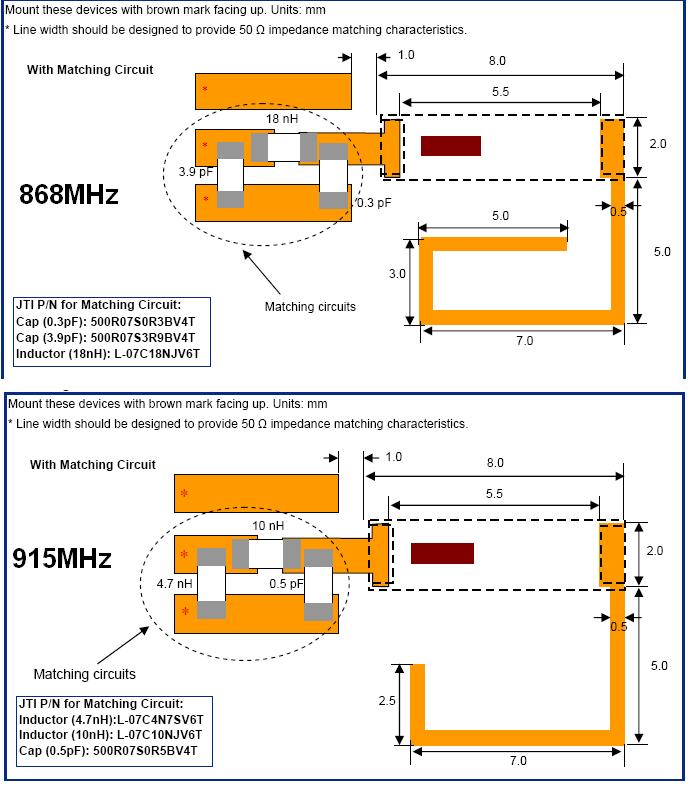
      On the Chronos CC1111AP, the 0ohm resistor essentially "extends" the antenna length, essentially switching it from 915 to 868MHz.See the picture below, where the blue lines are the traces, and the red line is the 0ohm resistor that further extends the long trace to the short trace. This 0ohm resistor is present in the 868MHz version of the AP.


      However, the CC1111 radio also requires different register configurations to operate at 868MHz // 915MHz, hence different firmwares are needed. If you have installed the Chronos SW package, you should notice 3 different firmware sets for the AP (433, 858, 915) located at C:\Program Files\Texas Instruments\eZ430-Chronos\Recovery\RF Access Point.

      Regards,


      Dung


      EDIT: 915MHz = no 0Ω resistor
               868MHz = 0Ω resistor populated


      Report Abuse
      • Reply
      You have posted to a forum that requires a moderator to approve posts before they are publicly available.
    • Jens-Michael Gross
      Posted by Jens-Michael Gross
      on Jul 20 2010 12:33 PM
      Guru139900 points

      Dung Dang
      the 0ohm resistor essentially "extends" the antenna, essentially switching it from 868 to 915MHz.[...]This 0ohm resistor is missing in the 868MHz version of the AP.


      Interesting. I always thought that the higher the frequency, the shorter the antenna. One wavelength is 34.6cm for 868MHz and 32.8cm for 915MHz

      But maybe this is extending the (estimated) 1/16 antenna at 868MHz to an 1/12 antenna at 915MHz, making it a little more sensitive.

      If this is the intention, and if it works, it will compensate the range-loss at higher frequencies, making the 915MHz version reach as far as the 868MHz version.

      _____________________________________
      Before posting bug reports or ask for help, do at least quick scan over this article. It applies to any kind of problem reporting. On any forum. And/or look here.
      If you cannot discuss your problem in the public, feel free to start a private conversation: click on my name and then 'start conversation'. But please do so only if you really cannot do it in a public thread, as I usually read all threads. And I prefer to answer where others can profit from it (or contribute to it) too.

      Report Abuse
      • Reply
      You have posted to a forum that requires a moderator to approve posts before they are publicly available.
    • Dung Dang
      Posted by Dung Dang
      on Jul 20 2010 14:46 PM
      Verified Answer
      Verified by Jeffery MacEachern
      Genius10820 points

      Jens-Michael,

      sorry, typo, please see edited post. The extended antenna length is for the 868MHz, shorter one is for 915MHz. Nonetheless, the path-loss difference shouldn't be too significant when moving from 868MHz to 915MHz as these two bands are relatively close to each other.

      To answer the the other question: to avoid complication and if you don't want to purchase the additional CC Debugger, you could wait for the 915MHz version to become available.

      More information on the chip antennas (Johanson) of the two versions (from the datasheet, essentially replicated in the Chronos):

      Regards,

      Dung


      Report Abuse
      • Reply
      You have posted to a forum that requires a moderator to approve posts before they are publicly available.
    TI E2E™ Community
    • Support Forums
    • Blogs
    • Videos
    • Groups
    • Site Support & Feedback
    • Settings
    TI E2E™ Community Groups
    • TI University Program
    • Make the Switch
    • Microcontroller Projects
    • Motor Drive & Control
    Other Communities
    • Deyisupport
    • Designsomething.org
    • beagleboard.org
    • TI on Element 14
    • TI on TechXchangeSM
    Other Technical & Support Resources
    • WEBENCH® Design Center
    • Product Information Centers
    • Technical Documents
    • TI Design Network
    • TI Technical Articles
    • TI Training

    All content and materials on this site are provided "as is". TI and its respective suppliers and providers of content make no representations about the suitability of these materials for any purpose and disclaim all warranties and conditions with regard to these materials, including but not limited to all implied warranties and conditions of merchantability, fitness for a particular purpose, title and non-infringement of any third party intellectual property right. TI and its respective suppliers and providers of content make no representations about the suitability of these materials for any purpose and disclaim all warranties and conditions with respect to these materials. No license, either express or implied, by estoppel or otherwise, is granted by TI. Use of the information on this site may require a license from a third party, or a license from TI.

    Content on this site may contain or be subject to specific guidelines or limitations on use. All postings and use of the content on this site are subject to the Terms of Use of the site; third parties using this content agree to abide by any limitations or guidelines and to comply with the Terms of Use of this site. TI, its suppliers and providers of content reserve the right to make corrections, deletions, modifications, enhancements, improvements and other changes to the content and materials, its products, programs and services at any time or to move or discontinue any content, products, programs, or services without notice.

    Follow Us Texas Instruments on Facebook Texas Instruments on Twitter Texas Instruments on LinkedIn Texas Instruments on Google+
    TI Worldwide | Contact Us | my.TI Login | Site Map | Corporate Citizenship | mobile m.ti.com (Mobile Version)

    TI is a global semiconductor design and manufacturing company. Innovate with 100,000+ analog ICs and
    embedded processors, along with software, tools and the industry’s largest sales/support staff.

    © Copyright 1995-2013 Texas Instruments Incorporated. All rights reserved.
    Trademarks | Privacy Policy | Terms of Use