• Join
  • Sign In with my.TI Login
Texas Instruments
  • Products
  • Applications
  • Tools & Software
  • Support & Community
  • Sample & Buy
  • About TI
Sample & Purchase Cart Sample & Purchase Cart
  • Search
  • Advanced
TI E2E™ Community
  • Support Forums
  • Blogs
  • Groups
  • Videos
  • 简体中文
  • More ...
TI Home » TI E2E Community » Support Forums » Power Management » SIMPLE SWITCHER® » SIMPLE SWITCHER® - Forum » using LMZ22010/LMZ23610 in inverting configuration and current sharing
Share
SIMPLE SWITCHER®
  • Forum
  • Announcements
  • Files
  • E2E Wiki
Options
  • Subscribe via RSS

using LMZ22010/LMZ23610 in inverting configuration and current sharing

using LMZ22010/LMZ23610 in inverting configuration and current sharing

This question is answered
Dan Andersen
Posted by Dan Andersen
on Jan 03 2012 12:41 PM
Expert3140 points

Can the LMZ22010 or LMZ23610 be using in an inverting configuration with current sharing?  If so, is there any level shift that must be perofrmed on the current share line?

National Modules Simple Switcher LMZ22010 current sharing
Report Abuse
  • Reply
You have posted to a forum that requires a moderator to approve posts before they are publicly available.
All Replies
  • Marc Davis-Marsh
    Posted by Marc Davis-Marsh
    on Jan 25 2012 16:03 PM
    Verified Answer
    Verified by Marc Davis-Marsh
    Expert3150 points

    The LMZ12010; LMZ22010; LMZ13610; LMZ23610 can all be used in an inverting configuration with current sharing.

    There is no level shifting that needs to be done on the current sharing line.  In the inverting configuration all logic signals are now referenced from the negative output voltage


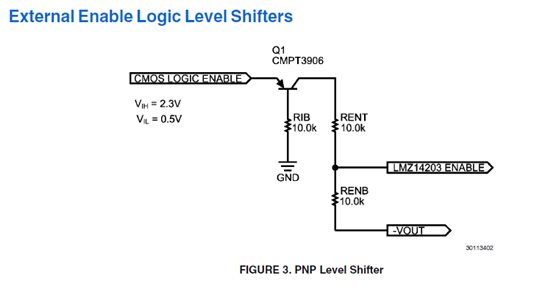
    Level shifting will need to be done on the enable pin, and synchronization pin, unless the enable and sync circuitry is referenced from the negative voltage.

    Application Note AN-2027 has details on the level shifting circuitry.  http://www.ti.com/lit/an/snva425/snva425.pdf.

    If you look at Figure 3, the PNP level shifter.  Adjust RENT so that the synchronization signal logic high does not exceed the 5.5V maximum value of the logic with reference to the negative output voltage. The same is true for the enable logic.

    For example:  The input clock is from 0V to 5V, and the device is configured for -3.3V out. Let RENB=10K.

                              RENT should be selected such that the voltage divider lowers the logic high 5V to (5V-3.3V) = 1.7V.

                              RENT = RENB * (Logic High -  Vset) / (Vset-Vout)

                              RENT = 10Kohm * (5V - 1.7V)/(1.7V-(-3.3v) = 6.6K

                              Quick re-check. Set Voltage = (10K * (5V - -3.3V) / 16.6K) - 3.3V = 1.7V


    One last thing to consider is that in this configuration the sum of the input current and the output current must be less than the current limit of the device.

    Regards,


    Report Abuse
    • Reply
    You have posted to a forum that requires a moderator to approve posts before they are publicly available.
TI E2E™ Community
  • Support Forums
  • Blogs
  • Videos
  • Groups
  • Site Support & Feedback
  • Settings
TI E2E™ Community Groups
  • TI University Program
  • Make the Switch
  • Microcontroller Projects
  • Motor Drive & Control
Other Communities
  • Deyisupport
  • Designsomething.org
  • beagleboard.org
  • TI on Element 14
  • TI on TechXchangeSM
Other Technical & Support Resources
  • WEBENCH® Design Center
  • Product Information Centers
  • Technical Documents
  • TI Design Network
  • TI Technical Articles
  • TI Training

All content and materials on this site are provided "as is". TI and its respective suppliers and providers of content make no representations about the suitability of these materials for any purpose and disclaim all warranties and conditions with regard to these materials, including but not limited to all implied warranties and conditions of merchantability, fitness for a particular purpose, title and non-infringement of any third party intellectual property right. TI and its respective suppliers and providers of content make no representations about the suitability of these materials for any purpose and disclaim all warranties and conditions with respect to these materials. No license, either express or implied, by estoppel or otherwise, is granted by TI. Use of the information on this site may require a license from a third party, or a license from TI.

Content on this site may contain or be subject to specific guidelines or limitations on use. All postings and use of the content on this site are subject to the Terms of Use of the site; third parties using this content agree to abide by any limitations or guidelines and to comply with the Terms of Use of this site. TI, its suppliers and providers of content reserve the right to make corrections, deletions, modifications, enhancements, improvements and other changes to the content and materials, its products, programs and services at any time or to move or discontinue any content, products, programs, or services without notice.

Follow Us Texas Instruments on Facebook Texas Instruments on Twitter Texas Instruments on LinkedIn Texas Instruments on Google+
TI Worldwide | Contact Us | my.TI Login | Site Map | Corporate Citizenship | mobile m.ti.com (Mobile Version)

TI is a global semiconductor design and manufacturing company. Innovate with 100,000+ analog ICs and
embedded processors, along with software, tools and the industry’s largest sales/support staff.

© Copyright 1995-2013 Texas Instruments Incorporated. All rights reserved.
Trademarks | Privacy Policy | Terms of Use