This thread has been locked.

If you have a related question, please click the "Ask a related question" button in the top right corner. The newly created question will be automatically linked to this question.

TPS7A84: LDO current rating

Part Number: TPS7A84
Other Parts Discussed in Thread: TL1963A-Q1, TPS74301, LM1086, LM317

Hi Experts,

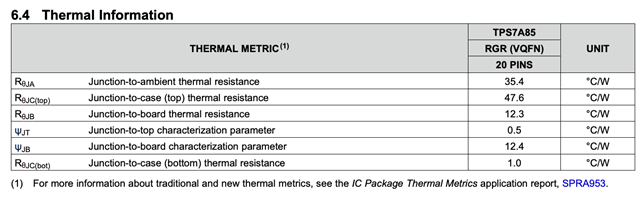
When looking at the LDO thermal resistance, they are the same between TPS7A83/84/85. Then how do i choose the LDO based on input/output voltage and current requirements?

For example, 3.3Vin, 1.8Vout, 65C ambient, if calculate from Rja, the max output current of all 3 LDO is same as 1.12A, if 1.5A is required, how to deal with this?
Thanks

  • Hello,

             Assuming that there can be no reduction/compromise on Ambient Temperature (TAMB = 65ºC) and/or power dissipation (VIN = 3.3V, VOUT = 1.8V, IOUT = 1.5A), we can approach the solution in two ways:

    (1)  You can select a different part that has a lower θJA, and can therefore safely support this ambient temperature and power dissipation. TL1963A-Q1, LM317, LM1086 & TPS74301 are possible options.

    (2) The θJA values provided in the datasheet are calculated for when the part is housed on a JEDEC Standard High-K board. By following some good principles/practices, one can quite easily improve the layout of the board over the JEDEC High K board, and can thereby reduce the θJA by even as much as 50%. The following app note lists and describes the impact of board layout on θJA : https://www.ti.com/lit/an/slvae85/slvae85.pdf. An improvement by 30% in θJA would be sufficient for you to use this device (TPS7A83/84/85) for this application.   

    Thanks!

    Regards,

    Srikanth

  • Thanks Srikanth.

    if we know the PCB temperature (assume simulated PCB temp around the LDO is 90C), can we simply calculate Tj by Rj-b (junction to board thermal resistance), by Tj=Pd*Rj-b + Tpcb?

    Suppose most heat is dissipated by PCB through the Pad under LDO chip. Not sure if this is also reasonable to estimate the Tj and which one is more accurate compared by calculating through Rj-a.

    Thanks

    Neo

  • Hello Neo,

                    Yes, you may use the Junction to Board thermal resistance θJB to make the Junction Temperature measurement. However, for accuracy purposes, you would have to create a setup that uses a ring style cold plate that would ensure that the vast majority of heat flows into the test board via the bottom of the IC. The board temperature measurement has to then be made accurately next to the die. More details of this process can be found at : https://www.ti.com/lit/an/spra953c/spra953c.pdf. Using θJA, in general, is an easier method to estimate the Junction Temperature. Thanks!

    Regards,

    Srikanth