This thread has been locked.

If you have a related question, please click the "Ask a related question" button in the top right corner. The newly created question will be automatically linked to this question.

BQ76972: Measuring strange stack voltages in stacked design

Part Number: BQ76972
Other Parts Discussed in Thread: TIDA-010247

Tool/software:

Hello,

We have a strange behaviour in our design which is very similar to TIDA-010247..

The board is connected to a cell simulator fixture (20 cells - 10 for each BQ) and powered by 48V supply.
The FETS and and current sensing resistance are  NOT CONNECTED yet.
We are seeing strange voltages on Stack voltages which are NOT EQUALS  to the sum of cell voltages and the values themselves should be 24V for each BQ.
It is notable that lowering supply voltage to 24V causes the gap to  disappear


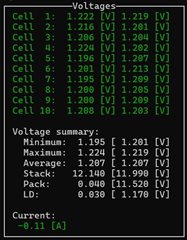
Here is screenshot from our custom monitoring tool:
(Left column is BOTTOM BQ and right column TOP BQ)
Power suppy at 49V
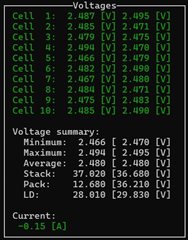


Power supply at 36V
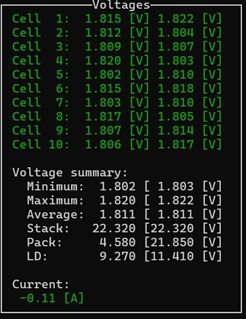

Power supply at 24V

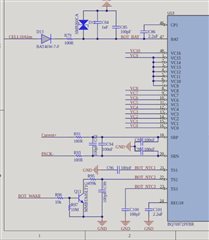
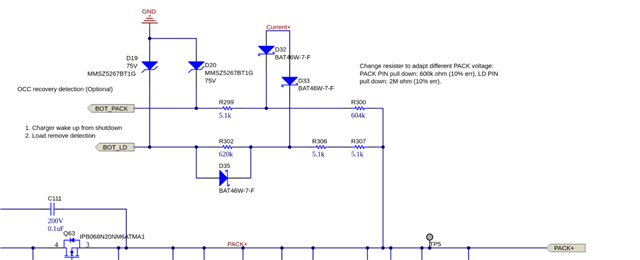
Here are the relevant schematcis:
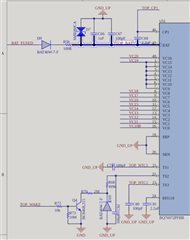


Any ideas on what is happening here?
Thanks Vadim

  • Hello Vadim,

    Is there a reason for not connecting the current sensing resistor and FETs yet? I think this previous post may be helpful: Stacked Design Bring-up Wrong Cell Measurement.

    Best Regards,
    Alexis

  • Hi Alexis, 
    Thank you for the tip...  We did solved Missing Current+ to GND shunt issue previously too as we've experienced negative voltage measurements on the top BQ.

    The FETs and Current sensing resistance are not connected because our design is split in 2 boards:
    Processing board (2 BQs MCU + connectivity stuff)  and Power Board with MOSFETs  thermistors and current sensing resistor.  
    The power board was not ready 3 days ago.
    What we do not understand is why the Sum of 2 stack voltages (as measured by BQs) is not equal to the supply voltage. 
    And the delta grows as we grow suplly voltage

  • Hi Alexis,

    We did test today with the power board. The FET control is working and the cell voltages have the correct values.

    The stack voltage remain incoherent with the sum of cell voltages (It starts to be wrong at ~28V).

    Could it be a gain to set or a missing calibration?

    How can a stack voltage be greater than the input bat?

    Can the reference/ground be incorrect in our configuration or schematic?

    Thanks,
    Ronan

  • As a reminder our design is based on TIDA-010247 https://www.ti.com/tool/TIDA-010247#overview which seems to be optimized for 48V batteries.

    Ronan

  • Hello TI Team,

    We did perform a calibration of voltages today.

    The stack voltage is now coherent but the gain value is around  ~17000 which is very different compared to the factory values (~34000) for both BQs.

    Also the pack voltage of the bottom BQ is coherent when the FETs are closed but is non zero when FETs are opened.

    Do you have any advice or comments?

    Thanks,
    Ronan

  • Hello ,

    It looks that with the TIDA-010247 the calibration of Pack and LD Bottom BQ voltages should be done differently.

    There is a voltage divider for the pack voltage on the BQ bottom:

    Ratio ~0.5 (600k / 1200k)

    There is voltage divider for the ld voltage on the BQ bottom:

    Ratio ~0.76 (2000k / 2600k)


    What is the purpose of those dividers for the bottom BQ?

    We are trying to integrate those voltage dividers for the calibration of the bottom BQ pack and ld voltages.

    By any chance, do you have a code sample of the calibration for this TIDA?

    We were not able to find the implementation of `void BQ769x2_Voltage_Calibration();` function declared here: https://github.com/TexasInstruments/mspm0-sdk/blob/main/examples/nortos/LP_MSPM0G3519/demos/bq769x2_TIDA010247/BQ769x2_Configs/BQ769x2_protocol.h#L546

    (Related to this post).

    Thanks,
    Ronan


    CC
    CC

  • Hello Ronan,

    Also the pack voltage of the bottom BQ is coherent when the FETs are closed but is non zero when FETs are opened.

    The device includes its own factory gain trim; however, it can be optimized when customers calibrate the device to their system/design.

    The stack voltage is now coherent but the gain value is around  ~17000 which is very different compared to the factory values (~34000) for both BQs.

    Is this with a load/charger attached or is this with no load and PACK+/PACK- pins are floating?

    What is the purpose of those dividers for the bottom BQ?

    The PACK and LD pins have a max rating of VSS+85. As mentioned in the image, you would want to change the resistor out to adapt to different PACK voltages as this reference design is for up to 32S and up to 1500V ESS applications. Some users may use less that 32S or lower voltages, so the PACK pin resistors do not need to be as high.

    By any chance, do you have a code sample of the calibration for this TIDA?

    We do not have any sample code of the calibration for this TIDA.

    Best Regards,
    Alexis

  • Is this with a load/charger attached or is this with no load and PACK+/PACK- pins are floating?

    It is without a load or charger so PACK+/- pins are floating.

    A very different gain value compared to factory trim looks normal for Pack/LD voltages (due to voltage dividers) but seems strange for Stack voltage, no?

    The PACK and LD pins have a max rating of VSS+85. As mentioned in the image, you would want to change the resistor out to adapt to different PACK voltages as this reference design is for up to 32S and up to 1500V ESS applications. Some users may use less that 32S or lower voltages, so the PACK pin resistors do not need to be as high.

    OK our design is 24V -> 72V so no divider will be required.

    Thanks,
    Ronan

  • Here is an example of a calibration output for BOTTOM and TOP BQ.

    Calibration Results Comparison BOTTOM
    ----------------------------------------------------------------------
    Parameter                 Old Value            New Value           
    ----------------------------------------------------------------------
    Cell 1 Gain                 12120                12290               
    Cell 2 Gain                 12120                12075               
    Cell 3 Gain                 12120                12058               
    Cell 4 Gain                 12120                12040               
    Cell 5 Gain                 12121                12056               
    Cell 6 Gain                 12121                12053               
    Cell 7 Gain                 12121                12021               
    Cell 8 Gain                 12121                12006               
    Cell 9 Gain                 12128                12059               
    Cell 10 Gain                 12128                1                   
    Cell 11 Gain                 12128                1                   
    Cell 12 Gain                 12128                1                   
    Cell 13 Gain                 12128                1                   
    Cell 14 Gain                 12128                1                   
    Cell 15 Gain                 12128                1                   
    Cell 16 Gain                 12128                12037               
    Cell Offset                0                    -16                 
    VDiv Offset                0                    -640                
    TOS Gain                   33486                17131               
    Pack Gain                  33481                15918               
    LD Gain                    34834                14807
    ----------------------------------------------------------------------

    Calibration Results Comparison TOP
    ----------------------------------------------------------------------
    Parameter                 Old Value            New Value           
    ----------------------------------------------------------------------
    Cell 1 Gain                 12121                12265               
    Cell 2 Gain                 12121                12226               
    Cell 3 Gain                 12121                12243               
    Cell 4 Gain                 12121                12254               
    Cell 5 Gain                 12121                12242               
    Cell 6 Gain                 12121                12205               
    Cell 7 Gain                 12121                12241               
    Cell 8 Gain                 12121                12253               
    Cell 9 Gain                 12125                12238               
    Cell 10 Gain                 12125                1                   
    Cell 11 Gain                 12125                1                   
    Cell 12 Gain                 12125                1                   
    Cell 13 Gain                 12125                1                   
    Cell 14 Gain                 12125                1                   
    Cell 15 Gain                 12125                1                   
    Cell 16 Gain                 12125                12223               
    Cell Offset                0                    22                  
    VDiv Offset                0                    -663                
    TOS Gain                   34238                17211               
    Pack Gain                  34387                17235               
    LD Gain                    32611                9544
    ----------------------------------------------------------------------

  • Hello,

    Our engineers are out of office and will get back to you next week.

    Best Regards,

    Luis Hernandez Salomon

  • Hello Luis,

    OK thanks for the info.

    The calibration results above is done with the following "target" voltages (FETs closed):

    1/ Power supply 30V:

    BOT STACK = 15V PACK = 15V (voltage divider ~0.5) LD = 22.98V (voltage divider ~0.76)

    TOP STACK = 15V PACK = 15V (TOP BAT IN) LD = 13.99V (divider + diode ratio 0.97)

    2/ Power supply 48V:

    BOT STACK = 24V PACK = 24V (voltage divider ~0.5) LD = 36.7V (voltage divider ~0.76)

    TOP STACK = 24 PACK = 24V (TOP BAT IN) LD = 22.25V (divider + diode ration 0.97)

    We also tried a calibration that doesn't integrate the ratio for the bottom BQ (i.e PACK/LD directly at a target voltage of 30/48V):

    TOS Gain                   33486                17162               
    Pack Gain                  33481                32285               
    LD Gain                    34834                19500

    Which then gives the values:

    PS 30V: Pack 24V, LD 19.6V (Stack 15V OK)
    PS 48V: Pack 42V, LD 37.8V (Stack 24V OK)

    Talk to you next week,
    Ronan

  • Hello / ,

    Any news from your engineers?

    Ronan

  • Hello TI Team,

    It looks we would need specific "VDiv Offsets" for Stack/Pack/LD to entirely compensate via the calibration.

    Do you think it is something we should consider (Could be done by the host MCU)?

    Thanks,
    Ronan

  • Hi Luis,

    I am sorry for pushing, but is there any chance that the engineers will have a look this week ?

    Regards,

  • Hi Alexis_H,

    We are still stuck with this issue, do you think we can get support on this matter ?

    Regards,

  • Hello Ronan,

    That is something that could also help. Section 2.4 TOS (Top-of-Stack), PACK, and LD Pin Voltage Calibration from the Calibration and OTP Programming Guide will be useful to refer along with Section 4.10 Voltage Calibration (ADC Measurements) from the technical reference manual

    Best Regards,
    Alexis

  • Hello ,

    Thanks for the links. We are using the exact same Python script as provided in the calibration guide.

    It looks the « stacked design » of two BQs requires a specific calibration procedure for Stack/Pack/LD from my understanding. But the reason doesn’t look clear.

    The calibration with a « mono design » on the evaluation board doesn’t generate such important gains/offsets and the Stack/Pack/LD voltages are quite correct without any calibration.

    Thanks,

    Ronan

  • Hello Ronan,

    The Python script provided in the calibration guide was made with a mono design in mind when doing so, however, the idea behind it should be similar. Is the calibration for the stacked design helping with what you are seeing now?

    Best Regards,
    Alexis

  • On the stacked design, it does help for the stack voltage.

    For pack and ld voltages, it doesn’t compensate all the error.

    Ronan

  • Hello Ronan,

    Just to double-check, is this still with the current sense resistor and FETs not connected?

    Best Regards,
    Alexis

  • Hello Alexis,

    No, everything is now connected (Sense + FETs).

    Thanks,
    Ronan

  • Hello , ,

    Were the stack/pack/ld voltages calibrated on the TIDA-010247?

    Thanks,
    Ronan

  • Hi Ronan,

    I am the designer of TIDA-010247. I didn't add the LD/PACK calibration code in the sample code. I was not required to achieve high accuracy for these voltage measurement. It seems you are on the right way to calibrate it. What's the difficulty now?

    BRs

    Kian

  • Hello ,

    OK nice to have direct contact with the designer of the TIDA!

    The calibration is now OK for STACK voltage (even if gains/offsets for TOP/BOT BQs are quite different compared to the default value which seems a bit strange).

    Still the calibration of LD/PACK voltages doesn't provide correct values compared to the input power supply.

    I would say it is because Vdiv_offset is computed on STACK voltage but the Vdiv_offset should be different for LD/PACK on a TIDA like design.

    From the calibration script:

    Vdiv_Offset_cV = (
        TOS_Gain * (TOS_Voltage_Counts_A / N_SAMPLES) / 2 ** 16 - TOS_V1_cV
    )
    
    Vdiv_Offset = round(Vdiv_Offset_cV / (100.0 * vscale))  # Convert to UserV


    Thanks,
    Ronan

  • Hi Ronan,

    The back-calculated Vdiv offset should not be a big value, right? It seems you have 6~8V error when have 48V power supply. 

    Did you try to calculate PACK and LD voltage via the Gain*raw count/2**16? 

    BRs

    Kian

  • Just focusing on BOTTOM BQ.

    The STACK voltages are correct with the following offsets/gains after calibration:

    BOTTOM

    VDiv Offset                -640                
    TOS Gain                   17131


    At 30V power supply Stack is 15V for both BQs (OK calibration target value was 15V)
    At 48V power supply Stack is 24V for both BQs (OK calibration target value was 24V)

    The PACK/LD are incorrect with the following gains after calibration.

    BOTTOM

    Pack Gain                  32285               
    LD Gain                     19500


    At 30V power supply Pack is 24V and LD is 19.6V (KO calibration target value was 30V)
    At 48V power supply Pack is 42V and LD is 37.8V (KO calibration target value was 48V)


    => So a ~6V error for PACK voltage and ~10V for LD Voltage.

    > Did you try to calculate PACK and LD voltage via the Gain*raw count/2**16? 

    It is what the calibration script is doing but will double check.

    Ronan

  • Hi Ronan,

    I see. I will try the calibration on my own board next week.

    BRs

    Kian

  • Hi Ronan,

    I tested it on my board. 

    I suggest not to follow the calibration guidance in this article Calibration and OTP Programming Guide .

    Because you will have a gain exceeding the length of 16bits unsigned integer. 

    I can get a accurate calibrated PACK/LD voltage via below process:

    1. Apply know VPACK_A
    2. Read PACK/LD voltage via direct command, read multiple data to get an average value 
    3. Apply know VPACK_B
    4. Read PACK/LD voltage via direct command, read multiple data to get an average value 
    5. Apply know VPACK_C
    6. Read PACK/LD voltage via direct command, read multiple data to get an average value 
    7. Cal the gain based on above data
    8. Gain can only be used in SW, cannot be written into PACK GAIN and LD GAIN register

    The gain I get for my board is:

    You need get your own gain on your board because the pulldown resistor has big variations. 

    BRs

    Kian

  • Hi Kian,

    Thanks for the experiment.

    So a gain of ~1.8 for PACK and ~1.6 for LD.

    I will try a method that applies the gains for PACK/LD on the software side but it should work fine.

    Is it ok for the internal securities / algorithms of the BQ if the PACK/LD are not calibrated? (especially the load detection).

    Thanks,
    Ronan


  • Hi Ronan,

    The load detection threshold is ~4V with a 100uA pullup detection current. So, we have a diode connected in parallel with the LD pin serial R. So it can bypass this large resistance when doing the load detection. It should not be a problem. 

    BRs

    Kian