This thread has been locked.

If you have a related question, please click the "Ask a related question" button in the top right corner. The newly created question will be automatically linked to this question.

BOOSTXL-AOA: IQ Samples for AoA calculation

Part Number: BOOSTXL-AOA


Dear All, 

I am currently using a pair of CC26x2R1 LaunchXL's in Master Slave mode (no passive) together with the SDK V 3.40.00.02.

My goal is to use the example python script : rtls_aoa_iq_with_rtls_util_export_into_csv.py from the rtls_agent folder in order to get IQ samples for offline processing on a computer. In the RTLS Toolbox section of the User's Guide (2.01.01.00) under Convert I/Q Data to Angle Difference it is mentionned that with a samplerate of 4 MHz and 2us slot duration only the samples 8 to 15 are kept for one antenna.

This is confusing to me as in one 2 us slot there would be only 8 samples in total at 4MHz sampling rate, take half out because of phase instability and only 4 samples are remaining. What am I missing here? 

Thanks in advance 

Colin 

  • Hi Colin,

    Where do you get 2 us from? In the text the slot duration is 8 us.

  • Hi Marie, 

    In the User's Guide RTLS Toolbox section under : Convert I/Q Data to Angle Difference. The text I'm referring to is as follows. 

    "When the radio frequency wave incident on to an antenna array (assuming there are only 2 antennas on the board, 4MHz sampling rate and 2us slot) and arrives at different antennas at different time, there will be a phase difference between the antennas. So we extract the phase difference between ant1_sample[8 to 15] and ant2_sample[8 to 15]. The switch among antennas will cause measurement error, therefore I/Q samples from 0 to 7 are discarded when calculating angles."

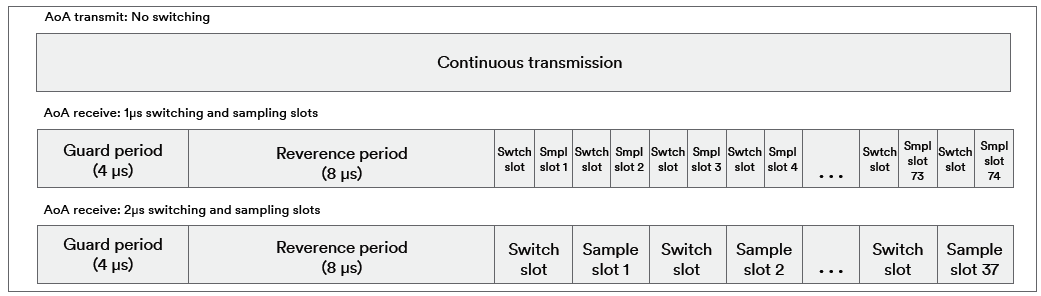
    I looked at the Technical Overview issued by the Bluetooth SIG and according to the table below a switching slot is reserved between each sample slot. A switching slot combined with a sampling slot has a duration of 4 us which would yield 16 samples. 

    My guess would be that the Users guide considers the switching slot to yield samples 0 to 7 and the sampling slot to yield samples 8 to 15 although they are not named this way. 

    What do you think of it? 

    Greetings 

    Colin 

  • Hi,

    First of all, you can consult the following threads that discuss the guard and reference period:
    - e2e.ti.com/.../859313
    - e2e.ti.com/.../3168534
    - e2e.ti.com/.../3185273

    Now to be back on the question regarding the number of samples per antenna. As you said, this number depends on the sampling time spent on each antenna and the sampling rate. The values available for these two parameters are presented on this page.

    As you said, with a slotDuration of 4us and a sampling frequency of 4MHz, you get 16 samples. The first 2us (8 samples) of the slotDuration must be discarded as it corresponds to the antenna switching.

    With a slotDuration of 2us and a sampling frequency of 4MHz, you get 8 samples. The first 1us (4 samples) of the slotDuration must be discarded as it corresponds to the antenna switching.So yes, you will have only 4 usable samples per antenna. However, as the CTE lasts enough to sample multiple time each antenna, you will end up with the same amount of data like with the 4us slotDuration. Keep in mind that the number of samples is mainly limited by the radio's RAM size (this is explained here).

    To finish, I would like to underline that if you chose to have a switching time of 1us, you have to be sure that your antenna board is able to switch antenna within 1us. This is not the case of the AOA booster pack provided by TI. You will also need to slightly modify the code of the example provided (I am mainly thinking to the #define done in the AOA.c file). The following modification will at least be required.

    #define AOA_NUM_VALID_SAMPLES            4
    #define AOA_OFFSET_FIRST_VALID_SAMPLE    4
    #define AOA_NUM_SAMPLES_PER_BLOCK        8

    (Please not that I haven't tested this code snippet as I haven't any antenna board to do so.)

    I hope this will help,

    Best regards,