This thread has been locked.

If you have a related question, please click the "Ask a related question" button in the top right corner. The newly created question will be automatically linked to this question.

AFE4403 Raw Data Waveform’s Rising and Falling TAFE4403ime

Other Parts Discussed in Thread: AFE4403

Hi,


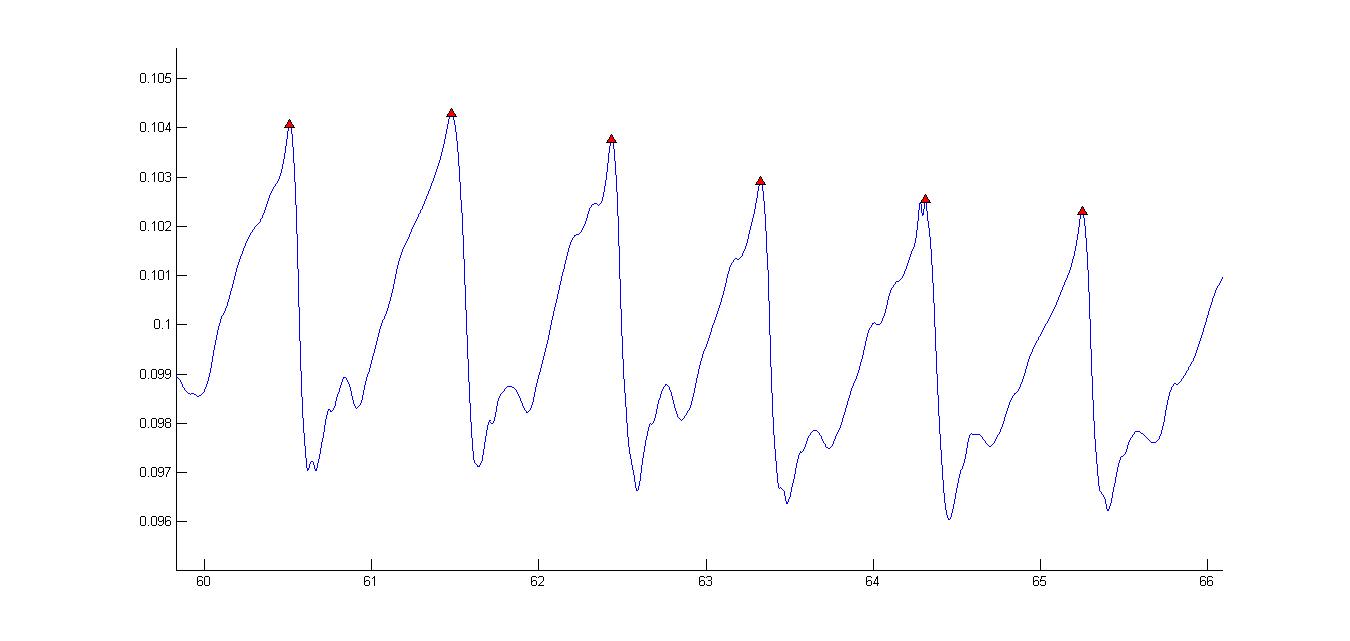
Please refer to the attached waveforms that were recorded from the wrist and directly plotted from the raw data without filtering with software/algorithm. However, the waveform’s rising and falling time with AFE4403 is quite slow; is it caused by the low pass filter inside the AFE4403 as Figure 36. Receiver Front-End of AFE4403 datasheet? Can you let me know the corner frequency of the low pass filter?


Best regards,

Ming Liao

  • Ming,

    We have received your post and hope to have a response back to you soon.
  • Ming,

    This is not caused by the filter.

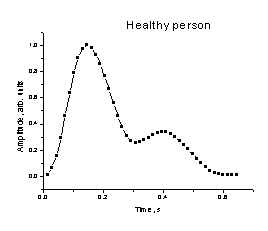
    The picture in this link (home.lu.lv/.../image004.gif) shows a PPG signal. The waveform is of pressure over time. Blood volume is directly proportional to pressure, and therefore the systolic pressure is where the blood volume is the highest.

    Higher blood volume results in greater attenuation of light and therefore lower light current. So, the light current output corresponding to the picture in the link is actually inverted and looks like the first waveform you have. The AFE44x0 reproduces the light current waveform WITHOUT any inversion.

    Therefore the AFE44x0 gives the digital output corresponding to the light input as received by the photodiode.

    In case you are still interested in the Low-Pass Filter, this is found in the electrical characteristics table (page 8) in the datasheet.
  • Hi Ming and Amy,

    I have a similar question.

    I use the AFE44x0SPO2EVM development kit together with MatLab and am getting this signal from PPG (mVolts x Seg). dicroctic notch is on the left of the peak

    According to several bibliographical references the PPG signal should read: dicroctic notch is on the right of the peak.

    Desenvolvimento de um Sensor deFotopletismografia para Monitorização Cardíaca para aplicação no Pulso (Rui Miguel Silva Martins, Coimbra, 2010);

    What should I do to extract an acquired signal? What is the reason for this "mirroring" of the PPG signal?