This thread has been locked.

If you have a related question, please click the "Ask a related question" button in the top right corner. The newly created question will be automatically linked to this question.

TAS5624DDVEVM / ternary modulation

Other Parts Discussed in Thread: TAS5624, TAS5624A, TAS5538

Hello,

I am evaluating TAS5624/TAS55x8 digital amplification technology.

I have some trouble with the ternary modulation mode: when selected, the clipping led is on and the input signal doesn't reach the amp output.

I tried to shutdown all channels but the first one, playing with parameters especially 0x1B an 0x38 without a better result.

Did anybody managed to use the ternary modulation on the TAS5624DDVEVM?

Francois

  • Hi Francois,

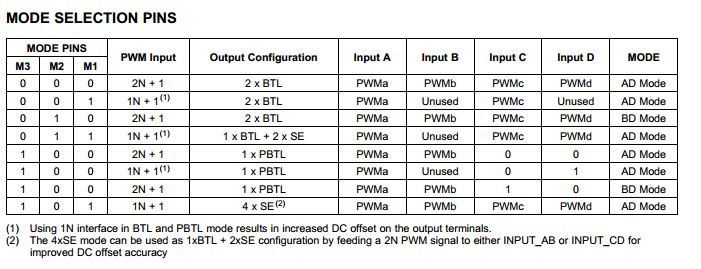
    TAS5624A does not support ternary mode. It supports AD and BD mode only (DS. pg 5 MODE SELECTION PINS table).


    reg,

    Paul.


  • Hi Paul,

    Thank you very much for your quick reply.

    It's my fault. I didn't have in mind that the mode should be set on the H-bridge as well. It seems the glue around the H-bridge is a little bit more important than I was thinking, I should have a closer look on it.

    Does it explain why I have more noise than expected when setting the TAS5538 in BD mode (without modification on the TAS5624A, so in AD mode)?

    The extra noise is probably due to too short pulses that do not reach the ON state (as seen on an oscilloscope). Playing with 0x1B and/or 0xB8 makes pulses larger and solves the problem.

    Regards,

    Francois

  • Hi Francois,

    You are on the right path. Internchannel Channel Delay is often tuned to optimized the THD+N performance in the BD mode. It take some time to fine tune it to the optimum performance based on each system.

    reg,

    Paul.

  • Hi Paul,

    Ok, if I understand well, the loop filter is clipping if the mean value of the input signal (A, B, C, or D) is too far from 1/2. That's always the case with ternary modulation. Do you confirm?

    I played with M[0..2] (mode selection) on the TAS5624A and I can't see any difference. Could you give me some information on what does exactly this setting?
    Especially, what's the difference on the internal of the TAS5624A point of view between:
    2 x BTL AD mode (M[0..2] = {000})
    2 x BTL BD mode (M[0..2] = {010})
    4 x SE AD mode (M[0..2] = {101})

    Regards,

    Francois

  • Hi, Francois,

    Allow me to jump in here.

    We can't really discuss internal operation of our IC on an open forum.

    However, to answer your question,

    The M[0..2] pins allow you to select one of those three modes. The device is just a gigantic buffer that takes your low-voltage, low-current input PWM signal and converts it to a large voltage, large current PWM stream to drive the speaker. It does not significantly change the PWM signal itself (it will make some minor corrections based on the feedback and protection circuitry).

    So, the mode pins actually control which inputs are routed where. THere is a nice table in the d/s that shows this:

    I'm not sure where this 1N and 2N stuff comes from, but, basically, 2N is a differential input, and 1N is a single-ended input (I guess it's short for 1-iNput and 2-iNputs). For BD, you need 2 inputs (differential), but for AD, you can get away with one input.

    Let me know if this still doesn't help clarify the situation.

    -d2

  • Hi Don,

    I clearly understand the instruction contained in this table. What I do not understand clearly is what actually does M[2..0].

    Especially, why is there no detectable change (oscilloscope and ears) between M[0..2] = {000}, M[0..2] = {010}, and M[0..2] = {101} whatever the input signal is AD or BD modulated?

    Perhaps didn't I look at the right thing to see the effect of this setting.

    Regards,

    Francois

  • Hi, Francois,

    The MODE pins control how the inputs are tied to the PWM channels inside the chip. Take a look at the table above again...

    -d2

  • Hi Don,

    Thanks for your time. I will plan some more tests to see if I can find a difference between 2xBTL AD, 2xBTL BD and 4xSE with both actual input in AD and BD mode. But it's probably not the best way for fine tunning. It's probably more curiosity than a real good idea.

    Regards,

    Francois