Part Number: ADS131M08
Dear team, recently I want to use ADS131M08 ADC in my design. I want to read multiple 3-axis force sensor 350 ohms Wheatstone bridge. can you please tell me is it a good selection in this application. thanks
This thread has been locked.
If you have a related question, please click the "Ask a related question" button in the top right corner. The newly created question will be automatically linked to this question.
Part Number: ADS131M08
Dear team, recently I want to use ADS131M08 ADC in my design. I want to read multiple 3-axis force sensor 350 ohms Wheatstone bridge. can you please tell me is it a good selection in this application. thanks
Jessica,
A good choice of the ADC depends on the functions and characteristics that are important to your design. For example, what data rate and resolution are you looking for in your design? Is simultaneous sampling required for your application? Or can you use a multiplexer with one ADC. What input range do you intend to measure? What reference do you intend on using?
If you intend on using a Wheatstone bridge type measurement, many use the supply to drive the bridge and the reference, so that the measurement is ratiometric. Because of this, the ADS131M08 may not be the best choice because the reference input is limited to 1.3V max.
Before I suggest another ADC, it might be best for you describe the system you're working on and what ADC characteristics are important to your design.
Joseph Wu
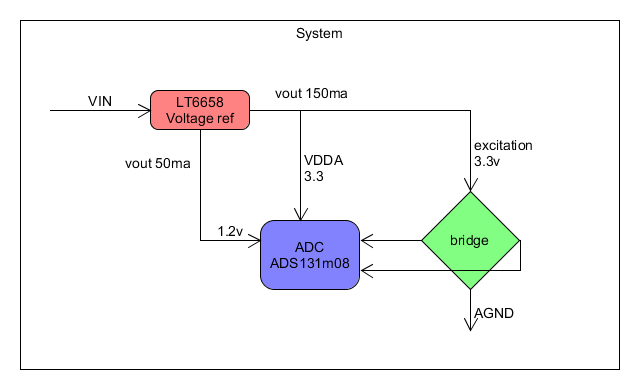
Thank you for your immediate response. I write the desired system here.
update rate: read all 8 ADC channels about 1 ms
simultaneous sampling is better but it's not a limit
effective ADC resolution: 1uV
max input voltage: excitation voltage * 4.5 mV
max excitation voltage: 10V
we are not limited to power consumption
Jessica,
The big problem that I see right now is how you drive the bridge. The ADC inputs are limited to AGND-1.3V on the low end to AVDD on the high end. The inputs are limited even further if the PGA is used in gains higher than 8. Because you have such a small input signal, you'll likely need the gain. With the PGA greater than 8, the upper limit is limited to AVDD-1.8V. This means that the analog input could only be as high as 1.5V. If the bridge is driven by a 3.3V supply, your outputs would be at 1.65V. If your bridge is driven by a 10V supply, then the outputs of the bridge would be near 5V. That would be far outside the input range of the device. To use this device with that large of a bridge excitation directly, you couldn't use that large of a unipolar supply. If you want to drive the input with a large voltage, you would need a bipolar supply.
Alternately, you could use an instrumentation amplifier at the output of the bridge, this could be used to both give some amplification, and to level shift the signal to the input range of the ADC. Note that adding any intermediate stage will add error. There will be some amount of gain error, offset, and noise added to the measurement.
So for your system, can you provide even more detail? What characteristics will be important to you? What supplies will you have in your system?
Joseph Wu
Jessica,
I haven't heard from you in a while, so I thought I'd check on you. I'd mentioned a couple of issues running the device as a ratiometric bridge measurement in my last post, and I wanted to check to see if you have more inputs about the system you were trying to measure. Also, it looks like you were able to get the EVM working in your other thread. Hopefully, you can use that to help evaluate your system.
I'll close this post for now, but if you have more questions, post back and we can continue to work on the device.
Joseph Wu