This thread has been locked.

If you have a related question, please click the "Ask a related question" button in the top right corner. The newly created question will be automatically linked to this question.

ADS1248: violating PGA Common-Mode Voltage Requirements but still measure correctly

Part Number: ADS1248
Other Parts Discussed in Thread: ADS124S08, ADS1220, LM7705

Hello,

In my application I use an ADS1248 for remote voltage measurement on a power resistor.

AIN2 is connected to the positive rail of the resistor (Sense+).

AIN3 is connected to the negative rail of the resistor (PGND, Sense-).

My ADC is referenced to AGND, and AGND is connected to PGND on the same board.

ADC settings: Gain=1, use internal 2.048 V reference, input = AIN2-AIN3
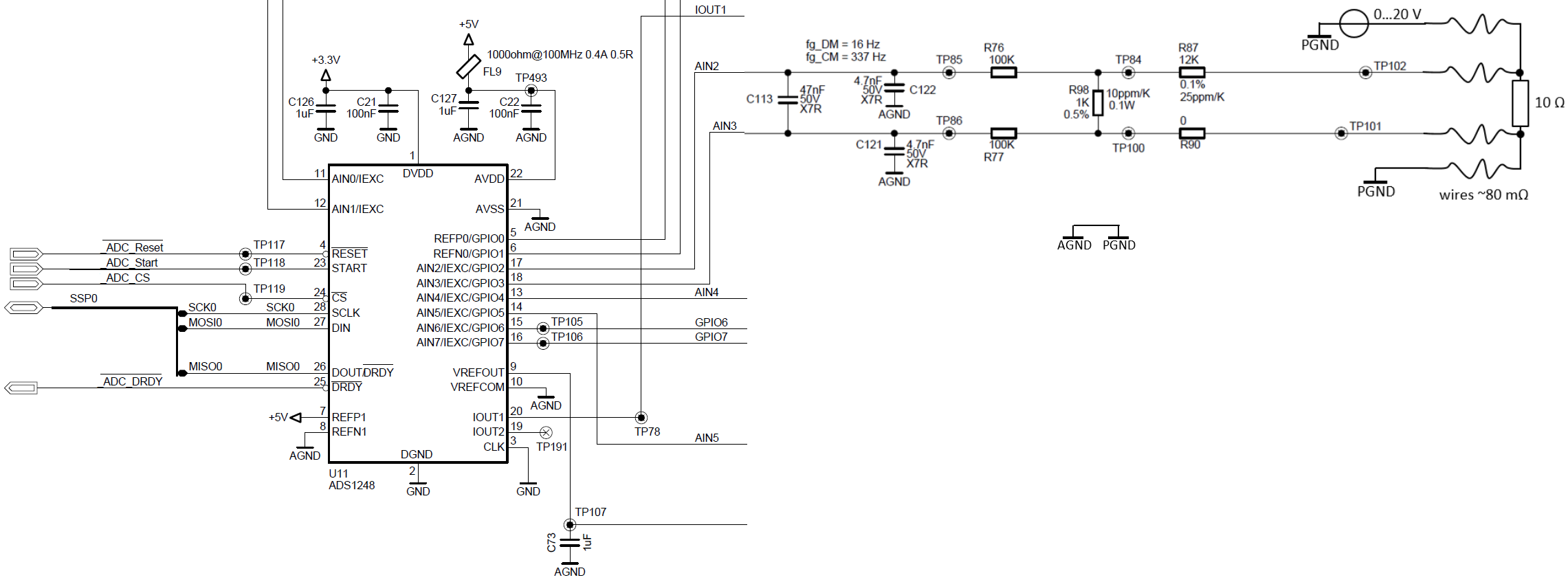
Judging from the datasheet it seems that I violated the PGA Common-Mode Voltage Requirements as described in section 9.3.2.1. I would expect that the voltages are clipped at 100 mV at the ADC PGA's output.

Measuring between AIN3 and AGND I reach 100 mV only at Uresistor = 13 V.

Nevertheless, I my ADC counts look fine and they fit the ideal curve quite well.

Here is a plot of the voltage across the 10 Ohm resistor vs the measured ADC count, the ideal transfer function subtracted:

No offset or similar artifacts are visible.

In my understanding this is a mismatch between the theory and the measurements. Where is the gap? Am I just lucky or have I overseen anything?

Thanks for your comments,

Chris

  • Christof,


    While you may be getting results that are close to the ideal, it may not always be the case depending on the operation.

    You are correct that we specify the input in gain of 1 to be within 100mV of the supply rails. This is because the input PGA is constructed similar to an instrumentation amplifier. With any amplifier, the output cannot reach either rail because of output drive limitation of the amplifier itself.

    Because the PGA only drives the ADC, the output of the PGA may get close to either rail because the amplifier load is low. However, there may be additional limitations depending on the temperature. For that reason, the output may be slightly non-linear as it goes toward the rails and we specify operation to 100mV of either supply.

    In operation, the PGA output range may extend beyond 100mV to either supply. However, we specify operation to that limit because of testing and temperature. Regardless, I would not use the ADS1248 with AINN set to GND. If you need that operation, you could construct a negative supply to extend the AVSS to a negative value, or use a device that has a PGA that may be bypassed. The ADS1220 and the ADS124S08 both have PGAs that can be bypassed to extend the input range.


    Joseph Wu

  • Joseph,

    Thanks a lot for your comments!

    You mention changes in linearity and output drive limitations depending on temperatures. Is any more specific data available on these topics that allows me to judge whether the issue is negligible in our application or not?

    Can one of your proposed alternatives be used as drop-in replacement for the ADS1248, but with the ability to bypass the PGA?

    Note that we noticed the issue rather late in the design phase and so I am looking for a hopefully minimal-invasive fix.

    Christof

  • Christof,


    I'm sorry, but we don't have any more detail or data about the drive of the PGA going into the supply rails.

    Also, we don't have a convenient drop-in replacement device. As we've developed new devices, we've changed feature sets, pinouts and larger packages for smaller packages. Based on what you've shown, I think the ADS124S08 would be the best replacement device. However, it comes in a 32 pin TQFP or leadless QFN package.

    I'm not sure what the best solution for you will be. There are two possibilities that I can think of that might work, but I don't know enough about how your system is put together to be sure.

    The first possibility is to make a bipolar supply for the ADS1248. It doesn't necessarily have to be ±2.5V for the AVDD/AVSS supplies. You could set AVSS to -0.2V and still have 100mV of room to the negative supply in gain of 1. A device like the LM7705 generates a voltage of -0.232V and I believe it has been used for this purpose. The second possibility would be to raise up PGND by a similar amount. This could be done by shunting the measured current through a Schottky diode, or a shunt reference.

    If you have more questions about putting together an alternate solution, please post back and we can work on it more.


    Joseph Wu