Hi,
i want to know how to calculate pull up resistance on A piont,pull down resistance on B piont and resistance between A piont and B piont.
Thanks a lot!
This thread has been locked.
If you have a related question, please click the "Ask a related question" button in the top right corner. The newly created question will be automatically linked to this question.
Hi,
i want to know how to calculate pull up resistance on A piont,pull down resistance on B piont and resistance between A piont and B piont.
Thanks a lot!
Hi Jacky,
You can find out how to compute pull-up and pull-down resistance values for RS-485 bus biasing in this blog:
If you have any questions on it please just let us know.
Regards,
Max
Hi,
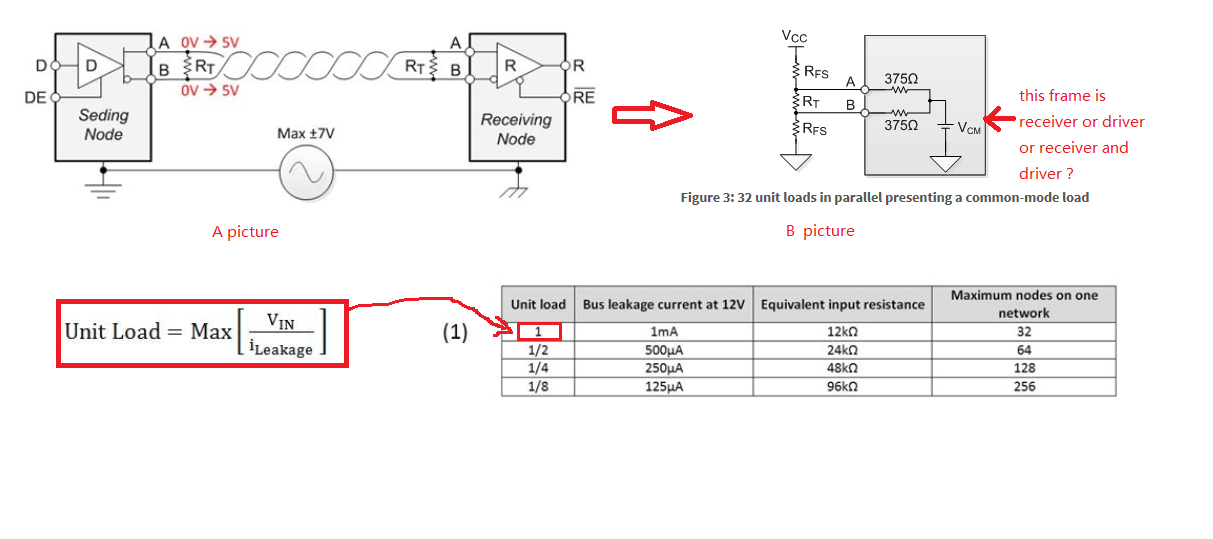
I understand A picture,but I do not understand B picture, a bit abstract,frame in B picture is receiver or driver or receiver and driver ?
I do not understand common-mode load 375,How to calc common-mode load is 375Ω? Is this related to the different 485 type chip ?
if not 32 nodes,and only two 485 chip(such as A picture),common-mode load still is 375Ω?
why the equivalent termination resistors in parallel is 60Ω ,How to calc 60Ω ?
unit load = 12V/1mA = 12 ,why unit load is 1 is not 12 ?(please see above picture),Maybe I don't really understand unit load?
Finally,would you please use schematic or Non-abstract picture(such as A picture) ,it can help me to understand easier.
Thanks a lot!
Hi Jacky,
The gray box in picture B doesn't show a single driver or receiver. Instead, it shows the equivalent loading of 32 "unit loads" placed in parallel on a bus.
The simple explanation of a unit load is that it is a unit that sinks at most 1 mA at 12-V applied voltage. From this standpoint, it can be thought of as a 12-kOhm resistance. If you had 32 12-kOhm resistances in parallel, it would give you a load of 375 Ohms (12 kOhm / 32 = 375 Ohms). You can read further details on the unit load concept in RS-485 in this blog:
The equivalent termination resistance is 60 Ohms for similar reasons. That is, it is typical to place a 120-Ohm resistance at the two furthest ends of a bus. Two 120-Ohm resistances in parallel would give 60 Ohms between the A and B lines.
I hope this is all clear now - please let me know if not.
Regards,
Max