This thread has been locked.

If you have a related question, please click the "Ask a related question" button in the top right corner. The newly created question will be automatically linked to this question.

ADS1299: Correct register configuration for positive pins referenced to SRB1 with inverted BIAS?

Part Number: ADS1299


Hello,

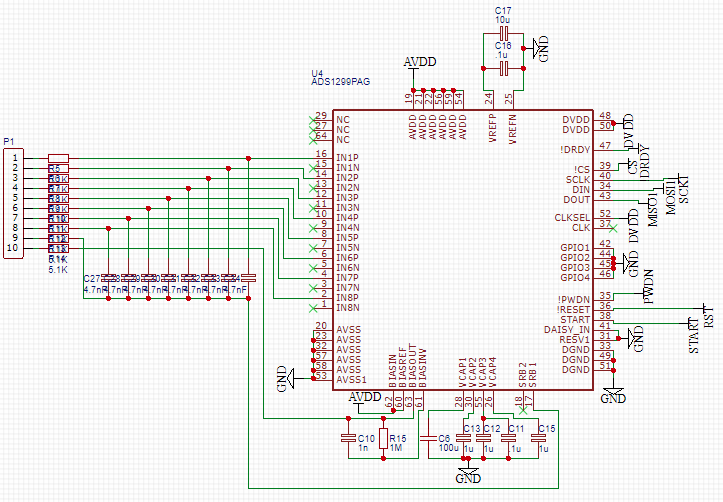
I have designed a breakout board for the ADS1299 according to the schematic below.

The negative pins are floating, and I want to reference all the positive pins to SRB1.

I want BIAS to drive the bias electrode with the inverted common-mode signal.

The breakout board has been connected to a Raspberry Pi, and the SPI comms has been successfully programmed and tested using a signal generator. 

On channel 1, it can accurately record a 1mV sine wave (that is the lowest amplitude the signal generator (SG) can produce).

To do this, I connect IN1P to the positive output of the SG, and I connect both SRB1 and BIAS to the negative output.

When tested on a human head, the signal never settles. Instead its jumps around and hits the max and min rails.

I have tried a number of register configurations (in particular changing and trying different combinations of config3, misc1, bias_sensp, bias_sensn and the individual channel registers).

None of them have so far given me accurate results.

I would appreciate it if someone could provide me with the correct register configuration to correctly implement the electrode setup in the schematic below.

Or, maybe there is a hardware issue which I have not spotted, but it is odd that I can accurately record mV signals from a SG when SRB1 and BIAS are shorted.

Thanks for your help.
  • Hi Mark,

    Thanks for your post.

    The setup that you described with your 1-mVp signal generator is how I would expect to test this setup. That is, the BIAS output is used to set the common-mode of the input signal by driving the function generator negative output. The positive output of the signal generator drives the INxP input referenced to the BIAS signal. At the same time, SRB1 is used to internally route the same common-mode signal to the negative channel input (INxN). 

    In the above setup, there is essentially no varying contact impedance between the signal source and the ADS1299 circuit. This is not the case with actual electrodes placed on human skin. The contact impedance can vary widely, causing the DC baseline of the signal to wander in the presence of any current (i.e. lead-off current, leakage current, etc.). Fixing this is not simply a matter of adjust the register settings, but rather involves post-processing data to remove the DC baseline and improving contact quality.

    Best regards,

  • Hi Ryan,

    Thanks for your reply.

    I have tried with wet electrodes, and some filtering after, but still can not get stable EEG.

    It may still be a hardware issue, but I just want to rule out the case that it could be a wrong register configuration.

    For the hardware configuration above using just channel 1, can you please tell what I should set the following register bits to (some of them are obvious, but just in case).

    Config3 - Reference Buffer = enabled or disabled?

    Config3 - Bias Measurement = open or BIASIN_Routed?

    Config3 - Bias ref signal source = BIASRef fed externally?

    Config3 - Bias Buffer = enabled or disabled?

    Ch1Set - SRB2 = Open (OFF) or Closed (ON)?

    Ch2-8Set - Power-down = Normal operation or Power-down?

    BiasSensP - BIASP1 = enabled or disabled?

    BiasSensP - BIASP2-8 = enabled or disabled?

    BiasSensN - BIASN1-8 = enabled or disabled?

    MISC1 - SRB1 = Open (OFF) or Closed (ON)?

    On a slightly different note, would it have been smarter for me to have used SRB2 as opposed to SRB1, as I can set whether SRB2 is on or off per channel, whereas with SRB1, there is only one bit in MISC1 to set it on for all channels?

  • Hi Ryan,

    Could you reply to my previous post when you have the time?

    I have tried post-processing and different electrodes, but still can't get EEG signals using just the IN1P, SRB1 and BIAS electrodes (it seems to be even worse when BIAS is connected). I would like to rule out register settings as a cause. 

    Thanks!

  • Hi Mark,

    Apologies for missing your reply. Please see my responses below:

    Config3 - Reference Buffer = enabled or disabled? Enabled. This is the ADC's reference voltage and is needed for conversions.

    Config3 - Bias Measurement = open or BIASIN_Routed? Open

    Config3 - Bias ref signal source = BIASRef fed externally? Internally. This sets the DC common-mode voltage of the BIAS amplifier.

    Config3 - Bias Buffer = enabled or disabled? Enabled. Needed to drive the BIASOUT voltage.

    Ch1Set - SRB2 = Open (OFF) or Closed (ON)? Open. Positive inputs seem to be driven by individual electrodes in your schematic.

    Ch2-8Set - Power-down = Normal operation or Power-down? Power-down, input-short (0x81).

    BiasSensP - BIASP1 = enabled or disabled? 0x00. (for now). This will configure the BIAS amplifier as a simple buffer to drive mid-supply to BIASOUT.

    BiasSensP - BIASP2-8 = enabled or disabled? 0x00

    BiasSensN - BIASN1-8 = enabled or disabled? 0x00

    MISC1 - SRB1 = Open (OFF) or Closed (ON)? ON. Externally, the INxN pins are floating. SRB1 must be used to drive the negative PGA inputs.

    Some customer have "reversed" the intended functions of SRB1 and SRB2 and there is no problem with doing this. The idea was exactly what you described - SRB2 allows you to drive a common signal to only select channels. The choice is up to you if you wish to revisit this in future designs.

    Best regards,