This thread has been locked.

If you have a related question, please click the "Ask a related question" button in the top right corner. The newly created question will be automatically linked to this question.

DAC3482EVM harmonic distortions

Other Parts Discussed in Thread: DAC3482

I am testing TSW1400 and DAC3482EVM.

I have fs=1228.8MHz and f_data=307.2MHz interpolation x4

I have mixer disabled, QMC gain set to 1446, no QMC phase correction, no QMC offset correction
Coarse DAC gain set to 15.

If I generate full scale sine wave using HSDC Pro I get severe clipping as on the scope picture. 

If I reduce the data (using scaling factor 0.6 in HSDC Pro) Then I get what I have measured with the spectrum analyzer.
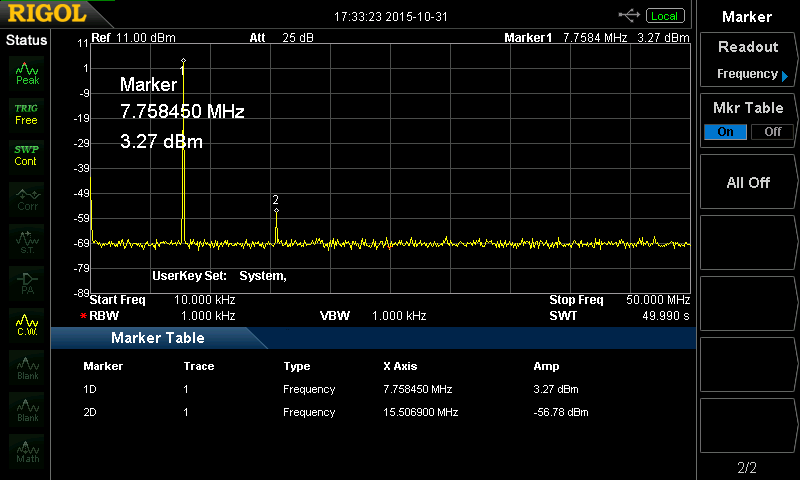

In this case I get my sine wave in the 1.5Vpp range but first harmonic is  about -60dBc.
From the  SFDR I see this is expected to be 20 dB better. 

So my questions:
1. Which unit is contributing to the gain in my data path. I believe that If Mixer is disabled and QMC gain is set to 1444,
    I should have gain 1 in the data path
2. Can I somehow generate better sine wave with less distortion with this system. 

Thanks
Dimitar 

  • Hi, Dimitar:

    1> If you set the QMC gain to 1444, the QMC gain is 3dB higher rather than 0dB(default 0dB is '1024'). So if you put the full scale in HSDC Pro, then use 3dB gain in QMC block, then you will cause the digital block go to saturation. This explain why you see the distorted sine wave with many harmonics. The way to solve it is to back off digital signal in HSDC-pro just like you have done , or back off the QMC gain.

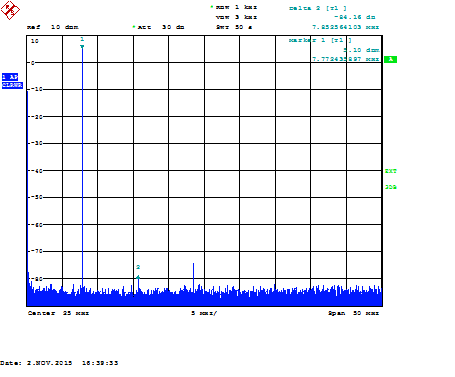
    2>I have done the same configuration and same test(with 0.6 scaling in HSDC Pro and QMC gain = '1446'). I haven’t seen HD2 degradation in my case(with R&S FSQ signal generator) as below:


    I am not so familiar with your RIGOL signal analyzer, and maybe the distortion is caused by instrument rather than DAC. Some suggestion:

     a> Try to adjust ATTEN to see whether it helps.

     b> Try to test with tone of higher frequency, and maybe instrument is not good at low frequency  when input is AC coupled.


    Thanks a lot!

    Yarn.

  • Hi Yarn,

    Thank you very much for your answer!

    Oh right QMCgain=1024 represents gain 0 I have misinterpret this, thanks!

    In addition we have VEXTIO=1.2 and Rbias = 1.271K in the EVM
    This means IOUTfs=30mA with dac_gain=15
    In the evaluation board for ac we have each of the DAC complement outputs loaded with 50 Ohm in respect to GND
    wich means 1.5Vpp at each DAC output. With a transformer we have those signals with 0 DC but still this means we are out of the
    DAC output compliance range for DAC3482 datasheet [0.5V, 0.6V].
    So I have realized that I shouls not have dac gain set to 15 with the EVM.
    Would you agree or disagree with above?

    It is very nice that you are measuring 80dBc spurious free dynamic range.
    In my case it is about 50-60 dBc. I will spend some more time tomorrow as it is very late here.
    Is there a way I check if my DAC is using full 16 bits and is not in a byte wise mode somehow?

    Thanks
    Dimitar
  • Hi, Dimitar:

    1> I agree with you about the 1.5Vpp at each DAC output. For more information about current DACs output termination, a pretty good app note is recommended here:www.ti.com/.../slaa399.pdf

    2>When you load the configuration file with your GUI, in the 'Input' tab, and go to 'Input Format'. You will see the input data format you are using (16 bit single or 8 bit dual ).

    Thanks a lot!
    Yarn.
  • Hi Yarn,

    Thank you for the good document.

    The Input data field in my case is "16-Bit Single" The firmware I load in the TSW1400 is DAC_SAMPLE_WISE.rbf
    Am I OK of using all of the 16bits of the DAC?

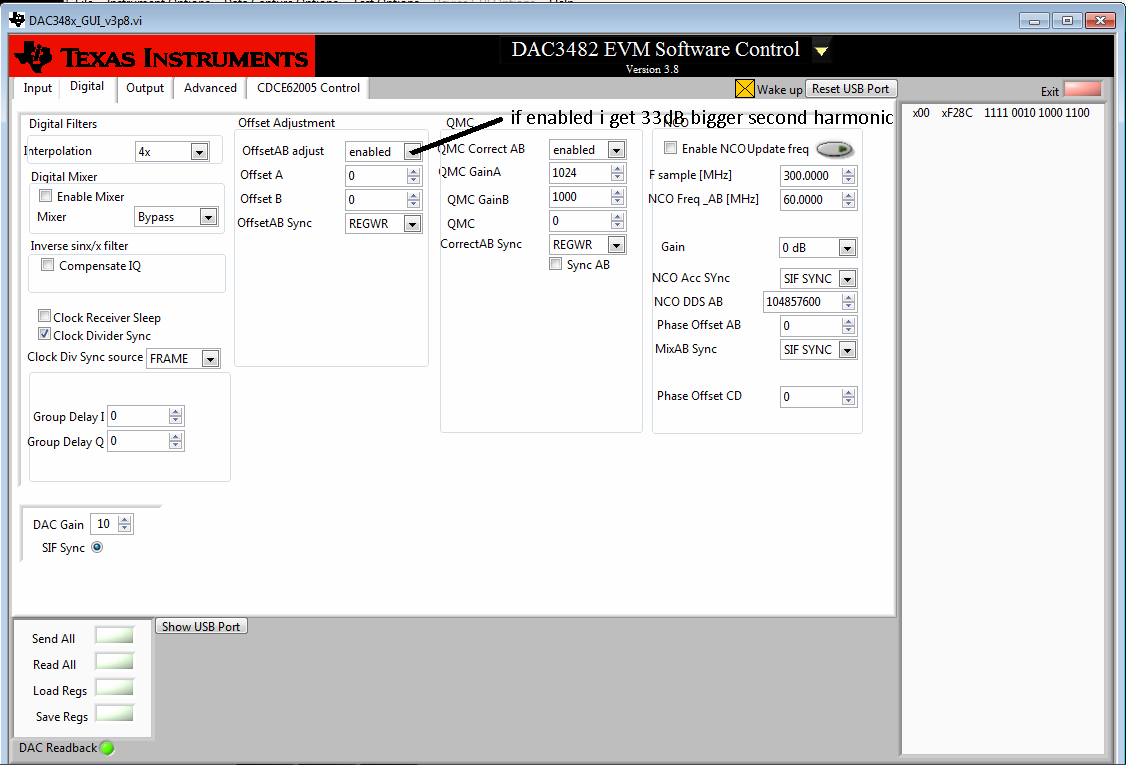
    I found something strange. Please see below picture.
    If I have QMC offset disabled I get about 33dB improvement in the second harmonic distortion I measure.
    (my second harmonics gets 33dB reduced compared with the case QMC offset block in the GUI is enabled and Offset A and B are 0)
    My believe is that Offset AB adjust enabled or disabled shoul dnot affect me as far as Offset A and B are 0.
    Any logical explanation about this behavior?
      

    With OffsetAB adjust disabled I have measured second harmonics -68dBc (for 80MHz tone) which probably is close to the non-linearity of my spectrum analyzer.
    And probably I actually see the imperfection of the measurement equipment rather the DAC.

    Thank you!
    Dimitar

  • Hi, Dimitar:

    1>The firmware you loaded is right. Yes, 16 bits you are using.
    2>I have enabled and disabled the QMC offset adjustment in my setup, and I haven't seen HD2 changes.
    Kindly, could you please follow my suggestion as below:
    When enable offset adjustment, re-type '0' in offset A and offset B to make sure 0 offset value is set to DAC. Then use the SIF_SYNC on the GUI.
    Also, could you kindly post your spectrum snap to me when enable and disable offset adjustment.
    Another thing to take care is to back off DAC output power to avoid saturation.

    Thanks a lot!

    Yarn.
  • Hi Yarn

    2>I have enabled and disabled the QMC offset adjustment in my setup, and I haven't seen HD2 changes.
    Kindly, could you please follow my suggestion as below:
    When enable offset adjustment, re-type '0' in offset A and offset B to make sure 0 offset value is set to DAC. Then use the SIF_SYNC on the GUI.
    Also, could you kindly post your spectrum snap to me when enable and disable offset adjustment.
    Another thing to take care is to back off DAC output power to avoid saturation.

    I can not reproduce this observation anymore so lets assume this have never happened.
    And yes I know about register write sync feature of the DAC.

    As a general comment. I beleive that the measurement distortions I have observed are due to my measurement equipment.
    Soon I plan to verify the design with another spectrum analyzer with better dynamic range.
    I am closing this topic now. Will reopen later if necesery.

    Thank you very much for your help!

    Kind Regards
    Dimitar Penev