This thread has been locked.

If you have a related question, please click the "Ask a related question" button in the top right corner. The newly created question will be automatically linked to this question.

ADS1247: design help

Part Number: ADS1247


Hi sir,

can you give me some suggestion on the GND layout and VDD circuit design method that maximize the ADC performance.

1) GND layout method
According to 12.1 (layout guidelines) of the data sheet, it is possible to separate the analog plane (AGND) and digital plane (DGND), but it is not required.
Please tell me more about this.
First, should AGND and DGND be separated for best performance?
(Is it the same performance without separation?)
If they are separated, is it correct to connect them under the ADC to eliminate the potential difference between AGND and DGND?
Is it better to place Amplifier and ADC (including digital signal pins) on the analog plane, place MCU and Interface on the digital plane, and separate them by Optional split as shown in Figure 123 and Figure 124?
In my schematic, AGND and DGND of the ADC are separated.

2) VDD circuit design
To get the best ADC performance,
Which is better, one is to connect AVDD and DVDD to the same VDD plane, and the other is to separate AVDD and DVDD.
In my schematic, they are separated by an LC filter(L5,C44).
(Is it better to separate power supply by LDO?)
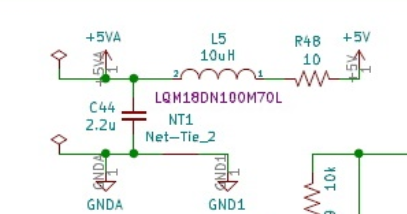
3)Application
If you have any application reports or information, please share them to me.

  • Hi,

    We recommend connecting AGND and DGND together via low resistance connection (0 ohm) resistor, as close as possible to the device for the reasons you mentioned. It is important that there is no inductance between AGND and DGND. Yes, I would recommend following figure 123 & 124. 

    I also would not recommend inductance on the supply lines of the ADC. When converting, the ADC will pull additional current, which an inductance would oppose. This could lead to issues for the ADC. Separating by LDO or regulator would be preferred compared to LC. No performance difference for joint or separate AVDD/DVDD. 

    If you have not seen it yet, a basic guide to RTD measurements is a very helpful document for working with these devices. However, it is not mentioned in the post what the application is. Unfortunately I do not have anything to provide that is power supply specific for this device family. https://www.ti.com/lit/an/sbaa275/sbaa275.pdf?ts=1597672463062&ref_url=https%253A%252F%252Fwww.google.com%252F