This thread has been locked.

If you have a related question, please click the "Ask a related question" button in the top right corner. The newly created question will be automatically linked to this question.

DLPLCR65NEVM: Illumination angle

Part Number: DLPLCR65NEVM
Other Parts Discussed in Thread: DLP650LNIR,

Dear Texas Instruments,

     Recently we are using your product for projection. However, we failed to find anything related to the illumination angle in all the manual available, thus causing some diffraction situation of the pattern shown. Could you provide more information on this if you may?

     Thank you for your kind assistance in advance! 

  • The DLPLCR65NEVM uses the DLP65LNIR DMD.  The datasheet indicates the tilt angle is 12°. For the on-state illumination to be normal to the window, the input illumination optical axis must be oriented at 24° relative to the window normal. This is mentioned in the DLP650LNIR datasheet in note (13) (b) under section 6.10 “Micromirror Array Optical Characteristics.”

    (b) Input illumination optical axis oriented at 24° relative to the window normal

    Does that answer your question?

    This Application Report may have more useful information as well:


    DLP65LNIR DMD Datasheet:

  • Dear Gary,

         Thank you for your kind and rapid reply! The instruction in the manual is quite clear. 
         However, as we illuminate the light on the DMD with the angle specified in the manual, the pattern is still not so ideal. 
         Please refer to the picture as below, for easier maintain we rotated the DMD by 45°, so that we should get good pattern with a laser coming with 24° on the right side of the picture, according to our understanding of the operation mode. 

         We have also tried fine tuning near the current illumination angle, but of no use. Could you show me your setup (or give us some advice to mount) if you may? 

         Thank you for your warm assistance and wish you have a pleasant new year holiday! 

  • Can you confirm, you illumination is coming in 24 degrees off the window normal (normal meaning perpendicular to the window), from the direction of pin A1 (rotated 45 degrees)?

    Can you describe what you are seeing and what you expect to see? I don’t see any illumination source (laser?) or optics; so I am not sure what it is you are seeing or are expecting to see.

    I believe the application report above describes typical illumination optics.  If you are using a laser, this document may be of some use: https://www.ti.com/lit/wp/dlpa037/dlpa037.pdf 

    There are several documents here that may be of use:

    https://www.ti.com/product/DLP6500FYE#tech-docs 

  • Dear Gary, 

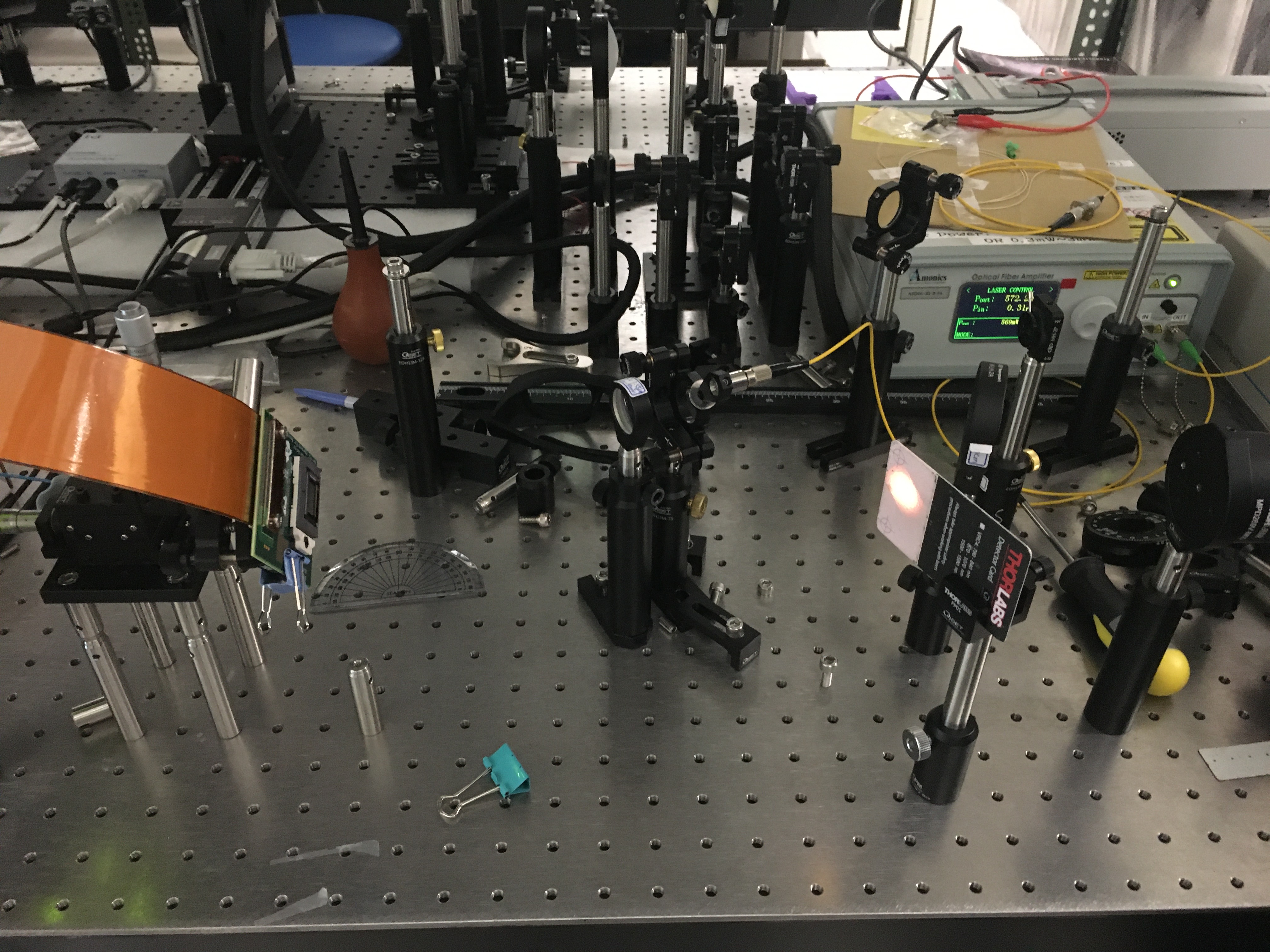
         I am very sorry for this late reply, as we were trying all sorts of possible solutions we could think of. Unfortunately, they are all of no use. Please see the attached picture, this shows the illumination system we are currently using. 

    While keeping the window is rotated by 45° and illuminate the DMD at 24° with respect to the window normal, we examine the reflected image on an IR card. 
    For your reference, the image we showed on DMD is this "Number 9". 

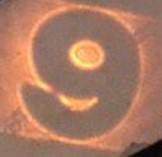
    However, from our experiment, we still observe some interference on the reflected pattern. As shown as following image.

    While we have tried our best to satisfy the illumination requirement of DMD, we are unsure where does this non-ideal effect come from. Could you provide some comments on this? 

    Sorry again for the late response, and thank you for your patience in advance! 

  • Dear Gary, 

          The following are the images that failed to show in the previous reply. First is the illumination optics. 

    Second is the "Number 9" we observed on IR card. 


  • Hello Mona,

    I work with Gary and have experience with DMD diffraction issues.  I have a some questions.  I am looking at the resulting "9" image on the IR card.  How does this differ from what you are expecting to see?  

    Is the power in the output significantly lower than expected ?  If so how much?

    Have you tried putting an IR lens on the output to re-image the surface of the DMD onto the card?  Also, what wavelength of IR are you using?

    Fizix