Welcome to the discussion about PLC technology and PLC solutions from TI
This thread has been locked.
If you have a related question, please click the "Ask a related question" button in the top right corner. The newly created question will be automatically linked to this question.
Welcome to the discussion about PLC technology and PLC solutions from TI
Hi Gary!
I think this new post is useful for you http://e2e.ti.com/support/microcontrollers/c2000/f/171/t/272631.aspx. It seems there are many problems with flash_api.
Regards,
Igor
Hi Wim,
I was looking at the Flash Utility and the documentation states to check the CPU rate. I note that the c2000 control card has a 20Mhz crystal but the CCS On Chip flash comes up as 10MHz with the TMS320F28069 device selected. Did you use this device selection?
Hello Gary!
While Wim is silent...Maybe my comment can clarify something. Are you sure about 20 MHz? At the scheme of my TMDSPLCKIT-V3 there is note: "Internal crystal is used by default". Internal crystal of F28069 has 10 MHz...
Regards,
Igor
Hi Igor,
The BOM indicates to "Do Not Populate" but the note says "internal oscillator used by default: Digikey part number 300-8214-1-ND can be used if desired" I looked up 300-8214-1-ND and its a 20MHz crystal. Looking directly under the F28069 as viewing trough the plastic cover, you can see the crystal. They may have installed the crystal for better PWM. They project sure has been challenging to say the least. I still can not find the flash_upgrade.out mentioned in Appendix B of the User's Guide.
Hi Gary!
Yes, indeed, there is strange situation with flash_upgrade.out for F28069. The PLC-packages V5002 & V1300 contain this firmware for F28335 (BTW V5002 contains the flash example & Flash-API-library). V6020 contains this firmware for F28M35 (though without API). But V5210,6000,6010 for F28069 don't contain this. I don't remember, did you request TI-PLC-branch (plc_support@list.ti.com)?
As for the external crystal then for greater certainty you can open the modem and pull of the Control Card from dimm-socket to see better, at long last.
Good luck,
Igor
Hi Gary,
I did all the programming through CCS so I haven't used the Flash Utility. I can not check on the crystal of the F28069 as I don't have a unit available anymore unfortunately. One thing I can imagine is they have to use the internal 10MHz in order to get the correct clock division for the G3 sampling frequency which might not be obtained from the 20MHz external crystal. As a matter of fact I never changed or checked anything around clocking and project settings as from the example I started with it seemed ok. Time was limited for that project so I couldn't dive deep into it to know all the details of the parts that seemed to work ok. Sorry for not being very helpful with your questions.
Wim
Hi Igor,
I don't recall asking for support from TI yet. I'm not to familiar with any of the software, CCS, IAR, Visual Studio, or the FET. My background is more into the PIC chips and the Atmel Megas. This is a learning experience for me. This is the second time I'm attempting PLC. The first time was with FSK and frankly it was dismal. it worked fine until you tried to go through a circuit breaker not to mention a transformer.
Hi Gary!
1 Well, the new compiler is not a big problem. At least CCS provides quite user-friendly interface http://processors.wiki.ti.com/index.php/C2000_Getting_Started_with_Code_Composer_Studio_v5.
2 At what frequency range did you use FSK? What was the frequency of the upper carrier?
Regards,
Igor
Hi Gary,
The flash utility is very handy indeed, also for (small) production quantities. For me it was just prototyping so I had no need.
I think you should bare in mind the TI philosophy (at least how I interpret it) here for the external crystal. The PLC kit is build around shelf parts, the uC module, the AFE module and the supply module for which they constructed a motherboard to have a demonstration kit. The uC modules are made universal for a variety of projects and demonstrators so they probably pack them with peripherals they think will be useful for current and future projects.
BR, Wim
Hi Igor,
It was a number of years ago, but it used a STMicroelectronics ST7540 PLC transciever. If your interested I think they sell a demo board but I built my own driven by a ATmega. Carrier freq was about 80K. Was only ass a demonstration.
Hi Wim,
There is nothing that says, just because the crystal is there doesn't mean it's used. I am also looking at a EVM430-F47197 e-meter. The IAR code seems to suggest the crystal frequency is 8.388608Mhz, while the schematic shows a 8 Mhz, but the actually crystal is a 16Mhz. I think the TI philosophy is "CONFUSION" Mission accomplished.
Hi Gary!
I think your power line communication (with circuit breakers & transformers) had a large attenuation at the frequency ~80 kHz. I have read ST7540-data sheet. The minimum frequency of a carrier is 60 kHz for this device. A possible solution is a shift to lower frequencies of carriers.TMDSPLCKIT-V3 provides flexible G3-API. For example, I got OFDM-spectrum 1.5-36 kHz. One may try...Well, if that does not help, there are the industrial Bell202,V.23,V.34-modems with FSK and carriers 1.2-3.4 kHz (although their connection to power line requires some decoupling device).
By the way there is another solution from TI. For TMDSPLCKIT-V2 based on F28335 there is API of flex-OFDM (package V1300). Now this API is not supported for new DSC (F28069 & F28M35). But this API allows to get the narrow band low frequency OFDM-signal (3-6 kHz, I have tried this variant).
Regards,
Igor
So is it safe to say that TI does not have a kit available that can handle the G3-FCC or 1901.2 modern standards? I would see that this current dev kit can only handle the older standards.
Hello Matthew!
TI supports G3-FCC for TMDSPLCKIT-V3. But in the case of G3 FCC band, F28M35x control card and Discrete AFE should be used (0243.TI_G3_UG.pdf). You just need to specify the required set of equipment when ordering TMDSPLCKIT-V3.
Regards,
Igor
thank you Igor, but I do not see the option to specify different chipsets anywhere in the ordering process, can you show me where this is?
Hi!
You must present your hardware requirements your local TI distributor when ordering. For example: TMDSPLCKIT-V3 G3-FCC based on F28M35. When I have ordered my Kit I did the same.
Regards,
Igor
HI ALL!
Has anyone been able to connect a PC to another piece of equipment, (serial printer, e-meter) and communicate via these modems with the equipments driver in point to point mode? I've verified the PC to equipment connect direct but can not seem to communicate via the modems.
Hello Gary!
If I understood right, you want to get the following connection chain: PC --- PLC modem---Power Line---PLC modem---Some Device. In this case the modems should translate the necessary protocol to communicate with the device. You need to write the modem's firmware that will support the translation of this protocol.
Regards,
Igor
Hi Igor,
Thanks for the response Igor. I thought that was what TI had done. In point to point mode the modem show be transparent, and there should be no need to for addresses or acknowledgment. If I understand you your saying I need to write the firmware from scratch?
Hi Gary!
PLC modems have the pre installed demonstrative firmware with some special protocol for the artless data translation (from PC to PC). But for communication with special device (printer, E-meter) the special protocol is required (the baud rate, the frame, the data format etc.) Thus for your task you need to write new firmware.
Regards,
Igor
Hi Igor,
PRIME is a TI protocol. How can you insure the PRIME protocol if you alter the firmware? More likely the Application and device needs to follow the defined protocol than redefining the protocol. In the documentation, the protocol is defined (sketchy as it is). See "Host Message Sequence.pdf". It would be nice if TI would chime in and give us all a hint and some direction here. From my experiments and understanding, PRIME is simpler. I could be wrong Igor, but I sure hope not. Rewriting the firmware seems a huge task.
Hi Gary!
Certainly you need to use PRIME-API-library of TI for creation of new firmware. But you define own data format which you want to transmit via modems for communication with some device. I don't mean that this task (the development of firmware) very simple, but one is solvable.
Regards,
Igor
Hi Igor,
what is the highest speed you have gotten out of the demonstration software? I was using G3 and best I could do was pull 8000 baud.
Hello Matthew!
At TMDSPLCKIT-V3 I have used PRIME & G3 firmwares of TI (the packages G3-V5210 and PRIME-V6000). The funny thing is that in both cases the PHY-test of PLC_Application_Suite.exe (Zero Configuration GUI) has displayed the same result: ~14400 bps on the statistic window (wherein baud rate did not depend on attenuation of the communication channel). For all three types of modulation (DQPSK, DBPSK, D8PSK). Perhaps TI-PLC-branch "sharpens" its KIT's firmware on such speed.
Regards,
Igor
Igor, I am very confused about what solutions TI does and does not offer.
I thought that you had made it clear that you could modify the TMDSPLCKIT-V3 to use the AFE032 chipset and then get G3-FCC but the support person at TI gave me this message.
Hello Matthew,
I placed the question regarding the AFE032 to the group and this is the response I received
“PRIME doesn’t have firmware using AFE032 (for FCC (up to 500kHz) band support). We have another solution of G3 FCC, which requires AFE032 or discrete AFE. The request to upgrade V3-Kits with AFE032 will not work, as the V3-Kit hardware circuitry does not support AFE032.”
I hope this answers your question for you. Thank you for contacting TI support.
Hello Matthew!
Alas! I work with a PLC modems for four months and I have noticed that the TI PLC branch provides weak technical support of its solutions (to put it mildly)...
Good luck,
Igor
Thanks again Igor, but just to be sure:
Do you currently have a TMDSPLCKIT-V3 with an AFE032 inside of it? And if so can you give me the phone number you used to order that?
Hi Matthew!
Unfortunately I was buying my TMDSPLCKIT-V3 based on F28069+AFE031 in Russia. I think this is not actual for you. In general about local distributers and others questions of support you can request to plc_support@list.ti.com or to Kim Wonsoo: wonsoo.kim@ti.com (I don't remember whether you tried to request thither).
Regards,
Igor
Is it right Igor that you tested the dev kit by writing your own applications? If so, is this something that you could share with the community, the source code of the tools you crafted to use the equipment?
Hello Matthew!
"My own application" sounds overly loud. I have used the phy_example_project from PLC packages G3DevelopmentPackageV5210 and PrimeDevelopmentPackageV6000. I have not even developed a serial communication with the modem via SCI (UART). In general I was interested maximum distance of communication provided by modems. The results are presented at firsts posts of this thread. My projects for CCSv5.2 are here 4544.PLC_projects.rar.
Regards,
Igor
So all you did was change the tone mask settings around to test?
Can you say what tone mask gave you the best distance?
Hello Matthew!
Yes. The maximal communication distance was my main goal. My communication line has very bad frequency parameters (very rapidly attenuation increases versus the frequency). Tuning tone mask allowed me to increase the distance from 8 km to 16 km when I have changed the frequency band of G3-OFDM on 1.5 -36 kHz (by default the frequency band was 35-90 kHz). Unfortunately the output transformer of TMDSPLCKIT-V3 is designed to operate in the range 10-500 kHz. Thus its operation on low frequencies is not effective. And the achieved communication distance did not correspond to my requirements. So at the moment I'm trying to develop a solution based on TMDSPLCKIT-V2 with F28335 and API library "flexOFDM". This library allows to generate the narrowband low frequency OFDM signal (up to 3-6 kHz). But the transformer is the same. Perhaps I will replace it. So my experience of using a TI PLC modems for my task is not very successful so far.
Regards,
Igor
Just out of curiosity how were you able to find 8km of uninterrupted power line for your testing? Did you use 8km of just cable or did you have access to the direct powerlines?
Hi Matthew!
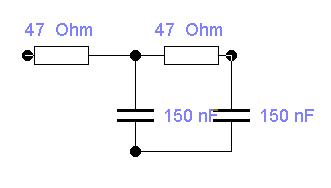
Everything is much easier! I have used the physical model of two-wire line. I knowed the parameters of my cable per unit length (the running parameters) from the cable specification and my technician soldered the physical equivalent on 40 km (from 40 resistors and capacitors 6765.1346.IMG0024A.rar, I did not consider the running inductive parameters because they are very small in our case).
Regards,
Igor
Hy,
Can you write the values of your resistors and capacitors, and upload a scheme of how you connected them please. I am interested of the equivalent of 1 Km so i understand u used it and multiply it for 40 Km. Your physical model is for low voltage ? Do you have values for medium voltage too ?
But how did you managed the impedance and conductance ?
Hi Males!
1 If you wish to create the equivalent of PLC then the best way to guide this 0172.TI_Channel_modeling.pdf. At this document for MV-cabel model: L = 1.9e-6 H/m, C = 8e-12 F/m, R = 0.03 Ohm/m, G = 1.5e-6 S/m.
2 Our case is very special. We are trying to use the cable for railway signals which have voltage ~40 VDC. The specification of this cable allows us to neglect L & G. So for example, our equivalent of 2 km looks as follows (resistors have power 40W):
3 Going back to my point 1. Real power line consist many decupling equipment (some circuit breakers, the transformers etc). Therefore, in my opinion making a good equivalent of such a line is almost impossible. Testing PLC-modems is best done on the real power line.
Regards,
Igor
In my testing I have found that the modem cannot communicate through fuses from one circuit to another inside a standard house setup
Is this to be expected? I thought the modem could be used to demonstrate in home uses.
Are the modems meant only for long range uninterrupted lines such as between your house and the central office of the power company?
Hello Matthew!
Do you mean an automatical circuit breaker under term a "fuse"?
Regards,
Igor
I mean that in one circuit breaker box there are many different sections of the house that are connected each to separate fuses. I can communicate within a section but not between sections.
For example. I can communicate between two outlets in the kitchen, but I cannot communicate between an outlet in the kitchen and an outlet in the bedroom.
But may be two phases (not one) come in the house: one at kitchen and other at the bedroom. Or there is only one phase? BTW the same effect will take place if there are two isolated neutrals.
Igor
I believe it is one phase. But let me ask then have you had it work between 2 different circuits that are connected at a fusebox?
Hello colleagues,
One of the characteristics of the G3-PLC is the ability to pass even through transformers without using any coupling device. It can achieve including communication between modems separated by 12km of power line (of course it depends on several conditions).
So, it does sound strange to hear that the modem cannot communicate through fuses (or circuit breakers).
What can happen is the wrong cirucit. For example, in Brazil, we receive at the homes two phases and one neutral. So for not overloading one phase we divide the phases in circuits. One phase for lightening, the other one sockets and so on.
So if my modem is connected in a socket with phase 1 and neutral, it will never communicate with the other modem connectef in a socket with phase 2 and neutral. The modems must be connected to the same circuit.
I think, it happened in your case, I mean, the modems are connected in different circuits. Because in normal conditions they should communicate normally.
Give feedback, please.
Samuel
Hi Matthew!
I have asked, beause, for example, there are 2 phases in house of my friend. In my house there is only one like your house (I hope it's so really). Unfortunately I didn't try my modem on power line. My task was other (refer please to my above posts). Now about fuses. Refer please to second post of Gary Moll on page 5 of this thread (http://e2e.ti.com/support/microcontrollers/c2000/f/171/t/254032.aspx?pi267163=5). He have faced with problems too when he was trying to go through a circuit breaker (but he used FSK modulation). I think at first one might take 2 new fuses (without power line) and try to connect via they. Then one might say about influence of fuses with more exactness.
Regards,
igor
Hello Samuel!
Thanks for participation. I suspect about 2 phases also, but Matthew asserts that he has only one...
Regards
Igor
Should phases matter? I have also tested high speed PLC modems that work at much higher frequencies and they communicate effortlessly across phases and circuits. Also, if phase is an issue than this technology has no application for in home use. How can TI expect that we would design some sort of home automation technology if it is not possible to have the devices communicate even from one room to the next in the same house?
I wish TI would respond to my these questions I emailed them before I came to the forums, but many weeks and no answer.
matthew tatar said:Should phases matter?
Of cause! For connection of TI PLC modems it is necessary to have one common circuit.
Igor