This thread has been locked.

If you have a related question, please click the "Ask a related question" button in the top right corner. The newly created question will be automatically linked to this question.

TMS320F28377D: Question about CLK and ADC characteristics data

Part Number: TMS320F28377D

Hello experts,

I got question about CLK, conversion rate and ADC characteristics from customer.
Could you give me advice?

1. about SYSCLK
In Table 5-12. Internal Clock Frequencies, SYSCLK range is 5-200MHz.
Is it possible to operate with over 200MHz?
For example, operate over 200MHz with using PLLRAWCLK(120~400MHz) in Figure 5-7 Clocking System.

2. about ADCCLK
From ADCCLK PRESCALE setting, we can set ADCCLK same level as SYSCLK.
If we operate ADCCLK over 50MHz, what point should we take care?
By using fast CLK, customer want to make ADC conversion speed faster.

3.about sampling rate
In datasheet P1 Analog subsystem, there is description "(up to 4.4-MSPS system throughput)" @ 16-bit mode.
Could you tell us the calculation of this?

4. about ADC characteristic graph
Do you have detailed characteristic graph data (especially, SNR) like attached file? 

AnalogDevices_0900766b80e42f7f.pdf

I would appreciate if you would give me reply.

Thanks and best regards,
Ryo Akashi
  • Hi Akashi-san,

    1 & 2) No, it is not possible to reliably operate the device or ADC beyond the recommended operating range.  

    3) Each ADC is 1.1MSPS so the system can throughput 1.1MSPS x 4 = 4.4MSPS in 16-bit mode since there are 4 ADC modules that can sample 4 signals in parallel.  To determine the sample rate on a single ADC, refer to the ADC timing section of the datasheet

    For example, with the minimum S+H time of 320ns (64 SYSCLKs), the total time between conversions if SYSCLK is 200MHz, PRESCALE = /4, ADCCLK = 50MHz would be:

    Tsh + Teoc = 64 SYSCLKs + 119 SYSCLKs =  183 SYSCLKs or 183 SYSCLKs * 5ns = 915ns

    1/915ns = 1.1MHz

    4)

    Fig. 12: For SNR, we would also expect F2837x ADC to have 6dB of increase in SNR for a doubling of the reference range.  SNR is specified on F2837x with the min. VREF of 2.5V, so going to the maximum VREF of about 3.3V would gain roughly 20*log(3.3/2.5) = 2.4 dB 

    Fig. 14: SNR for 16-bit ADC on F2837x is specified with 10kHz input.  Our SNR vs. frequency will be have a pretty similar characteristic; roughly 20dB/decade roll-off in SNR at some point past 10kHz (I believe the knee is at about 20kHz).  This is due to aperture jitter effects.


  • Hello Devin-san,

    Thank you for your reply.
    I understand the details.

    Regrading question 4), let me ask question.
    Do you have any graph or detailed data for SNR and SINAD which you mentioned?
    Also, if you have temperature drift data, could you share me?

    Thanks and best regards,
    Ryo Akashi  
  • Hi Akashi-san,

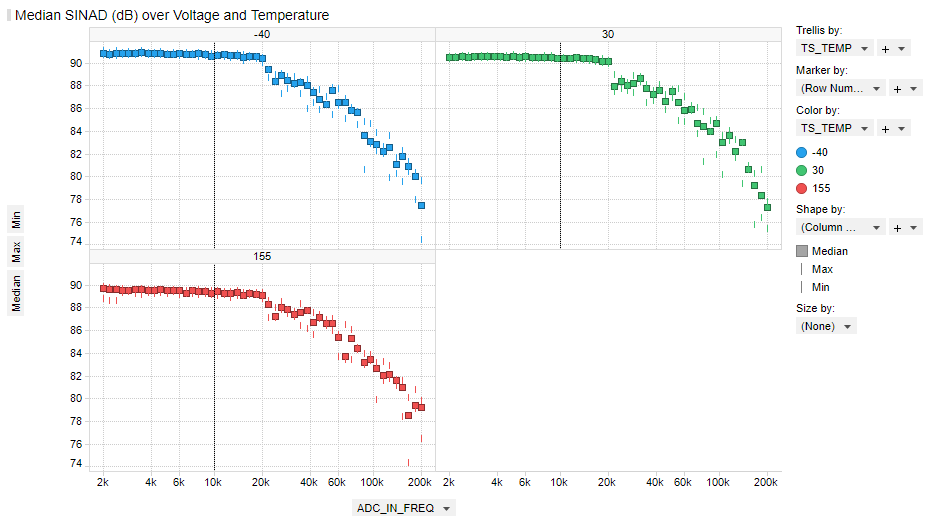
    Attached is a some typical data for SINAD vs Fin for 16B differential mode across temperature for some F2838x devices.  F2838x has the same ADC as F2837x. 

    I don't have any handy graphical data for ADC performance across VREF voltages, but the data in the DS is with VREFHI = 2.5V, which should be worst-case. 

  • Hello Devin-san,

    Thank you for sharing typical data.

    Let me ask additional question. 
    You mentioned F2837x have same ADC block as F2838x.
    But ADC characteristic in datasheet is different.
    Could you tell me what is the difference between F28377D and F28388D?

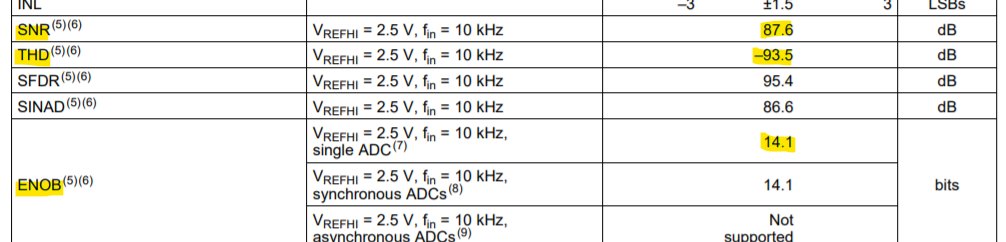
    From F28377D datasheet P106, SNR=87.6dB, THD=-93.5dB, ENOB=14.1bits as below.
    From F28388D datasheet P136, SNR=90.2dB, THD=-105dB, ENOB=14.65bits as below.

    I would appreciate if you would give me comment.


    Thanks and best regards,
    Ryo Akashi
  • Hi Akashi-San,

    The improvements in F2838x performance vs. F2837x are due to improvements in test setup noise and signal integrity.

  • Hello Devin-san,

    Thank you for your reply.
    But I'm sorry I'm not clear about the difference.

    ADC block is same, but F28388D's architecture around ADC block is improved compared with F28377D's one.
    So, F28388D's total performance is better than F28377D's one.
    Is my understanding correct? 

    Or, if test condition is same, both of them have same peformance?

    I would appreciate if you would give me comment

    Thanks and best regards,
    Ryo Akashi
  • Hi Akashi-san,

    We expect the same performance under the same the same conditions between these devices

  • Hello Devin-san,

    Thank you for your reply.
    I understand F28377D and F28388D could be expected same performance if these device are under the same conditions.

    Also, do you have any material about ADC spec except datasheet and technical reference manual?
    Customer wants to know the ADC spec more.

    I would appreciate if you would give me reply.

    Thanks and best regards,
    Ryo Akashi
  • Hi Akashi-san,

    The best resource to learn about the various ADC specifications is https://training.ti.com/ti-precision-labs-adcs