This thread has been locked.

If you have a related question, please click the "Ask a related question" button in the top right corner. The newly created question will be automatically linked to this question.

Compiler/TMS320F28379D: Linker placement of variables

Part Number: TMS320F28379D


Tool/software: TI C/C++ Compiler

Hello,

I have a question regarding the placement of variables in the RAM. I have defined the following section in my project. The RAMGS0 and RAMGS1 should be used for this.

This section is used by the following variables.

After compilation I get an error from the linker.
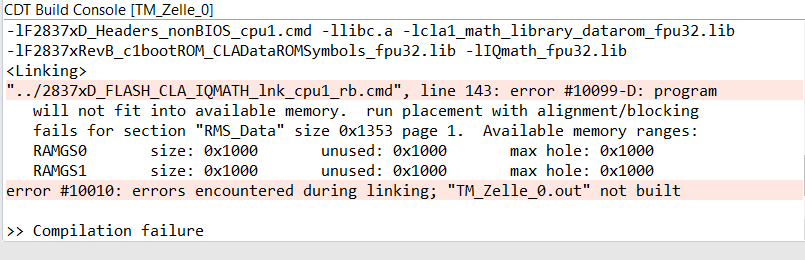
The variables need a space of 0x1353 words. The sum of RAMGS0 and RAMGS1 is 0x2000.


Why doesn´t the segment fit into the memory?


Thank you very much

Ralf

  • Ralf,

    It seems like there are other memory sections allocated to RAMGS0 and RAMGS1. If that's the case you will just need  to allocated another memory section to this section. 

    See https://processors.wiki.ti.com/index.php/C28x_Compiler_-_Understanding_Linking#Q:_The_linker_says_.22placement_fails_for_object.22_but_the_available_memory_is_larger_than_the_section

    for more information..

    Regards,

    Ozino

  • Dear Ozino,

    thank you very much for your response.


    I have tried to use RAMGS5 and RAMGS6 for the “RMS-Data” section, unfortunately with no success. In my opinion this should be work, because I have used the splitting operator “>>”.

    The size of the structures is definitely lower than 0x1000 words.

     struct t_data_10ms_ts

    {

       float sum;                            

       float chk;                            

       unsigned short idx;                    

       float mem[(unsigned short)(10e-3/TS_WR_MAIN + 0.5)];     };


    struct t_data_20ms_ts

    {

       float sum;

       float chk;

       unsigned short idx;

       float mem[(unsigned short)(20e-3/TS_WR_MAIN + 0.5)];

    };


    TS_WR_MAIN is 62.5µs, so the size of the mem[] fields is 160 and 320 float variables.

    Here is the content of my cmd-File:

    // The user must define CLA_C in the project linker settings if using the
    // CLA C compiler
    // Project Properties -> C2000 Linker -> Advanced Options -> Command File
    // Preprocessing -> --define
    #ifdef CLA_C
    // Define a size for the CLA scratchpad area that will be used
    // by the CLA compiler for local symbols and temps
    // Also force references to the special symbols that mark the
    // scratchpad are.
    CLA_SCRATCHPAD_SIZE = 0x100;
    --undef_sym=__cla_scratchpad_end
    --undef_sym=__cla_scratchpad_start
    #endif //CLA_C

    MEMORY
    {
    PAGE 0 :
       /* BEGIN is used for the "boot to SARAM" bootloader mode   */

       BEGIN               : origin = 0x080000,   length = 0x000002
    //   RAMM0               : origin = 0x000122, length = 0x0002DE
       RAMM0               : origin = 0x000124, length = 0x0002DC        // musste geändert werden, Fehler in der C2000 Ware
       RAMD0               : origin = 0x00B000,   length = 0x000800
       RAMLS0              : origin = 0x008000,   length = 0x000800
       RAMLS1              : origin = 0x008800,   length = 0x000800   
       /* RAMLS4             : origin = 0x00A000, length = 0x000800 */
       /* RAMLS5           : origin = 0x00A800, length = 0x000800 */
       RAMLS4_5         : origin = 0x00A000,   length = 0x001000
       
       RAMGS14          : origin = 0x01A000,   length = 0x001000     /* Only Available on F28379D, F28377D, F28375D devices. Remove line on other devices. */
       RAMGS15          : origin = 0x01B000,   length = 0x001000     /* Only Available on F28379D, F28377D, F28375D devices. Remove line on other devices. */
       RESET               : origin = 0x3FFFC0,   length = 0x000002

       /* Flash sectors */
       FLASHA           : origin = 0x080002,   length = 0x001FFE    /* on-chip Flash */
       FLASHB           : origin = 0x082000,   length = 0x002000    /* on-chip Flash */
       FLASHC           : origin = 0x084000,   length = 0x002000    /* on-chip Flash */
       FLASHD           : origin = 0x086000,   length = 0x002000    /* on-chip Flash */
       FLASHE           : origin = 0x088000,   length = 0x008000    /* on-chip Flash */
       FLASHF           : origin = 0x090000,   length = 0x008000    /* on-chip Flash */
       FLASHG           : origin = 0x098000,   length = 0x008000    /* on-chip Flash */
       FLASHH           : origin = 0x0A0000,   length = 0x008000    /* on-chip Flash */
       FLASHI           : origin = 0x0A8000,   length = 0x008000    /* on-chip Flash */
       FLASHJ           : origin = 0x0B0000,   length = 0x008000    /* on-chip Flash */
       FLASHK           : origin = 0x0B8000,   length = 0x002000    /* on-chip Flash */
       FLASHL           : origin = 0x0BA000,   length = 0x002000    /* on-chip Flash */
       FLASHM           : origin = 0x0BC000,   length = 0x002000    /* on-chip Flash */
       FLASHN           : origin = 0x0BE000,   length = 0x002000    /* on-chip Flash */

    PAGE 1 :

       BOOT_RSVD        : origin = 0x000002,   length = 0x000120     /* Part of M0, BOOT rom will use this for stack */
       RAMM1            : origin = 0x000400,   length = 0x000400     /* on-chip RAM block M1 */

       RAMLS2              : origin = 0x009000,   length = 0x000800
       RAMLS3              : origin = 0x009800,   length = 0x000800

       RAMGS0           : origin = 0x00C000,   length = 0x001000
       RAMGS1           : origin = 0x00D000,   length = 0x001000
       RAMGS2           : origin = 0x00E000,   length = 0x001000
       RAMGS3           : origin = 0x00F000,   length = 0x001000
       RAMGS4           : origin = 0x010000,   length = 0x001000
       RAMGS5           : origin = 0x011000,   length = 0x001000
       RAMGS6           : origin = 0x012000,   length = 0x001000
       RAMGS7           : origin = 0x013000,   length = 0x001000
       RAMGS8           : origin = 0x014000,   length = 0x001000
       RAMGS9           : origin = 0x015000,   length = 0x001000
       RAMGS10          : origin = 0x016000,   length = 0x001000
       RAMGS11          : origin = 0x017000,   length = 0x001000
       RAMGS12          : origin = 0x018000,   length = 0x001000     /* Only Available on F28379D, F28377D, F28375D devices. Remove line on other devices. */
       RAMGS13          : origin = 0x019000,   length = 0x001000     /* Only Available on F28379D, F28377D, F28375D devices. Remove line on other devices. */

       EMIF1_CS0n       : origin = 0x80000000, length = 0x10000000
       EMIF1_CS2n       : origin = 0x00100000, length = 0x00200000
       EMIF1_CS3n       : origin = 0x00300000, length = 0x00080000
       EMIF1_CS4n       : origin = 0x00380000, length = 0x00060000
       EMIF2_CS0n       : origin = 0x90000000, length = 0x10000000
       EMIF2_CS2n       : origin = 0x00002000, length = 0x00001000

       CLA1_MSGRAMLOW   : origin = 0x001480,   length = 0x000080
       CLA1_MSGRAMHIGH  : origin = 0x001500,   length = 0x000080
    }


    SECTIONS
    {
       /* Allocate program areas: */
       .cinit           : > FLASHB | FLASHC       PAGE = 0, ALIGN(8), crc_table(_linkerCrcTable, algorithm = CRC32_PRIME)
       .text            : >> FLASHB | FLASHC    PAGE = 0, ALIGN(8), crc_table(_linkerCrcTable, algorithm = CRC32_PRIME)
       codestart        : > BEGIN               PAGE = 0, ALIGN(8), crc_table(_linkerCrcTable, algorithm = CRC32_PRIME)
       .stack           : > RAMM1               PAGE = 1
       .switch          : > FLASHB | FLASHC     PAGE = 0, ALIGN(8)
       .TI.crctab        : > FLASHB | FLASHC        PAGE = 0

       /* Allocate uninitalized data sections: */

    #if defined(__TI_EABI__)
       .init_array         : > FLASHB | FLASHC, PAGE = 0, ALIGN(8)
       .bss                : > RAMLS2,           PAGE = 1
       .bss:output         : > RAMLS2,          PAGE = 1
       .data               : > RAMLS2,           PAGE = 1
       .sysmem             : > RAMLS2,           PAGE = 1
       .const              : > FLASHB | FLASHC,    PAGE = 0, ALIGN(8)
    #else
       .pinit              : > FLASHB | FLASHC, PAGE = 0, ALIGN(8)
       .ebss               : > RAMLS2,             PAGE = 1
       .esysmem            : > RAMLS2,           PAGE = 1
       .econst             : > FLASHB | FLASHC     PAGE = 0, ALIGN(8), crc_table(_linkerCrcTable, algorithm = CRC32_PRIME)
    #endif

       .reset           : > RESET,                 PAGE = 0, TYPE = DSECT /* not used, */

       Filter_RegsFile  : > RAMGS0,                   PAGE = 1
       
       .em2_cs0         : > EMIF2_CS0n,         PAGE = 1
       .em2_cs2         : > EMIF2_CS2n,         PAGE = 1

        /* CLA specific sections */
       #if defined(__TI_EABI__)
               Cla1Prog    : LOAD = FLASHA,
                          RUN = RAMLS4_5,
                          LOAD_START(Cla1funcsLoadStart),
                          LOAD_END(Cla1funcsLoadEnd),
                          RUN_START(Cla1funcsRunStart),
                          LOAD_SIZE(Cla1funcsLoadSize),
                          PAGE = 0, ALIGN(8)
       #else
              Cla1Prog    : LOAD = FLASHA,
                          RUN = RAMLS4_5,
                          LOAD_START(_Cla1funcsLoadStart),
                          LOAD_END(_Cla1funcsLoadEnd),
                          RUN_START(_Cla1funcsRunStart),
                          LOAD_SIZE(_Cla1funcsLoadSize),
                                                  PAGE = 0, ALIGN(8), crc_table(_linkerCrcTable, algorithm = CRC32_PRIME)
       #endif

       CLADataLS0        : > RAMLS0,             PAGE=0
       CLADataLS1        : > RAMLS1,             PAGE=0

       Cla1ToCpuMsgRAM  : > CLA1_MSGRAMLOW,       PAGE = 1
       CpuToCla1MsgRAM  : > CLA1_MSGRAMHIGH,      PAGE = 1

       RMS_Data         : >> RAMGS5 | RAMGS6,    PAGE = 1


    #ifdef __TI_COMPILER_VERSION__
       #if __TI_COMPILER_VERSION__ >= 15009000
            #if defined(__TI_EABI__)
                .TI.ramfunc : {} LOAD = FLASHA,
                                 RUN = RAMD0,
                                 LOAD_START(RamfuncsLoadStart),
                                  LOAD_SIZE(RamfuncsLoadSize),
                                  LOAD_END(RamfuncsLoadEnd),
                                   RUN_START(RamfuncsRunStart),
                                   RUN_SIZE(RamfuncsRunSize),
                                    RUN_END(RamfuncsRunEnd),
                                 PAGE = 0, ALIGN(8)
            #else
                .TI.ramfunc : {} LOAD = FLASHA,
                                 RUN = RAMD0,
                                 LOAD_START(_RamfuncsLoadStart),
                                  LOAD_SIZE(_RamfuncsLoadSize),
                                  LOAD_END(_RamfuncsLoadEnd),
                                   RUN_START(_RamfuncsRunStart),
                                   RUN_SIZE(_RamfuncsRunSize),
                                    RUN_END(_RamfuncsRunEnd),
                                 PAGE = 0, ALIGN(8)
            #endif
       #else
       ramfuncs         : LOAD = FLASHA,
                          RUN = RAMD0,
                          LOAD_START(_RamfuncsLoadStart),
                          LOAD_SIZE(_RamfuncsLoadSize),
                          LOAD_END(_RamfuncsLoadEnd),
                          RUN_START(_RamfuncsRunStart),
                          RUN_SIZE(_RamfuncsRunSize),
                          RUN_END(_RamfuncsRunEnd),
                          PAGE = 0, ALIGN(8)
       #endif
    #endif

       /* The following section definition are for SDFM examples */
       Filter1_RegsFile : > RAMGS1,    PAGE = 1, fill=0x1111
       Filter2_RegsFile : > RAMGS2,    PAGE = 1, fill=0x2222
       Filter3_RegsFile : > RAMGS3,    PAGE = 1, fill=0x3333
       Filter4_RegsFile : > RAMGS4,    PAGE = 1, fill=0x4444

        /* The following section definition are for IQMATH */
       IQmath           : > FLASHA, PAGE=0
       IQmathTables     : > FLASHA, PAGE=0
       IQmathTablesRam  : > FLASHA, PAGE=0


    #ifdef CLA_C
       /* CLA C compiler sections */
       //
       // Must be allocated to memory the CLA has write access to
       //
       CLAscratch       :
                         { *.obj(CLAscratch)
                         . += CLA_SCRATCHPAD_SIZE;
                         *.obj(CLAscratch_end) } >  RAMLS1,  PAGE = 0

       .scratchpad      : > RAMLS1,       PAGE = 0
       .bss_cla            : > RAMLS1,       PAGE = 0
       .const_cla        :  LOAD = FLASHA,
                           RUN = RAMLS1,
                           RUN_START(_Cla1ConstRunStart),
                           LOAD_START(_Cla1ConstLoadStart),
                           LOAD_SIZE(_Cla1ConstLoadSize),
                           PAGE = 0
    #endif //CLA_C
    }

    /*
    //===========================================================================
    // End of file.
    //===========================================================================
    */


    Thank you very much

    Ralf

  • The problem is all the arrays are in the same input section.  As described in this part of the larger article Linker Command File Primer, input sections may not be split.  

    The best solution is to build with the compiler option --gen_data_subsections=on, to put each array in its own subsection.  Then splitting would occur.  However, there is a compiler bug which prevents this solution from working.  I filed the entry EXT_EP-10080 to have this problem investigated.  You are welcome to follow it with the link below in my signature.

    There is a workaround.  Remove the SET_DATA_SECTION pragmas.  This causes the compiler to put each array in a subsection of the default section name .ebss.  Change the linker command file to have lines similar to these ...

       RMS_Data 
       {
          file.obj(.ebss)
       } >> RAMGS0 | RAMGS1 PAGE = 1
    

    This creates an output section name RMS_Data.  It is made up of one input section named .ebss, from the object file named file.obj.  Change file.obj to the name of the object file which defines these arrays.  The allocation of RMS_Data is split across the memory ranges RAMGS0 and RAMGS1.

    Thanks and regards,

    -George