This thread has been locked.

If you have a related question, please click the "Ask a related question" button in the top right corner. The newly created question will be automatically linked to this question.

LED1 LED2 flash error for HVMotorCtrl+PfcKit

Other Parts Discussed in Thread: CONTROLSUITE

Hi, I am using the HVMotorCtrl+PfcKit to test a sensorless PMSM, I used the program HVPM_Sensorless in the folder ~controlSUITE\developent_kits\HVMotorCtrl+PfcKit_v2.0. I followed the instruction of the file "Sensorless FOC of PMSM.pdf". In BUILD LEVEL 6, I can drive the motor run in closed loop at low speed, but once I set the reference speed higher, the controller will enter error state and the motor stops, the LED1 and LED2 flush continuously.

An variac input power is used and the voltage I used is about 110 V, the controlCARD is TMS280F28035. I changed the RS, LS and poles value according the motor I tested, and the BUILDLEVEL is set to LEVEL6, nothing else changed in the program.

So why the system can work well in low speed but encounters error once the speed is set higher?

  • Hi,

    Few years ago, we released

    C:\ti\controlSUITE\development_kits\HVMotorCtrl+PfcKit_v2.1

    In this folder, you will find "HVPM_Enhanced_Sensorless_2803x" project. It has improvements made over _v2.0 version. High speed is one of them.

    Rgds,

    ramesh

  • Hi, Ramesh,

    The new version works well, thank you!

    BTW: As all documents in the controlSUITE are about HVMotorCtrl+PfcKit_v2.0 (even the documents in the folder of V2.1), I had thought the v2.0 is the best version, I suggest to update the document in the controlSUITE, or maybe the controlSUITE I downloaded is too old (about one year before I downloaded it).


  • Conceptually most of them remain the same, but appreciate this feedback.
  • Hi, Ramesh,

    I use the controller kit to do a motor load test but get an error again.
    The test is: I use the controller kit to drive a motor to run at 3000 rpm, and slowly increase the load of the motor, as the load increase to about 0.3x Nm, the controller stopped and LED1 and LED2 flush continuously. Could you please suggest what may cause this error?
    I used the 2.1 version, and set the based frequency to 250 Hz, BUILDLEVEL7, 10 poles, and set the Rs, Ls as the motor's real resistance and inductance. The motor is started at open loop with reference set to 0.2, then change to close loop, then set the reference to 0.999. The motor runs good at no load. The controller is powered with the 15V DC power supply, the fan power connected and it is running during the test. The DC inverter uses 120V AC power supply via a variac.
  • What is the value of overcurrent trip reference setting on the board?

    On the lower left corner on page 1 of the schematic, you will notice over current threshold setting and trip generation circuits /logics. Make sure that you have the right values. The default connection is from the midpoint of R4 and R5, for a limit of nearly 8A.

    What  is the phase current at the time of tripping? Hope you did not change the shunt resistor values.

    rgds,

    ramesh

  • Hi, Ramesh,

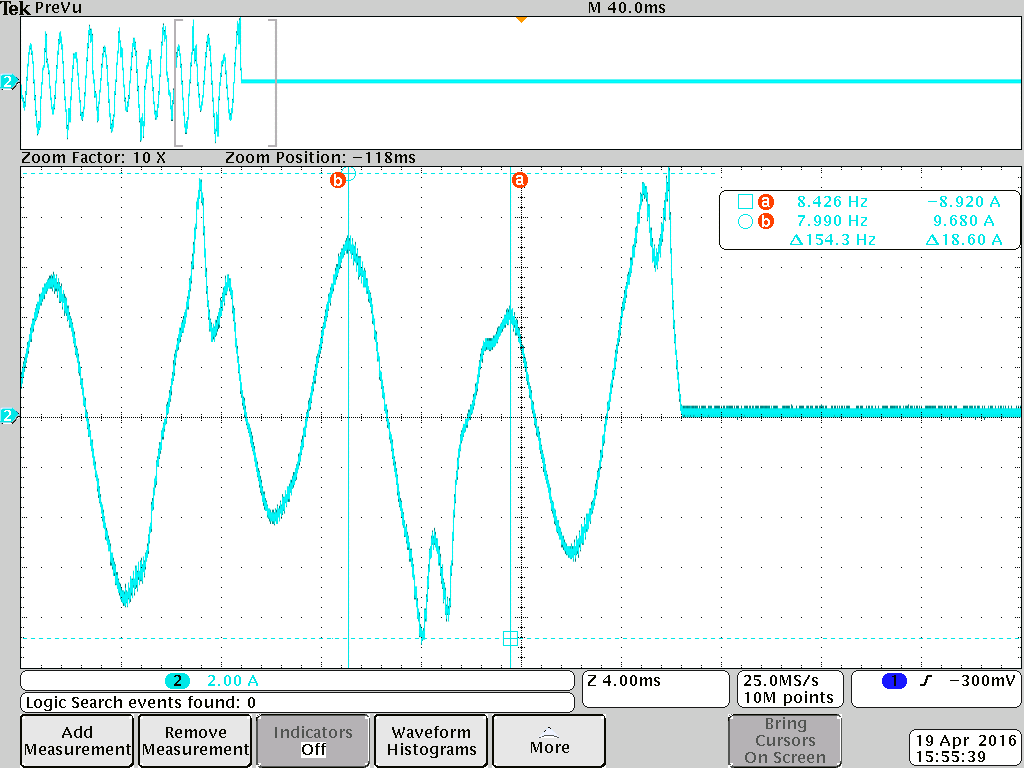
    I did not change anything of the board. I measured the phase current, and its peak value at the moment error happen is about 9.5 A, I think maybe it triggered the OCP. But the input power is about 180 W (output about 130 W), the rated power of the motor (output) is 320 W, so I need to test it with input power 400~500 W. Why the phase current is so large while the input power is only 180 W? Is it possible to use this kit to test the motor at its full rated power?

    Below is the captured phase current at the time the controller stopped due to error.

  • BTW: I contact the motor maker, it is said that the peak phase current at rated output is about 6 A, but now the power is only about 40% of its rated power, but the current is so large, is anything wrong for the control? I set the closed loop speed to 3000 RPM during the test, and the motor speed at its rated output is about 2600 RPM, I also noted that the motor speed always keep 3000 RPM as I increases the load until the motor stop due to error.
  • Good to know that OCP tripped the board otherwise the motor or inverter would have damaged.

    Test the motor at its rated level, 2600rpm/ torque rated at that speed. Ensure you give enough dc bus voltage at that speed.

    Also, try running the motor at various lower speeds from, say, 1400rpm in steps of 200 rpm up to 2600rpm, applying various loads. Hope you find the answer yourself.

    rgds,
    ramesh
  • Hi, Ramesh,

    I test the motor with various speed and various load, and found that the motor will enter error mode at different load under different speed. Below is the testing results:

    Motor speed (rpm)      Motor stop load (dyno current, A)

    1200                                   0.152

    1500                                  0.133

    1800                                  0.116

    2100                                  0.104

    2400                                  0.098

    2700                                  0.097

    3000                                  0.097

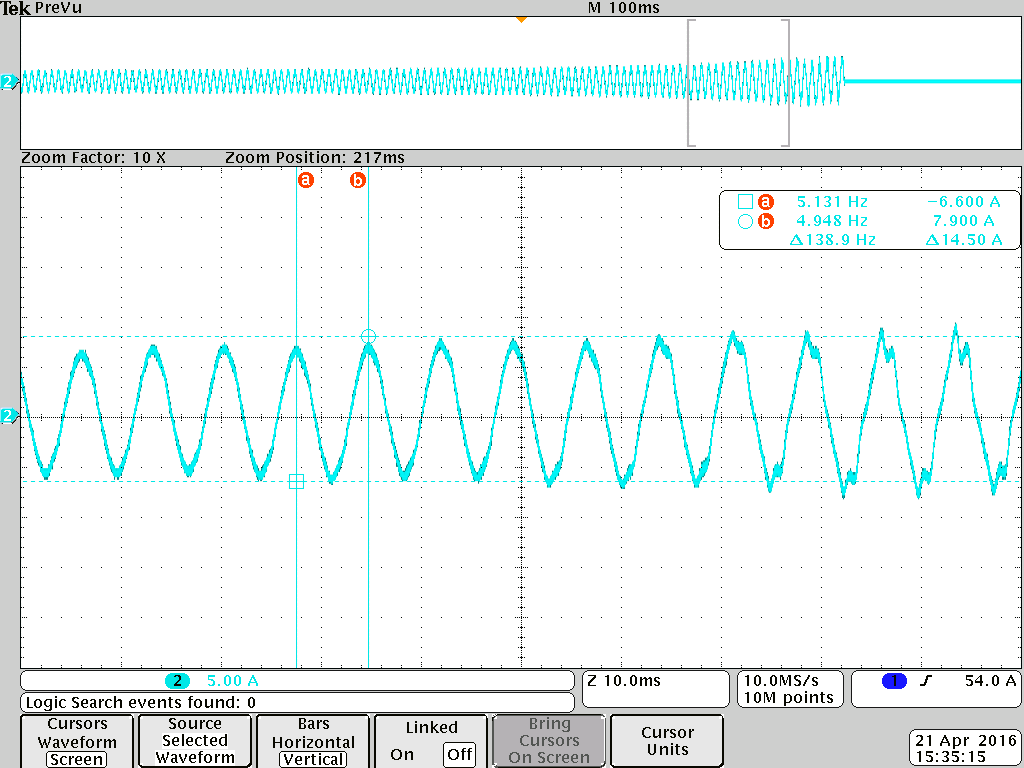
    Also I found that when the motor is about to enter error mode, the phase current gets distortion, as see the figure below. I think maybe the controller did not estimated the rotor position correctly at the time OCP happen. The motor I tested is IPM motor, whose Ld is not equal to Lq, but in the software, I did not see any choice of IPM or SPM motor, I only uses a mean inductance. Also, the motor's B-Emf Constant is usually needed when control a motor, but I did not see anywhere to input this motor parameter. Is it is OK with the above motor paramter settings? Does the software use some advanced control method like field-weakening etc.?

  • Since it is a voltage based model, subtracting the resistance  and inductance drop should take care of obtaining the bemf and there fore, bemf constant is not critical in this implementation.

    For the speeds you are testing, Ld and Lq inaccuracies should not cause control failure at lower loads. If anything, I would consider making the magnetic field stronger by setting positive IdRef and see how the system responds.

    rgds,

    ramesh

  • Hi, Ramesh,

    I tried to regulate the IdRef. Firstly, I changed the code line 1584 in HVPM_Enhanced_Sensorless.c "else pi_id.Ref = 0" to "else pi_id.Ref = IdRef" (otherwise, there is no effect to adjust the IdRef). Then I set the load at constant with dyno current 0.75 A, motor speed 2400 rpm, then adjust the IdRef, record the input power as follow:
    IdRef P_in (w)
    -0.4 126.5
    -0.3 113.9
    -0.2 104.9
    -0.1 100.1
    0.0 99.3
    0.1 103.6
    0.2 112.2
    0.3 125.2
    It seems that IdRef = 0 is the most efficient point for the system since the output power is fixed (constant speed and constant load).
    Then I set the motor speed to 2400 rpm, change the load at various IdRef, record the load current when the OCP happen:
    IdRef Dyno current @ OCP (A)
    -0.4 0.103
    -0.3 0.103
    -0.2 0.104
    -0.1 0.104
    0.0 0.104
    0.1 0.104
    0.2 0.104
    0.3 0.103
    It seems that the IdRef has low effect on the motor load capability.

    Any problem for my tests?
  • Are you able to run the motor at 2600rpm at rated power?

    Of course, when IdRef =0, the motor efficiency will be best. If you make IdRef>0, it is supposed to make the magnetic field stronger and be able to provide more torque.

    rgds,

    ramesh