This thread has been locked.

If you have a related question, please click the "Ask a related question" button in the top right corner. The newly created question will be automatically linked to this question.

TMS320F28069: Boot issues at high temperature

Part Number: TMS320F28069


Hi

We have a product on the market which works nicely at room temperature, but if it is switched off at elevated temperatures it wont switch on again until it cools down.

It is set up to boot in GetMode. I have scoped the TDO, GPIO34, TRST and XRS pins during startup, and they seem to do as expected.

I tested here in a chamber at 55 degrees, where the boot fails, but once it is back at room temperature it works again.

The specific chip I have here is F28069UPZPS, G4 A-6BC19QW, so it is an A revision.

I saw in the erratas an issue with the internal oscillator affecting CAN bootloading at high temperatures. Could it be that there is a similar issue here?

I hope someone can help.

  • Erik,
    Thanks for reaching out to the E2E forum. Unless you are using the CAN bootloader I doubt this is the issue, furthermore I wouldn't expect this to show up at 55C, as it is related to the oscillator accuracy and the needed accuracy by the CAN protocol.

    Just to clarify, this is only a problem if the device is powered on at temperature above 55C. Some pertinent questions:

    Q1)When the device is not working, can you clarify its behavior? Is XRSn always low, or is there a specific behaivor that is not happening, like PWM pulses or comm port inactivity?
    Q2)When the device fails is it just one aspect of the system that isn't working or the entire MCU is not doing anything.
    Q3)If the device is running(booted/powered at room temp) and the temperature is raised to the known problem temp, will the device stop working or is it OK
    Q4)Same as above, assuming your answer is the device is OK under this scenario; if XRSn is toggled low will the device work. Basically here I am trying to reproduce everything but a power cycle
    Q5)In the failing condition, power up at high temp, can you also put a scope probe on XRSn/VDD/VDDIO and note the behaivor. When the device is failing, can you toggle XRSn in this condition and make the device work again?

    This will be a good start and we can go deeper as we get more info.

    Best,
    Matthew
  • Hi Mattew

    Well, the signals can be controlled from an FTDI circuit for manual reboot, but for normal operation:

    TDO is pulled HIGH.

    TRST is pulled LOW.

    GPIO34 is pulled HIGH.

    XRS is pulled HIGH.

    I don't try to change them from this setting during normal boot, which is what I'm attempting now.

    As to activity, the device seems to do nothing. The boot signals go to 3.3V even when it fails, so I know this is not a problem with supply voltage.

    Normally there are a bunch of LEDs blinking, which doesn't happen, but I haven't strictly gone in there to check whether all pins are off. I guess I could.

    The device does not stop due to high temperature. It is only the reboot that doesn't work.

    I tried to pull the XRS low briefly several times when it was hot and not booting, but this didn't help.

    It also does not help to power cycle the entire circuit. The 3.3V will come back on, but not the device.

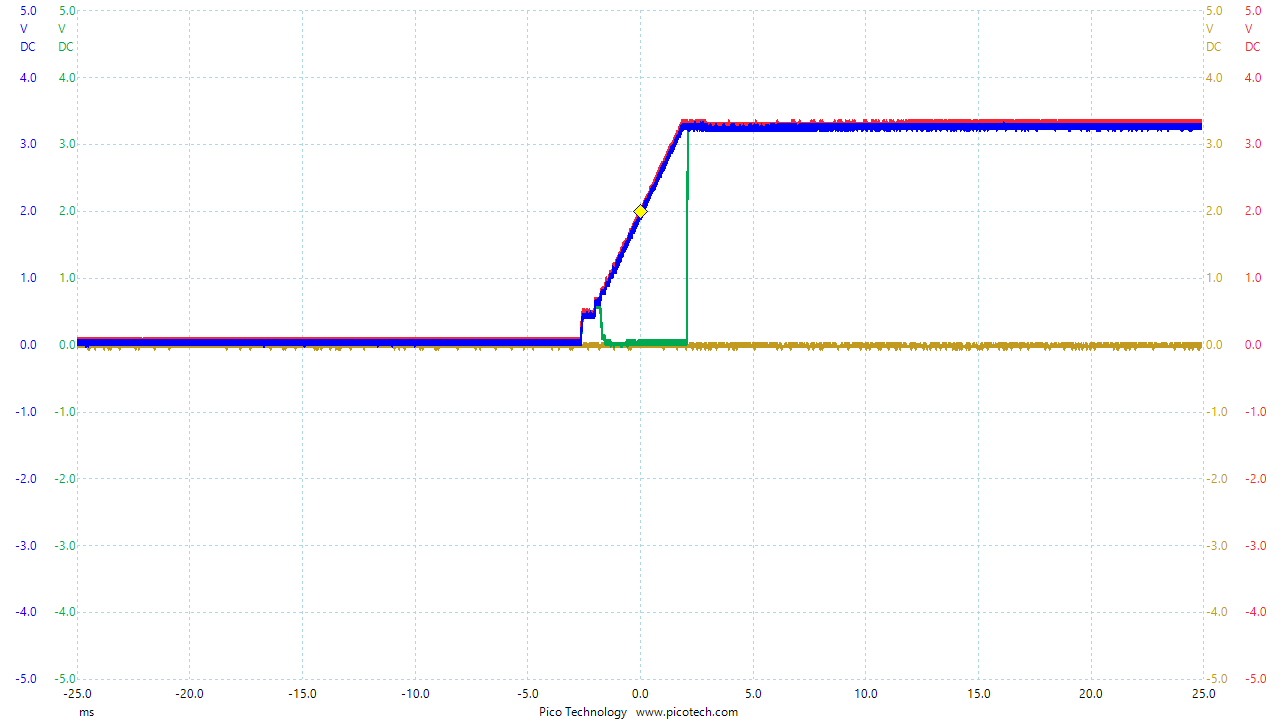
    Below are two plots that look fairly identical. One is when it works at 35 degrees, and the other is when it fails at 55 degrees.

    Blue is TDO. red is GPIO34, yellow is TRST and Green is XRS.

    Testing a bit further it wouldn't actually reboot until it fell below some 40 degrees.

    Cheers,

    Erik

  • Taking this off forum for now to expedite data sharing. Will post any relevant findings back to the community as warranted.

    Best,
    Matthew