


Part Number: DRV10983-Q1
Other Parts Discussed in Thread: DRV10983Q1EVM
I have a similar problem. All data is fine, but writing does not change the registers.
In the branch that I ran, the decision was not publicly published.
I do not have the equipment for testing and testing. I'm working with a self-made PCB:
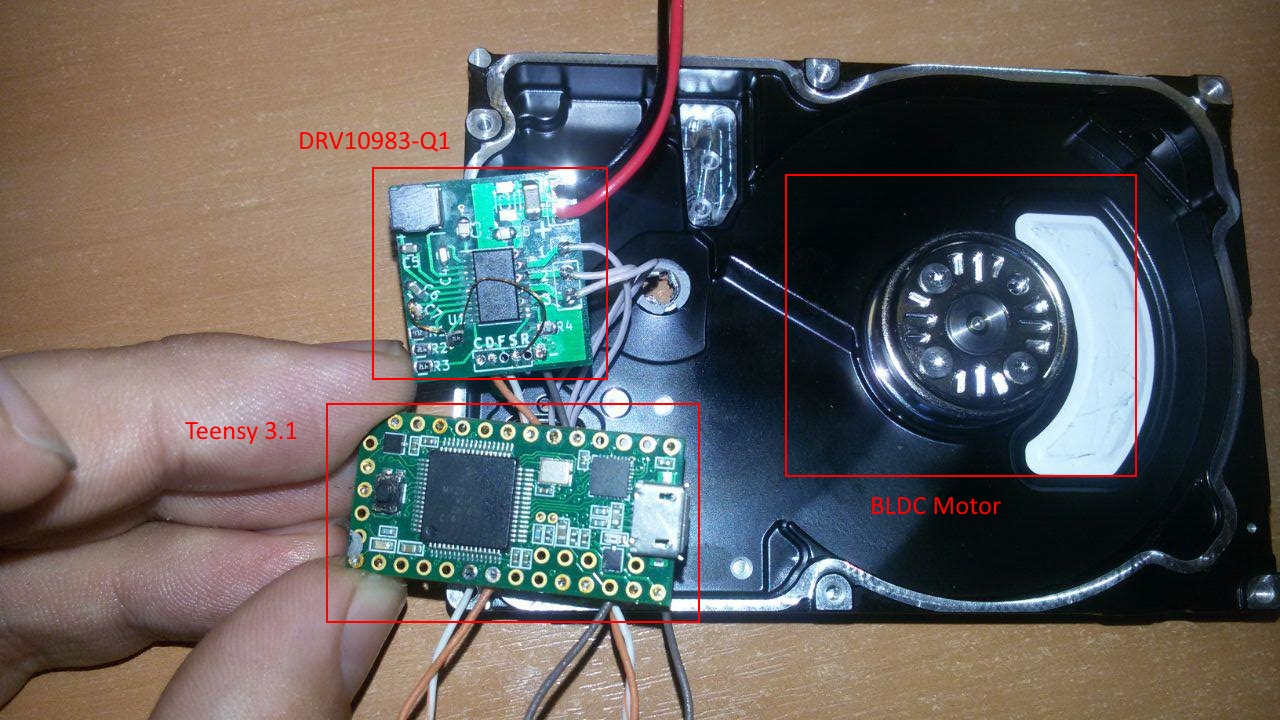
I get access to the parameters using Arduino.
Code:
#include <Arduino.h>
#include <Wire.h>

#define I2C_DRV10983_Q1_ADR 0x52

#define Fault_Reg 0x00 //
#define MotorSpeed_Reg 0x01 //
#define DeviceIDRevisionID_Reg 0x08
#define EEPROM_Access_Code_Reg 0x31
#define EEPROM_EeReady_Reg 0x32
#define EEPROM_Iindividual_Access_Adr_Reg 0x33
#define EEPROM_Individual_Access_Write_Data_Reg 0x34
#define EEPROM_Access_Reg 0x35
#define EECTRL_Reg 0x60

void setup() {
    Serial.begin(9600);
    Wire.begin();
}

byte readByAdress(byte reg_adr,  unsigned int &result) { //I2C write 2-byte register
    byte i = 0, err = 0;
    byte bytes[2] = {0, 0};
    Wire.beginTransmission(I2C_DRV10983_Q1_ADR);
    Wire.write(reg_adr);
    err = Wire.endTransmission();
    if(err!=0)
        return err;
    Wire.requestFrom(I2C_DRV10983_Q1_ADR, 2);
    while(Wire.available())
    {
        bytes[i] = Wire.read();
        i++;
    }
    result = ((bytes[0] << 8) | bytes[1]);
    return 0;
}
byte writeByAdress(byte reg_adr,  unsigned int value) { //I2C read 2-byte register
    byte bytes[2];
    bytes[1] = value >> 0;
    bytes[0] = value >> 8;
    Wire.beginTransmission(I2C_DRV10983_Q1_ADR);
    Wire.write(reg_adr);
    Wire.write(bytes,2);
    return Wire.endTransmission();
}
boolean flag = true;

void loop() {
    if(flag){
        int count = 0;
        unsigned int value = 0;
        unsigned int onReady = 0;
        delay(3000);
        writeByAdress(EECTRL_Reg, 0x8000); //Stop motor
        writeByAdress(EEPROM_Access_Code_Reg, 0x0000); //Reset EEPROM_Access_Code_Reg
        writeByAdress(EEPROM_Access_Code_Reg, 0xC0DE); //Set EEPROM_Access_Code_Reg
        while(onReady == 0 && count < 1000){ // Wait EEPROM ready
            readByAdress(EEPROM_EeReady_Reg, onReady);
            count++;
        }
        Serial.println("EEPROM_Access. Cycles of expectation: " + String(count));
        count = 0;
        onReady = 0;

        //Write values on shadow registers
        writeByAdress(0x90, 0x105A);   //new
        writeByAdress(0x91, 0x2F2A);   //new
        writeByAdress(0x92, 0x0050);
        writeByAdress(0x93, 0x1B8A);
        writeByAdress(0x94, 0x3FAF);
        writeByAdress(0x95, 0x3C43);
        writeByAdress(0x96, 0x016A);
        writeByAdress(EEPROM_Access_Reg, 0x0006); //EEPROM mass access enabled && update from 0x90-0x96
        while(onReady == 0 && count < 1000){ // ожидание готовности EEPROM
            readByAdress(EEPROM_EeReady_Reg, onReady);
            count++;
        }
        Serial.println("EEPROM_Update. Cycles of expectation: " + String(count));
        onReady = 0;
        count = 0;

        //Reading shadow register values for verification
        writeByAdress(EEPROM_Access_Reg, 0x0002); //EEPROM mass access enabled
        while(onReady == 0 && count < 1000){ // ожидание готовности EEPROM
            readByAdress(EEPROM_EeReady_Reg, onReady);
            count++;
        }
        Serial.println("EEPROM_Read. Cycles of expectation: " + String(count));
        count = 0;
        onReady = 0;
        readByAdress(0x90, value);
        Serial.println("0x90: " + String(value, HEX));
        readByAdress(0x91, value);
        Serial.println("0x91: " + String(value, HEX));
        readByAdress(0x92, value);
        Serial.println("0x92: " + String(value, HEX));
        readByAdress(0x93, value);
        Serial.println("0x93: " + String(value, HEX));
        readByAdress(0x94, value);
        Serial.println("0x94: " + String(value, HEX));
        readByAdress(0x95, value);
        Serial.println("0x95: " + String(value, HEX));
        readByAdress(0x96, value);
        Serial.println("0x96: " + String(value, HEX));

        writeByAdress(EECTRL_Reg, 0x0000); //Run motor

        flag = false;

    }

}
Result:
EEPROM_Access. Cycles of expectation: 1
EEPROM_Update. Cycles of expectation: 180
EEPROM_Read. Cycles of expectation: 1
0x90: 1048
0x91: 2f3b
0x92: 50
0x93: 1b8a
0x94: 3faf
0x95: 3c43
0x96: 16a
As can be seen from the results, the registers retain the default values and new data are not applied.

