This thread has been locked.

If you have a related question, please click the "Ask a related question" button in the top right corner. The newly created question will be automatically linked to this question.

DRV2700: Blowing up DRV2700 drivers

Part Number: DRV2700

Good afternoon,

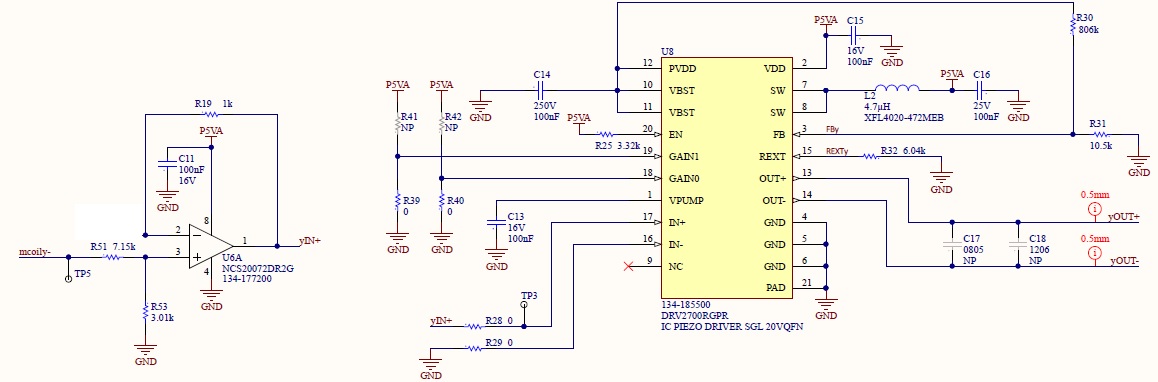
We've designed a board that uses the DRV2700 driver to drive a 1.5uF piezo actuator that positions a mirror.  Its input is a 0-12V DC signal (mcoil-) that makes small (<1V) corrections up to 50k times per second.  It is working quite nicely, though limited to 105V at the output in this configuration, but the output noise is canceled out in differential mode, so a big improvement over the flyback version.

However, we've had 3 of these drivers blow up.  Suddenly the HV output drops low, as does the voltage present on the SW node.  In circuit, I measure ~1.08k ohms between pins 8 (SW) and 11 (VBST).  On a working driver, I measure ~800k ohms between these two nodes.  One time the driver blew up when power was cycled, another time the driver blew up when the input signal (mcoil-) changed suddenly by a volt or two.  After blowing up, the driver board draws excessive current (enough to burn up a zero ohm 0603 resistor in the 5V supply path).

With the bad parts removed from the board, I measure between pins 8 and 11. 50 ohms on one, 1.4k ohms on another.  A working driver measures OPEN between these 2 nodes.

I see from the block diagram that there is a diode between pins 8 and 11, and sure enough, my DMM in diode mode measures .615V on a working part, and 0.558V on a bad part.  One part (that measured 50 ohms) measures 0.056 across that diode, so nearly a short.

From the datasheet, I don't see ratings that I am exceeding.  My schematic is attached below.  Do you see any glaring problems with how this is configured?  Or some known mode of operation that can lead to permanent damage to this part, and the apparent diode between SW and BST nodes in particular?
Thank you,

Andy

  • Hi, Andy,

    Thank you for the provided information.

    I'm wondering if you could limit the analog inputs with some capacitors and zener diodes in order to prevent any sudden voltage change like the DC coupled DAC input configuration ( http://www.ti.com/lit/ds/symlink/drv2700.pdf#page=22 ). In the datasheet, there are no details about a DC input in single-ended mode. So, you should be careful to protect the inputs.

    If possible, please try with the DC-Coupled Referenced Input. This configuration is specific to control piezo loads with a certain DC level.

    http://www.ti.com/lit/ds/symlink/drv2700.pdf#page=23

    Please take a look at this and let me know if you have additional observations or comments about it.

    Best regards,
    Luis Fernando Rodríguez S.

  • Hi Luis,

    Thanks for the quick reply.  

    I can experiment with the input, perhaps a low pass filter to prevent fast changes to the input.  But I'm not sure I follow your line of thinking -- that damage to the diode between SW and BST should be affected somehow be affected by the inputs to the amplifier.  The inputs are within the ranges specified in the absolute max ratings of the datasheet since the input op-amp will constrain the input to 0-5V. 

    But I'll try a low-pass filter at the input.  Does anything look problematic at the output?  And what would the device do if it overheated?  Could it be permanently damaged in that way?

    Thank you,

    Andy 

  • Andy,

    I reviewed again you schematic but I cannot find anything wrong on the output circuit. Everything seems to be in order.

    Could you try my suggestion about the input circuit? Let me know if you have additional observations so we can try with some other things.

    Best regards,
    Luis Fernando Rodríguez S.

  • Hi, Andy,

    Do you have any feedback on this? Let me know if you have additional questions or observations on this.

    Best regards,
    Luis Fernando Rodríguez S.