This thread has been locked.

If you have a related question, please click the "Ask a related question" button in the top right corner. The newly created question will be automatically linked to this question.

TPS23861: Question about I2C of TPS23861.

Part Number: TPS23861


Hi Team,

I have a few questions about the I2C of the TPS23861.Please help to solve. Thanks.

1. The specification of TPS23861 has clear requirements for the rise and fall times of I2C. Part of my customer's design is only about 10ns, please help to clarify the risk of the edge being too fast or too slow.

And how to change the edge time. By changing the pull-up resistors?

2. Are the I2C inputs of the TPS23861 equipped with Schmitt trigger inputs? Are the thresholds 0.9V and 2.1V? Thanks.

Regards,

Charlie

  • Hello Charlie Xiao,

    Because of the Thanksgiving holiday in the U.S., TI E2E design support forum responses may be delayed this week. Thank you for your patience.

    Regards,

    Rohit Parashar.

  • Hi Charlie, 

    You can decrease rise and fall times of your I2C signals by using a lower value pull-up resistor. Depending on the I2C Master, it maybe possible to configure the slew rate of SCL and SDA pins through configuration or register settings. In any case, rise and fall time of 10ns will not pose a problem with TPS23861 function.

    Regarding "Are the I2C inputs of the TPS23861 equipped with Schmitt trigger inputs? Are the thresholds 0.9V and 2.1V?" 
    Yes and yes. 

    Regards,

    Sai Gunda

  • Hi Sai,

    Thanks for your support.

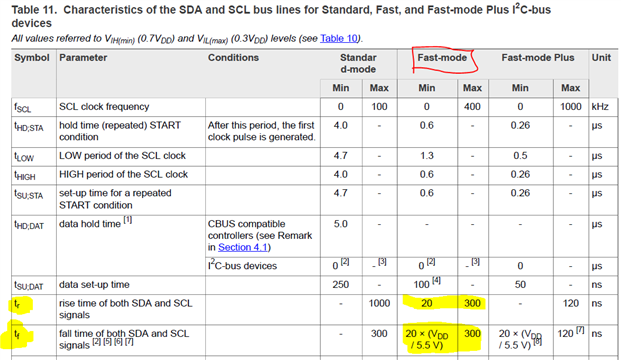
    Why does the TPS23861 specification have a clear requirement for the rise and fall time of I2C, which is between 20-300ns?
    Please help to clarify the risk of the edge being too fast or too slow, for example, what is the risk of 1ns or 1us? Thanks.

    Regards,

    Charlie

  • Hi Charlie, 

    In the case of rise and fall time which is too slow, the risk is incorrect sampling of the I2C data. Problems include corrupt data transmission, dropping commands entirely (nak condition every time), and hang up of the i2c state machine. In the case of edge rate being too fast, I usually do not encounter many customers reporting problems with this scenario. Generally, faster edge rates can cause increased crosstalk on other signals. My recommendation is to meet the edge rate requirements stated for the TPS23861. 

    To clarify why we have requirements for the rise and fall time, it's to increase interoperability with majority of i2c master devices by adhering to the i2c standard. I am attaching the spec that I found on the web to the bottom of this thread. Refer to the rise and fall time specifications for the "Fast-mode" standard which is for i2c bus speed upto 400KHz. You might find a newer version from the NXP website if you search for "UM10204".

    UM10204.pdf

    Regards,

    Sai Gunda