This thread has been locked.

If you have a related question, please click the "Ask a related question" button in the top right corner. The newly created question will be automatically linked to this question.

LMR33640EVM: Modifying board to output +5/-5V

Part Number: LMR33640EVM
Other Parts Discussed in Thread: LMR33640

Hi Team,

A has 2 LMR33640EVM boards and would like to modify one of the boards as an IBB with -5V output while the other has +5V output from a +12V output.

Because the evaluation board has a common ground between the input voltage and the output voltage, the customer must separate these ground. I am thinking of removing the 3 capacitors: Cblk, Cin, and Chf and connecting them to the ground similar to this thread. Will this work? can you suggest other method?

Also, could you tell me how to calculate the power consumption of a IBB converter?

Thank you.

Regards,

Marvin

  • Hello

    Leave C2 (Cin), and C3 (Chf) in place.

    Reconnect C1 (cblk) from VIN to the system ground; check voltage rating.

    Please see the attached app note for more information about IBB.

    It is not easy to estimate the efficiency of an IBB; it will be worse than the equivalent buck.

    Based on the LMR33640 and your conditions at 2A load, I would guess about 70% efficiency.

    Thanks

    3122.snva856a.pdf

  • Hi Frank,

    Thanks for the support. The customer was now able to produce a +5V and -5V output using the EVMs.

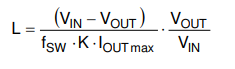
    Now, I am helping the customer with the calculation for the inductor. On the EVM the inductor value used was L=6.8 µH calculated from the datasheet formula below:

    As for the IBB modified EVM, we got the value of L= 32.8µH using the formula from the  application note you provided:

    However, the IBB modified EVM is giving correct output (-5V) even if the inductor was not replaced and the original L=6.8 µH soldered in the board is used. why is this still working? why the IBB equation for the calculation of the inductor does not take into account the output current As in the case of Buck.?

    Regards,

    Marvin

  • Hello

    The value of 6.8uH is OK; although a value of 10uH would also work.

    The load current rating is also hidden in the equation for the IBB.  It is in the ΔIL term.

    ΔIL = K*Iout-rating.  In this case I use the following values in the equation for L in the IBB app note:

    Vin =12V, Vout=5V, Fs=400kHz, n=0.7, K=0.3 Iout-rating 4A.  This gives me about 10uH.  

    The inductor sets the ripple current, which we usually set at 30% (K=0.3) of the max rating for the 

    device.  But it is not very critical.

    You can test with the EVM with a 6.8uH or 10uH and be sure you can get your required load current

    and it looks stable.

    Thanks

  • Hi Frank,

    Thanks for the help.

    Regards,

    Marvin

  • Hi Frank,

    I have a follow up question, how can I calculate or select for the proper clamping diode for this? the documentation does not specify how.

    Thank you kindly.

    Regards,

    Marvin

  • Hello

    Any good small signal Schottky diode would be OK.

    Voltage rating for Vout and maybe 1A or 2A or so.

    Thanks