This thread has been locked.

If you have a related question, please click the "Ask a related question" button in the top right corner. The newly created question will be automatically linked to this question.

TPS1H200A-Q1: Current limit FAULT issue

Part Number: TPS1H200A-Q1


Hi,

Customer designed Current Limit 2.5A in Holding Mode.

When the current limit is reached, the fault pin is low and the outpin voltage remains on/off.

It seems to correspond to Overload in Table 7-2. Fault Truth Table.

If the current reaches the current limit when configured in Holding Mode, it will not be held and will not recover after it goes down.

When the current limit is reached in this mode, the current shall be maintained at the limit until the device reaches the thermal shutdown or the load current drops.

Do we not understand the holding mode well?

Please give me some advice.
  • Hi Cho,

    Holding mode of the device means that the turn off and turn on is automatic but it is based all on thermals of the device.

    In holding mode, when the current limit is triggered, the device will clamp current at the user set value. This is dissipative in nature and will cause the device to heat up and shut down due to thermal shutdown. Then the device cools down. Once the device cools sown sufficiently, it will automatically turn back on again. This process repeats until the fault condition is removed or the device is disabled.

    Thanks,

    Shreyas

  • Hi Shreyas,

    May I know the Wattage value of the IC?

    The current limit set value cannot be reached under the test conditions below.

    - Current set value 2.5A

    - Voltage: 12V

    - load: 10ohms

    When power is supplied, the current is measured by 300-350mA, but it is thermal shutdown.

    Additional testing.

    Current Limit Set Value : 500mA

    Load: 5 ohms (100W)

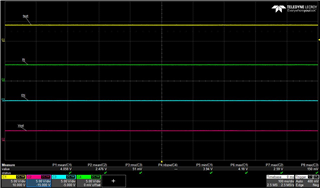
    1. 5V, 500mA(IN_High  / EN_LOW)

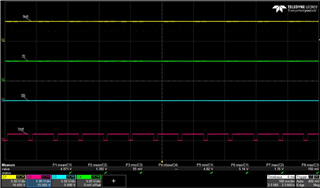
    2. 7V. 350mA(IN_High / EN_LOW)

    The fault does not turn low even though Vout fails to maintain supply and the current has dropped from 500mA to 350mA.

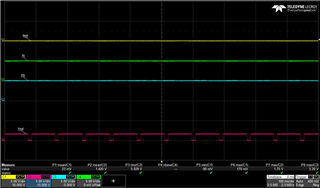
    3. 5V, 500mA(IN_High / EN_High)

    Fault is Low even though the current is consuming the set 500 mA.

    4. 7V, 350mA(IN_High / EN_High)

    Vout does not maintain normal supply.

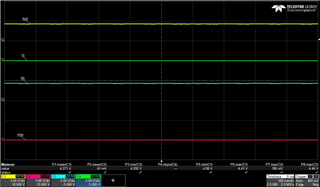
    5. 5V, 0mA(IN_Low / EN_High)

    If you change IN from high to low at 5V supply and 500mA, the Fault becomes High and the Vout is shut down.

    Does it work for Standby DIAG mode?

    When the current limit is reached, the fault does not change from H to L (in the EN low state), and when the EN is changed to High, the fault does not become H and comes out as L even though it is consuming normal current.

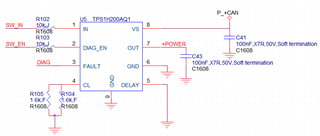
    Please review if the operation is normal or if there is a problem with the schematic.

  • CHO,

    We spec the device to be able to run at 2.5A nominally. The voltage doesn't really matter too much as very little voltage is being dropped over the on resistance of the FET. This will depend on how the device is setup with the layout, however. The majority of the heat generated from the device is dissipated on the PCB via the thermal pad. The 2.5A number is using a standard JEDEC 2s2p layout.

    Can I ask how you are simulating these loads? Are you using an eLoad or an actual resistive element?

    Best Regards,
    Tim

  • Hi Timothy,

    Thank you for your reply.

    The customer is connecting and testing cement resistance.

  • Hi Cho,

    DIAG-EN has to be high for the fault to respond to the current limit.

    The current limit has an accuracy value associated with it so it is possible that in some devices, 500mA is not sufficient to trigger the limit. 

    The current limit accuracy is defined for overload condition that exceed 1.5x times the current limit. Slow ramp can affect the accuracy as well.

    Once the current limit is triggered, the device will hold the current at the specified value until it heats up and turns off. It will retry when it cools down enough as mentioned in the datasheet. 

    For more information about the current limit and accuracy please view the following document: https://www.ti.com/lit/an/slva859b/slva859b.pdf?ts=1700597246215 

    Thanks,

    Shreyas