This thread has been locked.

If you have a related question, please click the "Ask a related question" button in the top right corner. The newly created question will be automatically linked to this question.

LMR33630CRNXEVM: LMR33630C CFF calaulate and decide

Part Number: LMR33630CRNXEVM


Hi Expert 

I tried to understand the CFF calulate and I have some question need your help

the equation shows below in datasheet : my Cout : 66uF, VREF=1V, Vout=3.3V, RFBT=100K , chip freq=2MHz , Loading current from 150mA to 3A

My CFF result : less than 31.97pF 

and Using Webench to check my PM/GM/CROSSOVER FREQ

So, I sweep the CFF value on websim shows below

CFF=30pF   GM::19.36 PM: 90.75 Crossover Freq.:44.6k

CFF=33pF   GM: 18.8   PM: 91.75 Crossover Freq.:41.93k

CFF=56pF   GM: 16.21 PM:84.16  Crossover Freq.:71.21k

CFF=68pF   GM: 15.46 PM:76.93  Crossover Freq.: 80.02k

CFF=100pF GM:14.29 PM:64.66 Crossover Freq.:90.81k

I means, these CFF value seems no stability problem with oberserve from PM/GM/CrossFreq.

Question : Why the equeation setting like that? Something I misunderstand or ignore the from design? 

Should I notice something in larger CFF value? or some operation condition?

Can expert help me out of this ? 

(I know it will imporve transient reponse by increase crossover freq. that's our target, too.)

Reference doc attached, thanks!!

 CFF_Evaluation and Performance Optimization of Fully Integrated DC-DC Converter.pdfslva289b_CFF Com.pdf  

  • Hi,

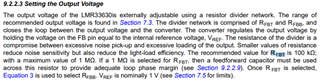
    Thank you for your question and your testing results. The equation in the datasheet is a good starting point for a feedforward capacitor that will keep most applications stable and provide good enough transient response. This being said, it is a starting point and is mainly for applications with higher values of RFBT. It can very well be the case that your design works just fine without a feedforward capacitor. For lower values of RFBT, a feedforward capacitor is not necessary and the system will still be stable and have a good transient response. See section 9.2.2.3 for more details. I have included the excerpt for your convenience:

    If you still want to include a feedforward capacitor to ensure loop stability you can, but this will likely slow down your transient response. You can still use the equation as a starting point and then optimize the feedforward capacitor using one of the app notes you already linked.

    Thank you,

    Joshua Austria

  • HI Joshua 

    Thanks for the reply. 

    For the application, yes. It function normally without CFF.

    However using CFF to increase crossover frequency to imporve the transient is our main target,

    -

    Q1.So can you explain the detail about "slow down your transient response." ?

    Base on the crossover frequency, referenced document and PSPICE simulation result. 

    Bigger cff value improve the transient ripple when Cout is fixed.

    (If you need pspice transient reslut, please give me a mail adress)

    -

    Q2. Is the "less than" sign in the equation inevitable? Or is it conditional?

    I mean my result base on webench considerated PM/GM/Crossover freq. exceed the calculated value 3X, but it still function well.

    Then, PSICE function check also well. It Make me really confuse.

    Just make sure that result can be trust when I broke the equation. 

    The reference document that I attached,they have no limit about CFF. (Just back to PM and control theory)


    Thank you for your attention to this matter.

  • Hi Cheney,

    In regards to Q1, apologies I misspoke. including a feedforward capacitor will improve your transient and boost gain/phase.

    In regards to Q2, the less sign is a recommendation. It is a starting point to where you can try and begin experimenting. If you go above this equation, there may be a point where you hit instability, but if your calculations and simulations are showing acceptable margins/crossover frequency, then for your use case, this is likely viable and good to use. Please refer to the https://www.ti.com/lit/an/slva289b/slva289b.pdf?ts=1701285890218 app note (I believe you already sent this one) for the optimization process. 

    Thank you,

    Joshua Austria

  • Hi Joshua

    This really help.

    thanks

  • Hi Cheney,

    You're welcome!