This thread has been locked.

If you have a related question, please click the "Ask a related question" button in the top right corner. The newly created question will be automatically linked to this question.

TPS7A05: TPS7A0533PDQNR: This LDO exist also without "Active Discharge" function ?

Part Number: TPS7A05
Other Parts Discussed in Thread: TPS7A03, TPS7A02, TLV707

Tool/software:

Dear Sir or Madam,

one question because I see in the datasheet follow description regarding the order code in chapter 11.1.2 Device Nomenclature:
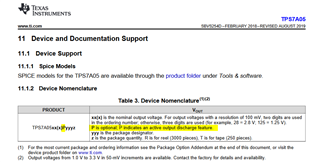
Does exist this article without the "Active Discharge" ? The order code has included the "P" as optional for that feature. But I cannot find the article "TPS7A0533DQNR" without "P". 

If not available: Does exist this LDO with another designation? Or you can offern an alternative?

Thanks beforehand.

Best regards

Wolfgang Walter

  • Hi Wolfgang,

    I believe this is a typo; all TPS7A05 devices have an active pulldown feature. If I'm understand correctly, you want a device with similar specs but with no output discharge feature? Which specs are important for your application?

    Regards,

    Nick

  • Hi Nick,

    thank you for your fast reply. You are right. For my application it is interesting to use the same LDO with its specification without the discharge feature. Especially this small package is here from interest!

    So if the TPS7A0533PDQNR cannot be offered without the "P" can you give me an alternative article with such an DQN-Package and 3.3V? It would be advantageous for us to simply replace the LDO in existing designs.

    Thank you very much beforehand.

    Best regards

    Wolfgang Walter

  • Hi Wolfgang,

    We don't have any devices that have the same specs that don't have an active discharge, especially the super-low Iq that TPS7A0X family (TPS7A02, TPS7A03, TPS7A05) has. The closest devices that has versions that don't have the active discharge feature that also come in the X2SON (DQN) package are TLV713 and TLV707.

    Is there a constraint in your application that makes the active discharge feature undesirable? 

    Regards,

    Nick

  • Thanks for your fast reply. I think the TLV707 series is interesting for us. That would be an alternative to use TLV70733ADQNR. 

    In fact, we have an application where the active discharge is undesirable. If there is an unexpected drop in the power supply, a supplied data saving process should be completed/finished as far as possible in the system. 

  • Hi Wolfgang, 

    I see. I'm curious whether a simple diode at the input of the power tree would prevent the regulator inputs to collapse along with the main power supply long enough to similarly complete the data saving process? Then you could use the TPS7A05, which has much lower Iq draw. Of course I don't know much about your system so maybe this suggestion is off, but the active discharge circuit only engages when either the input voltage falls below the UVLO threshold, or when the EN signal is pulled low, and since you are using the 3.3V version, by the time the UVLO (falling) limit is passed (UVLO will trip before EN if EN is tied to IN), the device will already be in dropout and as the input falls there will be reverse current from the output to the input that will discharge the output anyways. If there is a diode, at least the regulator input will hold up longer and help minimize the effect of this scenario. 

    Regards,

    Nick

  • Hi Nick Butts.

    Thanks for your ideas.

    There is another question regarding your recommended TLV70733ADQNR. Is there an limitation regarding the output capacitance? We just want to use 200µF cause of the case which is described above to have a data saving process. We want to keep the storage process shutting down for as long as possible so that enough data can still be saved.

    In the datasheet I cannot find any hints.

    Thanks and best regards

    Wolfgang Walter

  • Hi Wolfgang,

    The datasheet does not mention a maximum output capacitor and says that there just needs to be "at least" 0.1uF effective capacitance. To me this implies that there is no an upper limit, and 200uF should be fine. 

    Now for the issue of wanting to keep the output held up for long enough for the data saving process to complete, I want to point out that if the input collapses quickly, the body diode of the pass FET conducts, and the output cap will be discharged quickly anyways. Furthermore, if the output has a large capacitor, the current through the body diode can be very large and not limited, and the device can be damaged. So, I think your choices become a bit limited, and the diode solution becomes likely necessary. In my view, the simplest solution is to use 2 diodes (one additional diode to the one I mentioned before): one from OUT to IN, and one at the input before the LDO solution. This will prevent the body diode from taking the current, protecting the LDO, and will also prevent the output from discharging through a low-impedance path.

    Regards,

    Nick

  • Hi Nick,

    thank you for your detailled explanation.

    You are right and I will protect the whole thing with the additional diode at the input. Especially now I have also the possibilitiy to have for the input a high enough Voltage that the forward voltage of the diode is irrelevant.

    Best regards

    Wolfgang Walter