This thread has been locked.

If you have a related question, please click the "Ask a related question" button in the top right corner. The newly created question will be automatically linked to this question.

TPS61025 Power Stability

Other Parts Discussed in Thread: TPS61025

Hello all,

I am using the TPS61025 in my design.

Under typical conditions, the load on the TPS61025 output is around 15 mA.

However, occasionally, I activate an actuator, and this will bring up the current by about 100 mA temporarily.

I am using the following components:

22 uH inductor: http://www.digikey.com/product-detail/en/CLF6045T-220M-D/445-15128-1-ND/4168212

10 uF input capacitor: http://www.digikey.com/product-detail/en/0/445-7486-1-ND

47 uF output capacitor: http://www.digikey.com/product-detail/en/0/445-11420-1-ND

I am using a single 1.25V NiMH battery to power the system.

I am also using a reset IC such that when the battery falls below a certain threshold, the output of the reset IC drives the enable pin of the TPS61025 low (this is to prevent battery drain).  This output goes low when the battery is at 1.0V.

Normally, the system works fine and there are no power issues.  However, I activate a vibration motor during before the battery reaches 1.0V (as an alert mechanism), and this causes issues on the power line.  Essentially the battery voltage line fluctuates, which causes the reset line to fluctuate.

I have gone through some calculations, and I believed that the component selection should have provided a more stable output.  Here are my calculations:

---------------------------------------------------------------------------------------

Iout = 115.0 mA
V_out = 3.3 V
V_bat = 1.1 V
f = 600.0 kHz

IL = I_out * V_out/(V_bat * 0.8)
IL = 431.25 mA

deltaIL = deltaIL = 0.2 * I_L
deltaIL = 86.25 mA

Recommended L = 14.1706924316 uH

deltaV = 10.0 mV
Output Cap Min = (I_out * (V_out - V_bat))/(f * deltaV * V_out)
Output Cap Min = 12.7777777778 uF

---------------------------------------------------------------------------------------

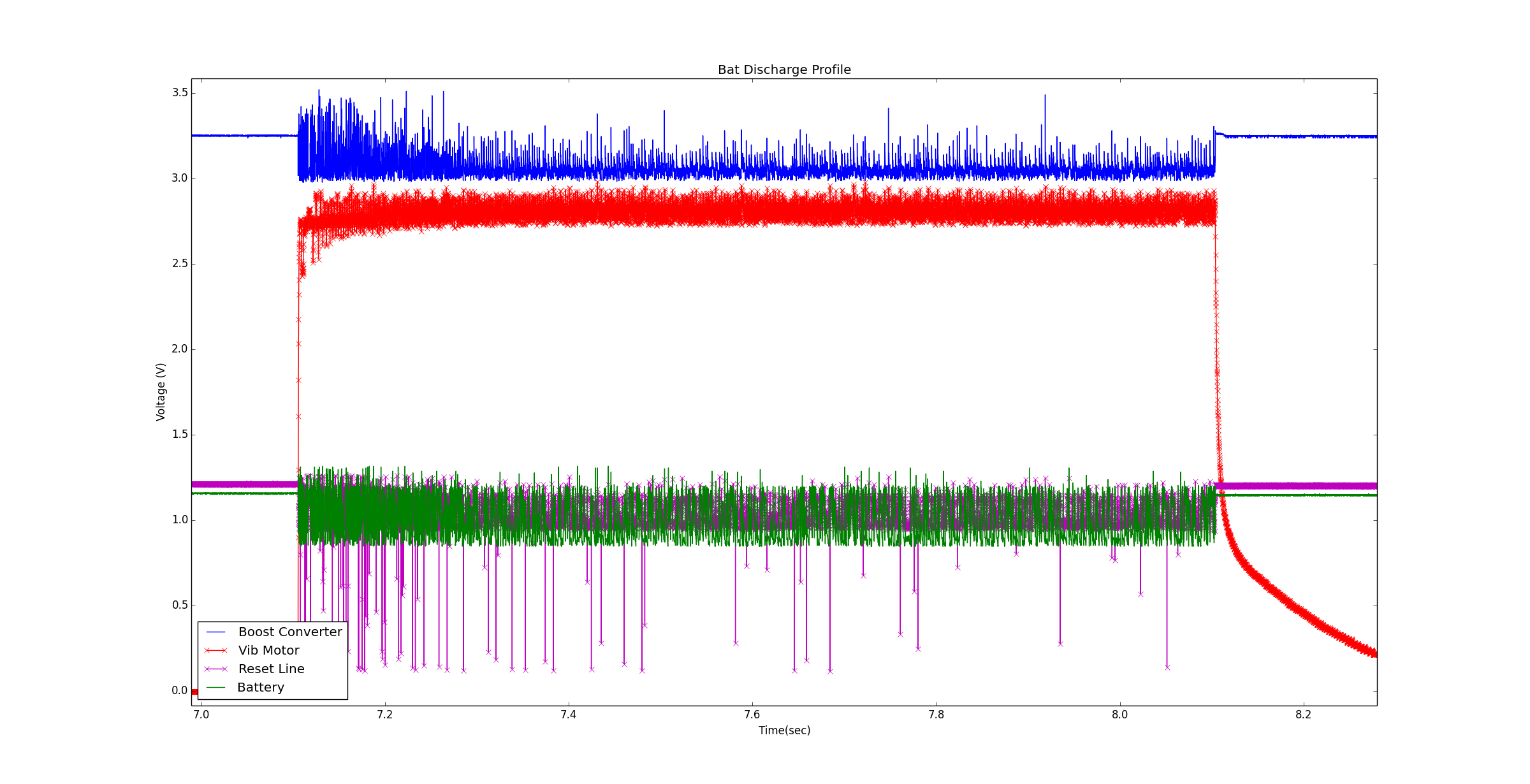
I have attached a plot of the lines.

Thanks,

Mehdi

  • it seem TPS61025 unstable is caused by the fluctuation of the reset IC's output. could you try to connect the TPS61025's EN pin to VBAT. if the problem is solved by this. you can try to add a filter circuit to the input of reset IC to avoid fluctuation.
  • Hi Jasper,

    Thank you for your reply. I will try experimenting more with the circuit tomorrow.

    I can add a filter to the reset output, and I am sure that with the correct capacitor value (along with selecting the proper on/off times of the vibration motor), I can essentially prevent a reset from happening. However, is there a way I can reduce the ripple on the Vout line? I already have a 47 uF capacitor on Vout and ground. Could adding a smaller capacitor in parallel (or increasing the current capacitor value) help reduce the ripple? Or should I consider increasing the capacitor value at Vin (currently it is 10 uF). Essentially, I worry that a fluctuating Vin (the battery voltage) would cause ripple on the output. Making the enable line more stable will help but I am not sure it will eliminate the problem.

    In any case I will get back to you tomorrow.

    Thanks,

    Mehdi
  • "I worry that a fluctuating Vin (the battery voltage) would cause ripple on the output. "
    this is why i suggested connecting the EN of TPS61025 to VBAT (disconnect with RESET IC output ) firstly. so it is to narrow the potential root cause.
  • Hi Jasper,

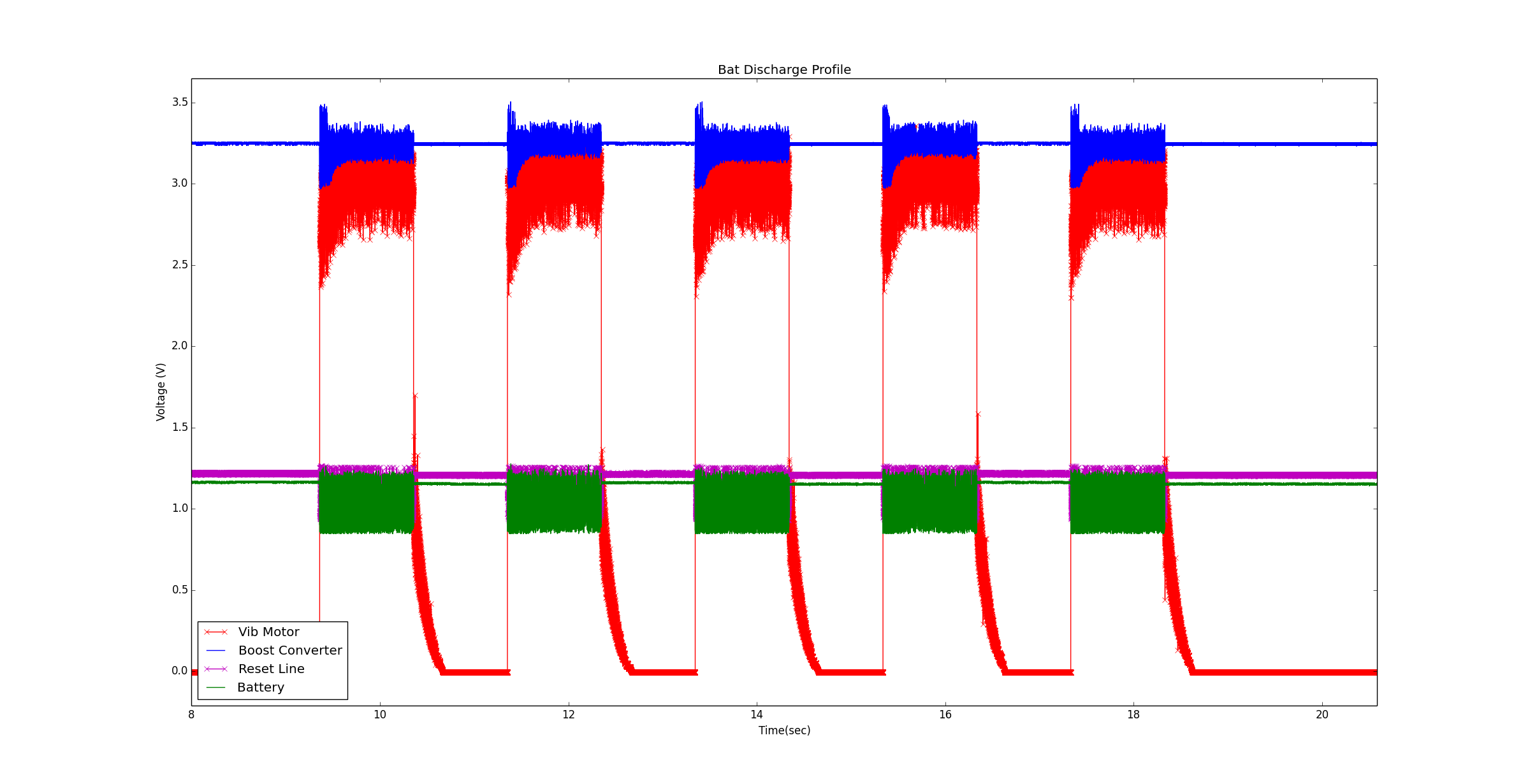
    So I took your suggestion into account.  I removed the IC from the PCB, and now the reset line is connected to Vbat via a pullup resistor.  Here is the plot below.

    The system is definitely more stable.  I am a little concerned with the on-transient however.  The reset IC is set to pull the enable line low when Vbat < 1.0V.  If you zoom in on the plot, during the on-transient of the motor, this condition does happen:

    I'm not sure if there is much I can do about this as this is the nature of adding a load.  But if I understand correctly, smaller capacitor values are supposed to suppress transient noise (at least to some degree).  Could adding the correct combination of capacitors on Vbat and Vout minimize this behavior?

    I suppose that alternatively I could filter the reset circuit output to prevent the reset line from going low during this transient.

    Thanks,

    Mehdi

  • Sorry, as it turns out I made a mistake in the previous post.  I had a series resistor connected to the motor, and it turned out there was a bad connection so that the actual resistance from power to motor was higher.  I have retaken the measurement.  Unfortunately, there is a lot of noise in the power lines, and this is unworkable.  I do realize that adding a load will create noise on power lines, but based on the calculations on my original post, I expected the system to be much more stable than this.

    So it appears the load is too big for the boost converter to behave in a stable manner?  Aside from decreasing the load, are there any other measures I can take?

    Thanks,

    Mehdi

  • Hi Meddi
    could you share a block diagram of the system? does the TPS61025 power the motor?

    keep EN=1, and please the measure the Vbat, VOUT, SW pin and inductor current waveform, zoom in, so we would know what really happen in each cycle.

    please try to connect PS to high, disable the PFM, maybe this would help