This thread has been locked.

If you have a related question, please click the "Ask a related question" button in the top right corner. The newly created question will be automatically linked to this question.

Recommendation for a high voltage bias supply

Other Parts Discussed in Thread: TPS40210, UC3842, UCC2897A, UC3843, UC3845, UC3844

I have a need for a high voltage (~1000V) bias (almost zero current) supply used in detecting ionization. I've looked at a design from Maxim, but it requires a custom toroid coil which is causing me headaches.

The requirement is to use an existing 12V (or similar low voltage) supply to generate a postive high voltage. This is applied to a plate that will force alpha particles away - towards ground potential. There is no specification for the ripple as it could be a couple volts and not have an effect on the outcome.

I was just wondering what the E2E community might recommend.

  • You might want to try posting in the isolated forum as well.  I am fairly sure we do not have any non-isolated solutions. 

  • Hi David,

    A design could probably done to meet this using the TPS40210. However this would also require a custom transformer. Unfortunately I'm not sure if there is an alternative which does not require some type of custom magnetics.

    Can you elaborate on the issue you're having with them now?

    Best Regards,
    Anthony

  • It's really rather trivial. The app note from Maxim recommends a Fair Rite toroid and I've been able to get samples. However, with my thumbs I haven't been able to wind one without the windings shorting to the ferrite. The unit it too small for me to do the usual Kapton wrap, so I tried to get samples of the coated toroid. The best I could do was a minimum order of $50 (some had an added fee for the coating!) At this time, it's only for a few protoypes. The other side of the problem is that even when I get to production, the vlumes have been (optimistically) projected at around 100/year.

    One possibility might be HV modules like those available for PMT applications, but the pricing is too high for this project. (See: http://www.emcohighvoltage.com )

    So, I decided to look at alternatives. I'm hoping that something might be available with less headache.


  • I would not recommend TPS40210. I'm using it in exactly this kind of circuit and it's causing a lot of problems. 

    1st, it's lacking adjustable input low voltage sensing. So if you have a thermal runaway condition, TPS40210 will happily let your supply fry as it keeps in cranking higher duty cycle while the input voltage is dropping. 

    Second, the current sense measurement is for very low voltage. Fine for high-current applications but here it's just going to cause problems as there will be a huge leading edge spike due to the high potential in parasitics. It's not possible to fine-tune the cut-off current with 0.2V threshold as precisely as you can with 1V threshold current sense controller. 

    Third, feedback voltage target is 0,7V. You will have very high voltage division in the feedback already and this adds some unnecessary extra. 

    I'm currently redesigning a circuit with a custom magnetic using UCC2897A. I have a functioning 900Vout supply using TPS40210 in a simple boost configuration. For a new project I'd recommend using a "stupid" UC3842 variant with 3rd order low-pass filter in the current sense input (input turn on spike is really high in this case). Bear in mind the efficiency will be horrible so losing 0.2W in voltage measurement circuit generates a lot of waste heat in the main switch and inductor. You can save some headache by choosing a "smart" UC3842 derivate with integrated slope compensation and leading edge blanking but beware of overhelming the leading edge blank circuit. Also make sure to choose a model with a hard duty cycle clamp. You will be running in DCM with ~470uH - 1mH inductor. Capability of the inductor to store energy matters here, I have had some good experience with panasonic ELLATV series.

    You want to keep the switching frequency as low as possible as the switching losses dominate. Aim for 28kHz or so. I have a UC3843 controlled earlier circuit I replaced with the "improved" TPS40210 that has caused a lot more problems than the dumb UC3843 ever did. You will need a lot of external circuits, though. Also do not neglect to think about heat sinks for the main inductor and FET. 

  • Olli,

    Thank you for sharing your experience with this type of design. You are right, the UC3842 has advantages for the high output voltage in this type of application.

    Out of my own curiosity, what is the input voltage and output current for your 900V output TPS40210 boost design?

    Best Regards,
    Anthony

  • I'd recommend using UC3844 or UC3845 (TL2844DR, many other variants exist) instead - You want to have hard clamp on the duty cycle as it's possible Bad Things will happen if you have 2nd crossover causing alternative small/big pulses. 

    The TPS40210 circuit can do 24-to-975V @ 40C ambient. There is no real current load on the bias voltage. Actual load from feedback and other circuitry is about 0.5mA. The efficiency is really miserable at around 20% as majority of energy is lost on switching & parasitics. Hence this particular design is not suitable for a circuit needing more substantial power than a static bias voltage. 

    I'm designing an improved circuit based on UCC2897A aimed to generate 1800VDC from 24V input.

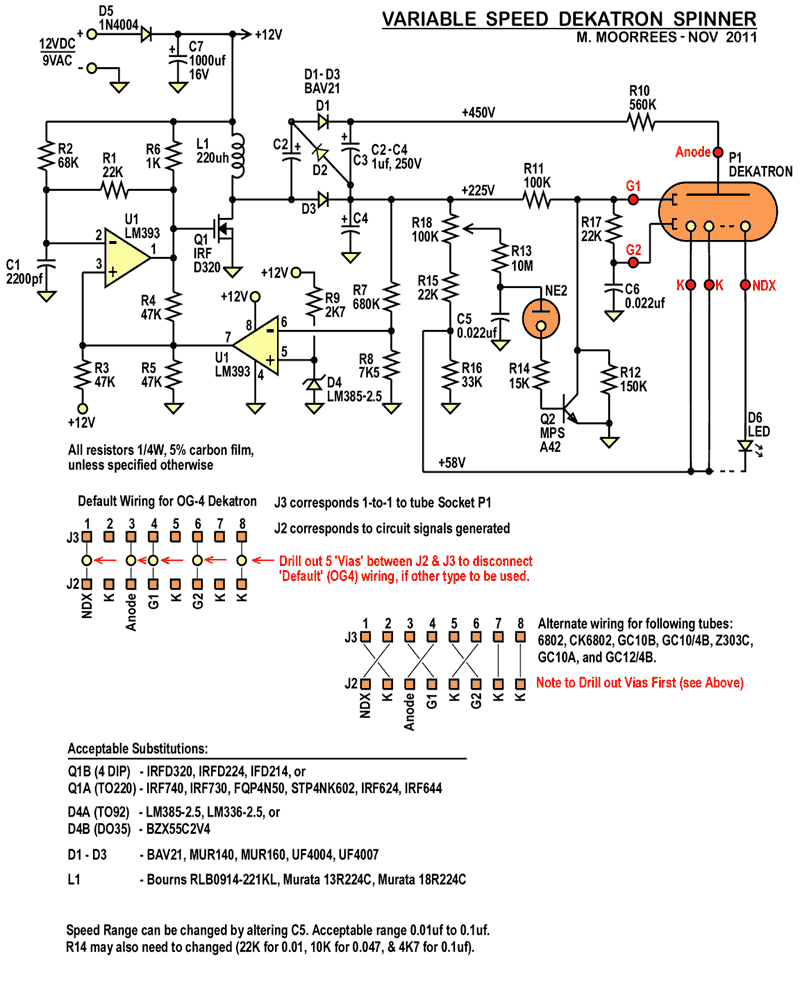
  • This is just some info I ran across. If you look at the upper left section of http://threeneurons.files.wordpress.com/2011/12/sp393_sch.gif there's a simple boost converter that utilizes a voltage doubler circuit to get to 450V. It seems that his switch controller and voltage feedback could be replaced with a newer PWM style chip and thus save some real estate.

    I've seen this type of design in a couple of places and was wondering about any thoughts to this approach...

  • I think using something a bit more contemporary would be a better starting point. Texas should have some appnotes for modest ~100V output boost circuits. Main difference between those and what you want to achieve is that you'll be running in DCM and the inductor energy storage capacity is critical. Oh and the leading edge spike is obscene. 

    If you're going to have 1kV output, you'll likely run into trouble with the voltage feedback using a resistor divider as here. Unless you want to burn a lot of power on feedback alone, you have to use pretty big resistors.

    Using a negative opamp amplifier changes the feedback to essentially negative feedback current controlled which is much more precise with high impedances. Naturally the Opamp needs to be cmos/jfet style or the input bias will ruin things. You'll need another negative amplifier to restore the correct polarity, though. 

  • Since you defined "no load" at the output, you might as well as use a voltage cascade circuit. Greinacher or Cockroft-Walton should work well for you, just be careful with the diode/capacitor voltage ratings. In this case, though, since there's no transformer, negative voltages do not come into play. You can chain the Greinacher circuit as much as you want, be sure to ground the bottom side of the circuit although it's not drawn in the wiki diagram.

  • Hello Olli;

    I am going to work on similar design, what is your experience with UCC2897, with high voltage putout. Any specific things that i should look out for?

    Thanks

  • I know this is not a TI solution, but for those interested I found that application note AN118-4 from Linear Technologies had good coverage of various designs. I ended up using the circuit from Figure 8 and was able to use standard parts. It works great for my needs.