This thread has been locked.

If you have a related question, please click the "Ask a related question" button in the top right corner. The newly created question will be automatically linked to this question.

BQ27542-G1: BQ27542-G1 reporting increased battery capacity after shutdown for few hours ( did not checked below 4 hours)

Part Number: BQ27542-G1
Other Parts Discussed in Thread: BQSTUDIO, EV2400, GPCCHEM

Hi, 

I am facing issue with fuel gauge BQ27542-G1   reporting  battery capacity if  device (host CPU) kept  shutdown  for  few hours. 

It is noticed that fuel gauge is reporting proper battery capacity from 0% to 100% during continues charging  and also 100% to 0% during continuous discharge.   Also showing   last reported  %  value  properly if device is immediately turn ON  after shut down. 

The issue facing when device  (host CPU) kept  shutdown  for  few hours  . The fuel gauge shows  increased capacity of 20%  to  30% at lower battery level . 

For eg : 16% at shutdown shows as 46% after 6 hours . 30 % at shutdown shows as 57% after 18 hours . 

The details of battery :

No.of cell  and type of battery : 1 , Li-Polymer

Capacity : 3000mAH

Voltage : 4.2V

Let me know how to solve this issue . 

Regards

PSG_4

  • Hello,

    Can you re-recreate the issue with EVM and EV2400 using bqStudio to log the data?

    Did you complete the GPCCHEM process and do a learning cycle on the battery?

    The gauge will take an OCV reading after a reset and correlate the voltage it is at (whether it is relaxed or not) with a SOC value.

    Sincerely,

    Wyatt Keller

  • Hi Wyatt Keller,

    We had  successful   finished learning cycle and flashed GG files in those units. 

    Above said  issue happens  only  when  system (host CPU) is kept in   shutdown mode for few hours.  As you suggest , I can  connect  BQ27542 I2C lines to EVM EV2400 and take logs with BQ studio during shutdown period of few hours . 

      For your information , we are not using any Operating system ( but only C code)  and not using any  driver to communication with BQ2742-G1 . We are just reading SOC  and voltage from registers. We are not writing any registers . Is it creating issue ?  Let me know any initialization required ?  or driver required for communicating with BQ27542-G1  ? 

    Regards

    PSG_4

  • Hello,

    Can you share the GPCCHEM report and the learning cycle files?

    Yes if you could log the behavior so we can see what exactly is occurring when the gauge updates the SOC.

    Sincerely,

    Wyatt Keller

  • Hi ,

    GPCCHEM report is missing while changed my working station PC  and now  I am not able to find it out since  almost 1 year. All of this  delay  happened because of  covid -19  lock down. 

    I will try to get logs using EVM4200 and BQ studio during system shutdown. 

    Could you please comment about above query .   Need to do assert any reset command before taking reading from fuel gauge after shutdown ?   Any  driver  is required  communicating to BQ27542 -G1  ?  We are using only C programming code  to just read SOC and voltage . Not asserting any reset command or not writing   any  command for functional mode change from normal to sleep / full sleep/hibernate  and vice versa. 

    Regards

    PSG_4

  • Hi Wyatt Keller,

    I have re-created the issue and collected logs with EVM EV2400   and  BQ studio during host CPU shutdown for few hours .

    Device kept shutdown at 32% and after 6 hours , state of charge jumped to 61%  . Kindly have look on .csv file attached . 

    Regards

    PSG_4

    BQ27542_G1_ jumping_after Shutdown.zip

  • Hello,

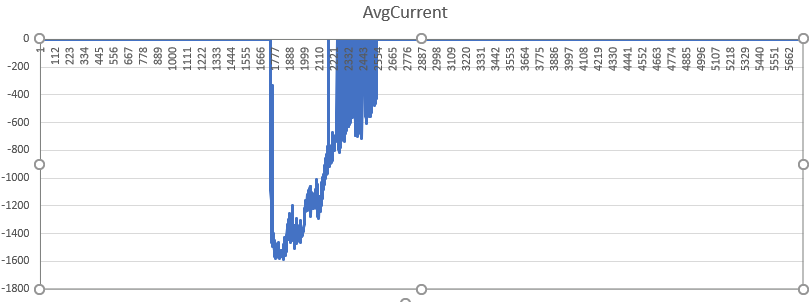
    Can you also share your .gg file? Is your load very dynamic? I see the average current looks pulsed.

    To clarify, the gauge was working fine and then this started happening randomly?

    Sincerely,

    Wyatt Keller

  • Hi Wyatt Keller,

    Attached gg file here  . 

    Actually  System  load is not dynamic and it is around 350mA in normal working mode . The load current  during system shutdown in around 375uA (micro Amp) .   The logs  are taken during  system  shutdown (after  disconnected I2C line from host CPU then connected to EV2400) .  

    Log starts at 31% (battery voltage = 3.767V) and log end after 6 hours with battery capacity =61% ( battery voltage =3.760V) . The voltage difference between both log points are  less (only 7mV) and hence actual load during shutdown also  very less. 

    Warm Regards

    PSG_4

      3000mAH Battery gg file.zip

  • Hello,

    What was the log shared earlier? It looks like the current jumps from 0 to 600-800mA from the log I am looking at:

    Sincerely,

    Wyatt Keller

  • Hi Wyatt Keller ,

    The log had taken when system (host CPU) was at shutdown stage  and  to show the  increase in battery capacity  during shutdown (original issue under discussion) . 

    After  system shutdown , I2C lines are  removed from host and connected to EV2400 and collected log using BQ studio  for 6 hours. Log starts at 31% (battery voltage = 3.767V) and log end after 6 hours with battery capacity =61% ( battery voltage =3.760V) . it is clear that there no voltage difference after 6 hours and hence no current consumption . Voltages are measured with multimeter.  

    I am not understanding current jumps from 0 to 600-800mA  as there is no voltage reduction at battery terminals after 6 hours . 

    Regards

    PSG_4

  • Hello,

    I'm still not quite sure what the log is showing, there is current flowing according to the gauge so the system isn't shutdown.

    Usually we see SOC jumps like this when the design capacity is wrong or the steps weren't completed successfully:

    Find the chem ID using GPCCHEM tool.

    Set the parameters for your application (design capacity, current thresholds)

    Run a learning cycle for Qmax and Ra to update.

    Then accurate gauging can be achieved. It looks like the gauge thinks the battery has less capacity than it really does and corrects it when the system is in shutdown.

    Sincerely,

    Wyatt Keller

  • Hi Wyatt Keller ,

    This jumping issue happens only in system  shutdown mode .There is no voltage reduction at battery terminal so that there is no current consumption during shutdown.  

    But  I did not see any single digit  % jumping during continues charging and discharging operation .    If the issue with learning cycle , how gauge can works properly  during in  continues  operation.

    Regards

    PSG_4


  • This is most likely due to the transient model of the gauge.

    You can check if the capacity is actually increasing by discharging at a constant load and seeing if the 0% point is reached at term V.

    The other thing you can do is make sure you have a properly selected chemID via GPCCHEM and a proper learning cycle.

    Thanks!

  • HI ,

    Let me know the feedback about gg file attached in  earlier  reply. 

    Battery details are 4.2V , 3000mAh . 

    Regards

    PSG_4

  • Hello,

    As mentioned earlier, if your gauge did not learn correctly or has a bad chem ID, which is more likely regarding your issue, then you need to run GPCCHEM on a relax - discharge - relax log of the full battery voltage according to the cell manufacturer.

    Sincerely,

    Wyatt Keller

  • Hi Wyatt Keller,

    My battery  battery chemical combination  LiCoO2/11 and capacity is 3000mAh . Once I uploaded  relax - discharge - relax log  to  GPCCHEM , the matching CHEM ID  received was totally for different chemical combination. 

    So I  selected CHEM ID 1223 from BQ studio tool  (Chemistry TAB) which is very very close to  battery chemical combination  LiCoO2/11  and 3000mAH  capacity .

    Do you have any facility to do calibration  if  I send battery  directly to  your office ? 

    Regards

    PSG_4

  • Hi Wyatt Keller,

    My battery  battery chemical combination  LiCoO2/11 and capacity is 3000mAh . Once I uploaded  relax - discharge - relax log  to  GPCCHEM , the matching CHEM ID  received was totally for different chemical combination. 

    Report from GPCCHEM  is attached . could you please suggest suitable CHEM ID from report  ? 

    MY battery details are : 

    Voltage : 4.2V 

    Capacity : 3000mAH 

    Chemical combination : LiCoO2/11

    Regards

    PSG_4

    Chem ID log_Inno-report.zip

  • Hello,

    The report tells you which ID to program that has the best match: Best chemical ID : 2066 Best chemical ID max. deviation, % : 1.18

    This is a good match, even if the chemistry is different it is still a good match and will not affect the chem ID operation in the gauge.

    Sincerely,

    Wyatt Keller

  • Hi Wyatt Keller,

    It seems capacity of chem ID  2066 is 2420mAh  and our custom battery capacity is 3050mAh.

    Is it okay to select ID 2066 with less capacity?

    Or else I have to ID  0264  with exact 3000mAh capacity  in the below attached  list (chemical ID max. deviation, % : 2.34) ?

    Regards

    PSG_4

  • Hello,

    The capacity stated in the chem ID database does not affect your application, you need to set your own design capacity in the data flash of the gauge.

    The chem ID is used along with the programmed design capacity to do gauging. Refer to the impedance track app note for more explanations into the algorithm: www.ti.com/.../slua364

    Sincerely,

    Wyatt Keller

  • Hi Wyatt Keller,

    I am doing calibration again with  Chem ID 2066  using fuel gauge  BQ27542.  My battery nominal design capacity is 3000mAh and  system minimum operating voltage is 3.5V  . First flashed Chem ID 2066 to BQ27542 and then done calibration for  CC offset and voltage .

     I have below doubt about Parameter Q&A  settings . 

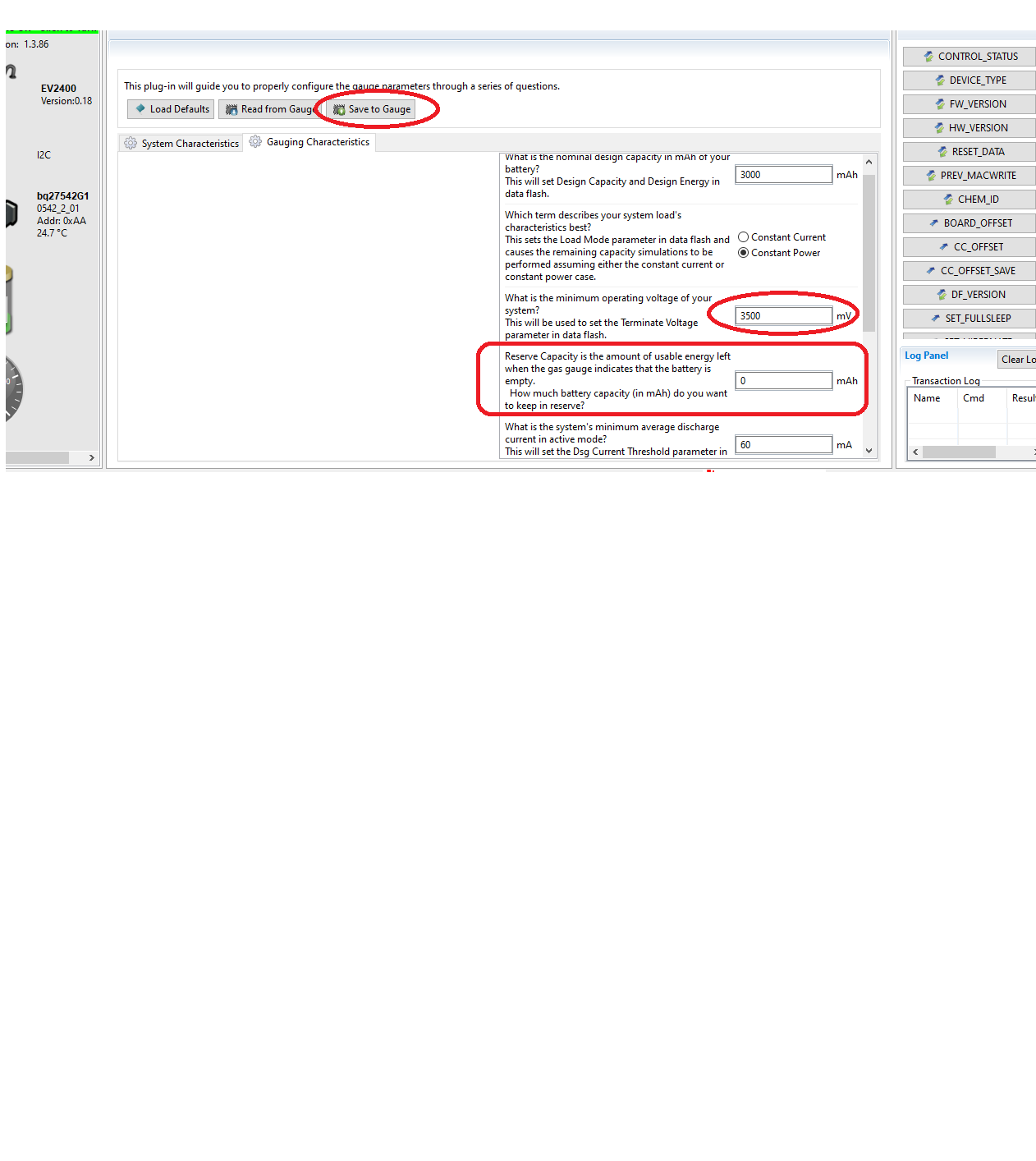
    1. Is  " save to gauge " is required  after   configuring System characteristics and Gauge  characteristics in Parameter Q&A  tab in  BQ studio tool  ?   This feature is  not supporting in my BQ  tool .

    2. Is it possible to enter "reserve capacity " as 0 mAh (zero) if  I want to declare battery is  empty at 3.5V  ( system minimum operating voltage is 3.5V) . If value must be non -zero  , how to find reserve capacity ?

    System characteristics and Gauge  characteristics in Parameter Q&A  tab  is attached for reference . 

    Regards

    PSG_4

  • Hello,

    You can configure the reserve capacity for the amount of capacity you want remaining when the gauge reports 0% SOC.

    You will need to save the calibration data to the gauge, the calibration values in data memory will change if the calibration was successful. You can read the data memory after calibration and should see the values change from default.

    Sincerely,

    Wyatt Keller

  • Hi,

    What I understood from your reply is , there is no need to save "parameter Q&A" as it is before doing calibration.  Calibration values in data memory will change if the calibration is  successful. I can read  the data memory after calibration and should see the values change from default

    Regarding reserved capacity  configuration , my system  minimum voltage is 3.5V .There will be  appx. 300mAh charge will be kept as not using  when fuel gauge report as 0% capacity  at 35.V .  System will shutdown at 3.5V and  this 300mAh is not useful. 

    So let me know what should be value I have to  enter as reserve capacity . Is it 300mAh or 0mAh ?

    Regards

    PSG_4

  • Hello,

    I'm not sure I understand what the Q&A question is. For calibration use the EVM user's guide to find the calibration values for your system. You can average 20-30 boards calibration data for the final production golden image to program other gauges.

    If your final voltage is 3.5V you should set your terminate voltage to 3.5V so the gauge uses that voltage to predict 0% SOC.

    Read through section 6.1 Introduction to Impedance Track in the TRM for information regarding the terminate voltage: www.ti.com/.../sluub65a.pdf

    Sincerely,

    Wyatt Keller 

  • Hi Wyatt Keller ,

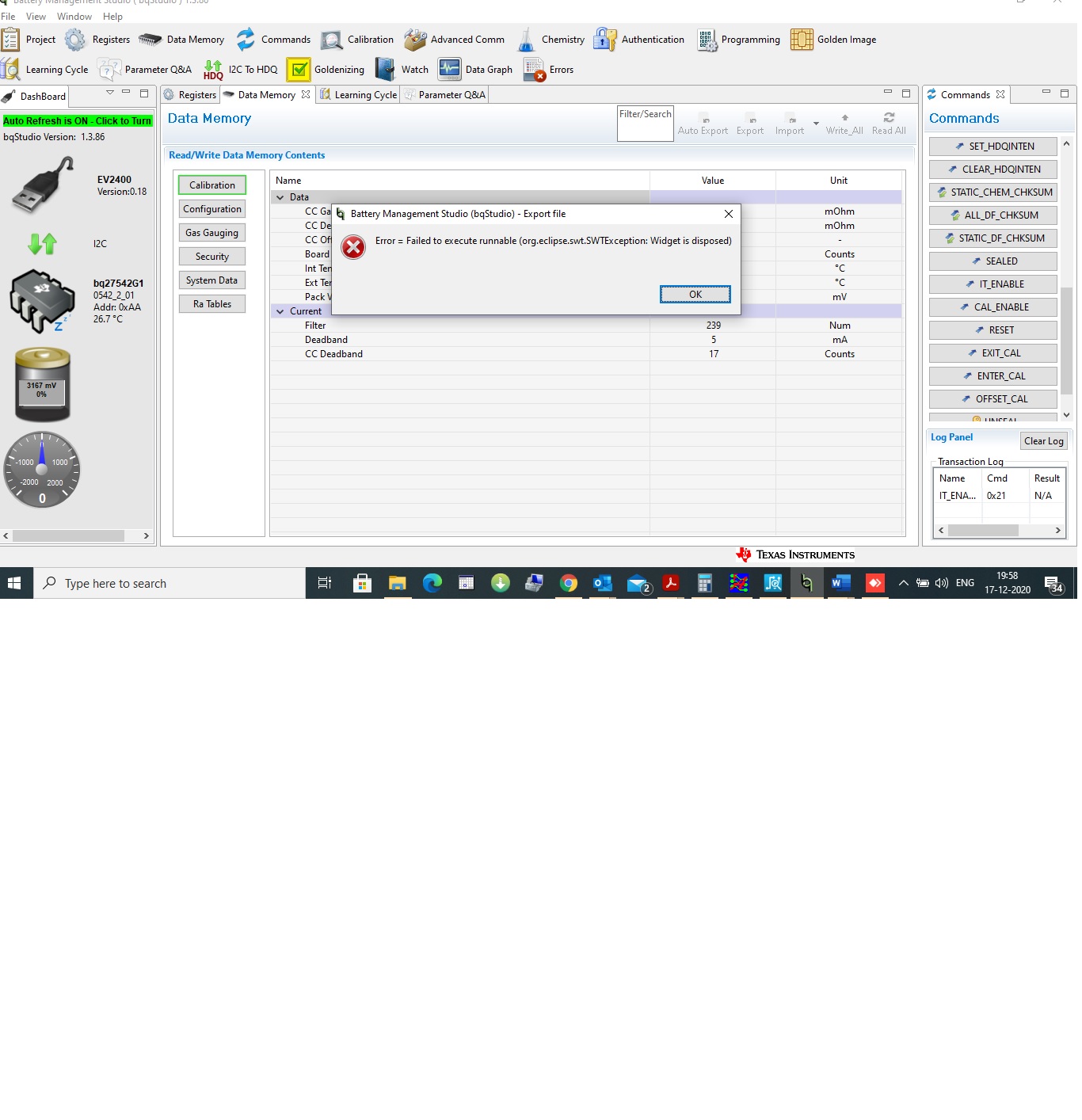
    I have finished successful learning cycle with BQ studio tool V 1.3.86  but facing issue while exporting data memory. 

    While do export getting  error " Failed to execute runnable(org.eclipse.swt.SWTException:Widget is disposed ". Image attached for your reference .

    Could you help me to rectify this issue on urgent basis ? If suggesting for install different tool version , then how to save all data for learning cycle which is running from last 30 hours 

    Can we do create golden file without exporting/importing  data memory  ? 

    Regards

    PSG_4


  • Hello,

    Can you export the .gg file or the .srec? either will work to transfer the data from the learning cycle.

    Or you can save the Ra and Qmax values with a screenshot if neither work and manually input the values.

    Sincerely,

    Wyatt Keller

  • Hi , 

    Thanks for reply. 

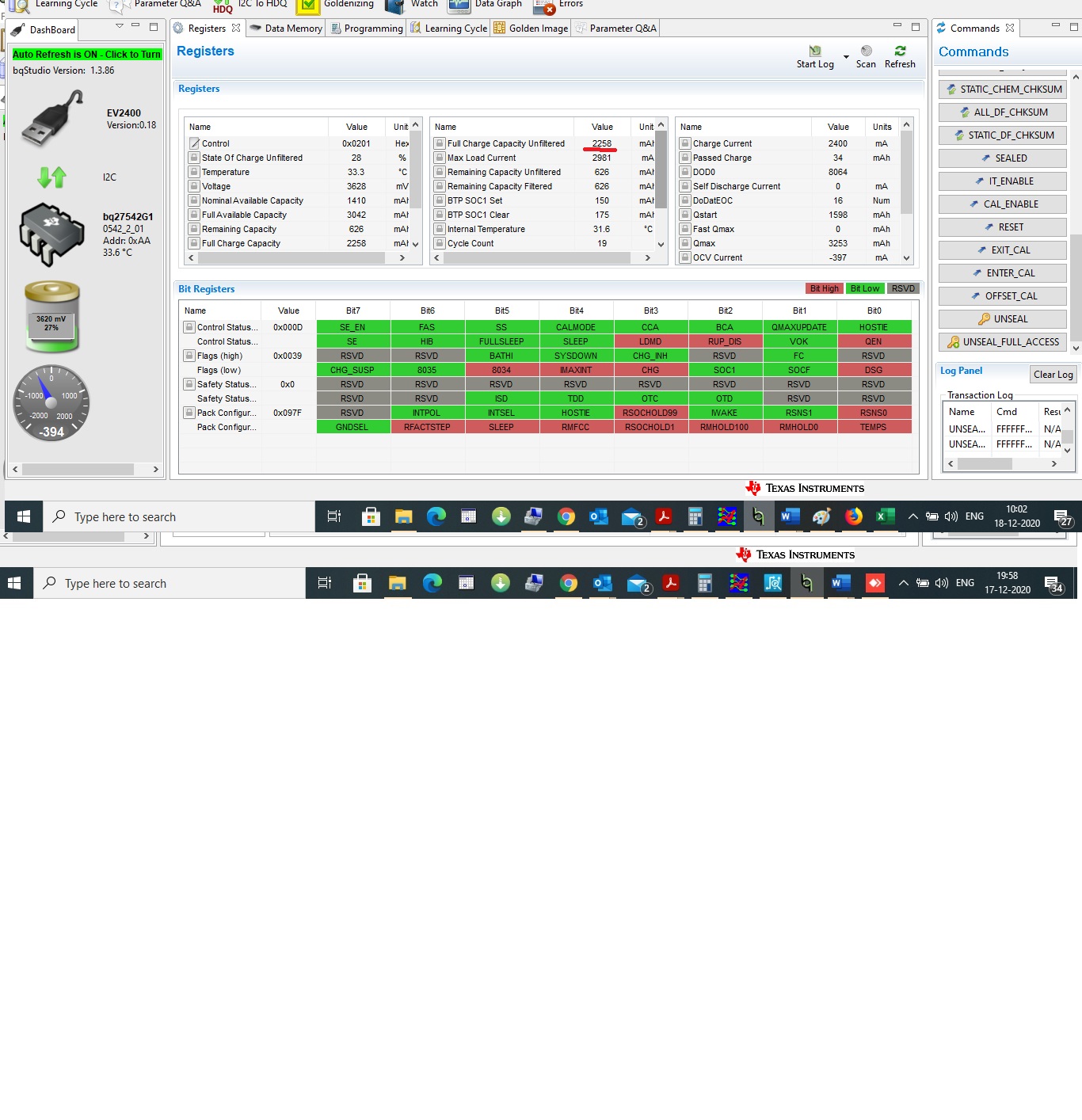
    Once I flashed newly generated .srec  file in another board  , there is a mismatch in    "full charge capacity unfiltered" value  between  calibrated Fuel gauge board . 

    The  actual battery capacity value is 3000mAh  . After successful learning cycle in calibrated board ,  "full charge capacity unfiltered" value  shown in BQ studio  is 2938mAh at 0% battery (3.147V).  This is acceptable for us . 

    But  once   flashed golden file in another board , its   "full charge capacity unfiltered" value  is shown as 2258mAh at 27% ( 3.62V )

    Attached  .srec file and  screen image for reference. 

    Is this failure of .srec file flashing ?  Is it mandatory to import  .gg.csv file in all boards  along with .srec file programming ?

    Regards

    PSG_4

    Golden File 17122020.zip

  • Hello,

    This is a repeat question. The answer is provided on the other thread.

    Sincerely,

    Wyatt Keller