This thread has been locked.

If you have a related question, please click the "Ask a related question" button in the top right corner. The newly created question will be automatically linked to this question.

TMP101: Pullup for SCL

Part Number: TMP101
Other Parts Discussed in Thread: TMP117

Dear Technical Support Team,

I have questions about TMP101.

Q1

The datasheet specifies a pull-up resistor for the SCL pin. Is this necessary?
Since the SCL pin is an input pin, I think a pull-up resistor is unnecessary unless the driving side is an open-drain port.

Q2

If pullup is not necessary for SCL(Answer of Q1 is Yes), is it possible to set a pulldown resistor on the SCL line?
Another IC is also connected on the same SCL bus, and it is preferable for that IC to have a pull-down resistor.

Q3

The TMP117 specifies that a pull-up resistor is required when using the SCL pin as an open-drain output.
Do different temperature sensors conforming to the same I2C standard have different requirements?

TMP101: I²C specification for multi-master (multiple master devices)? Cross-stretch compatible? (Possibility of SCL port becoming an output port?)

TMP117: I²C specification for both multi-master (multiple master devices) and single-master (one master device)? Cross-stretch incompatible?
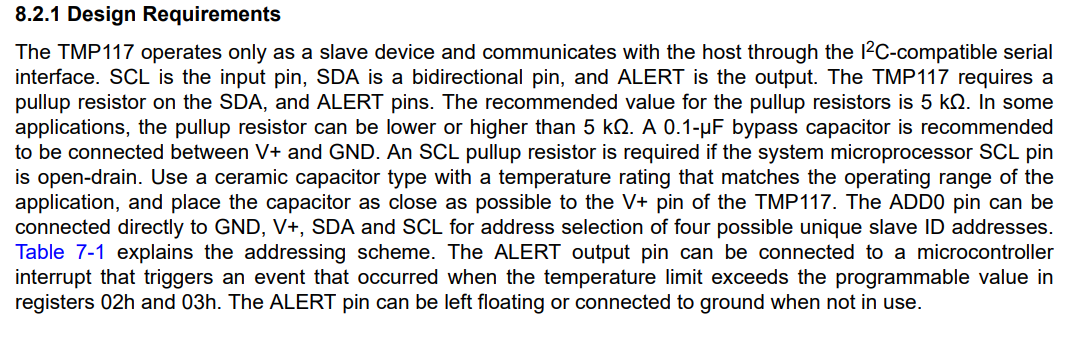
image.png

◎Background of the Question
I plan to mount memory on the same bus line. 
Generally, I2C specification has clock strech and I think the push-pull driving is non-standard and not recommended.

I'm concerned that using pull-up on all lines could potentially cause unexpected stop conditions, so we want to pull down the SCL line.
The intended circuit is single-master, so collisions on the SCL line are not expected. We anticipate that all AC characteristics required by the device can be satisfied.

Best Regards,

ttd

  • Pull-up is not required at SCL.

    Assuming timing and logic level parameters are met, I don't see a reason for the SCL input to interact with a pull-down resistor.

    The TMP101 and TMP117 are not different in this regard. The SCL is only an input on both devices. The text is describing a typical application. Pull-up resistors are a normal feature of the I2C bus.

    ren

  • Hi Ren,

    You said:

    Assuming timing and logic level parameters are met, I don't see a reason for the SCL input to interact with a pull-down resistor.

    →Please allow me to confirm once more. When only a pull-down resistor is placed on the SCL line,
    is it correct to understand that it is acceptable (and can be used) as long as the timing and logic levels are met?
    I modified the board to pull down the SCL line, and it appears to be functioning without issues.

    Best Regards,

    ttd

  • I assume your SCL driver is push-pull. It would have to source current to create logic high when there is no pull-up resistor present. Open drain drivers require pull-up resistor to create logic high. The I2C bus is defined as open-drain (as opposed to push-pull) so that it can be shared by both controllers and targets safely. The TMP products cannot act as controllers. The TMP products are only I2C targets. It's for this reason that their SCL pins are input-only, and their SCL pin can safely share the bus with a push-pull driver on the SCL pin only.

    ren

  • Hi Ren,

    Thank you for your response. I understand. Also, I wanted to confirm about the pull-down resistor (in a push-pull configuration without pull-up). I believe it would function, but is it not recommended as TI?

    ◎Background of the Question
    I plan to mount memory on the same bus line. I'm concerned that using pull-up on all lines could potentially cause unexpected stop conditions, so we want to pull down the SCL line.

    I'm sorry for asking again and again.

    Best Regards,

    ttd

  • Personally, I would choose a small series resistor instead. However, there is nothing explicitly prohibiting you from using a pull-down resistor. As I stated before, you must ensure that the timing and logic level specifications are met. It's not impossible to do so with such a resistor.

    ren