This thread has been locked.

If you have a related question, please click the "Ask a related question" button in the top right corner. The newly created question will be automatically linked to this question.

AWR1642: SNR at ADC input and output

Part Number: AWR1642

hi: 

I have some questions about the SNR values at ADC input and output.


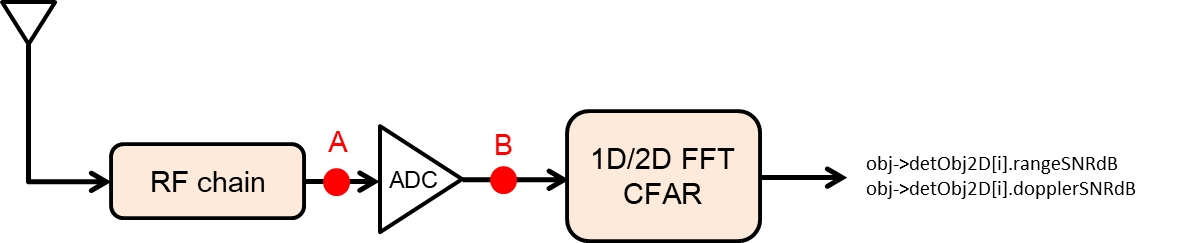
a) I would like to calculate the SNR at ADC input (i.e. A point in the following fig). Is the Noise figure, denoted as Nf, in RF Spec. for the receive processing chain from the receiver input to the A/D converter? If yes, Can I calculate the SNR using the equation: SNR  = Pr / (KTBeff  (Nf))? where K is the Boltzman constant, T absolute ambient temperature in degrees Kelvin and Beff is the effective bandwidth of the receive processing chain from the receiver input to the A/D converter.

b) If I can obtain SNR @ A, then I would like to calculate SNR at ADC output (i.e.,@ B). But I could not find the noise figure or gain for ADC in RF spec. Where can I find the information?

c) I also try another way for SNR @ B.  In the demo code, I found that two SNR values, i.e., Range SNR and Doppler SNR after CFAR process (please refer to the following fig). Can I use the two value and FFT processing gain to derive the SNR @ B? Specifically,  is the SNR @ B ~= Range SNR (dB) - processing gain (dB)?

thx

Stan
  • Hi Stan,

    a) Yes, and the formula that you have is correct. However it is difficult to compute Beff at A. I would recommend computing it at B.

    b) Unless the ADC is close to saturation, its noise figure doesn't contribute to the overall noise-figure of the chain. As such, you can use the same formula at B. The only change is that the effective bandwidth Beff at the output of the ADC is the sampling rate.

    c) RangeSNR and DopplerSNR are approximate estimates of SNR (and are output by the logCFAR function), in the range dimension and the doppler dimension respectively. They are also biased (slightly) because the logCFAR operation computes the 'geometric mean' instead of the 'arithemetic mean'. However, for your purposes, they may be fine.

    That being said, I have one suggestion. Instead of using 'SNR @ B ~= Range SNR (dB) - processing gain (dB)', I would suggest that you use 'SNR @ B ~= Doppler SNR (dB) - processing gain (dB)'. This is because clutter affects the 'range SNR' measurement, and degrade it significantly. However, 'doppler SNR' is less affected by clutter because clutter is stationary. As such 'doppler SNR' wouldn't be affected.

    The final point to note is that 'processing gain' needs to be computed carefully taking into account some non-idealities in the system  for example  windowing of the FFT results in some loss in SNR.

    Regards

    Anil

  • Hi Anil:

    Your explanation is clear.

    It really helps me a lot.

    I appreciate your assistance.

    Regards,

    Stan