


Part Number: TMS570LC4357
Tool/software: Code Composer Studio
Hello,
I want to run an encryption algorithm that needs 10kilo bytes of memory.
For that I did changes in .cmd file
MEMORY
{
/* USER CODE BEGIN (2) */
/* USER CODE END */
    VECTORS (X)  : origin=0x00000000 length=0x00000020
    FLASH0  (RX) : origin=0x00000020 length=0x001FFFE0
    FLASH1  (RX) : origin=0x00200000 length=0x00200000
    STACKS  (RW) : origin=0x08000000 length=0x00030000 //<= here are my canges I took from the RAM memory
    RAM     (RW) : origin=0x08030000 length=0x0007EB00 //<= here are my canges I took from the RAM memory

/* USER CODE BEGIN (3) */
/* USER CODE END */
}
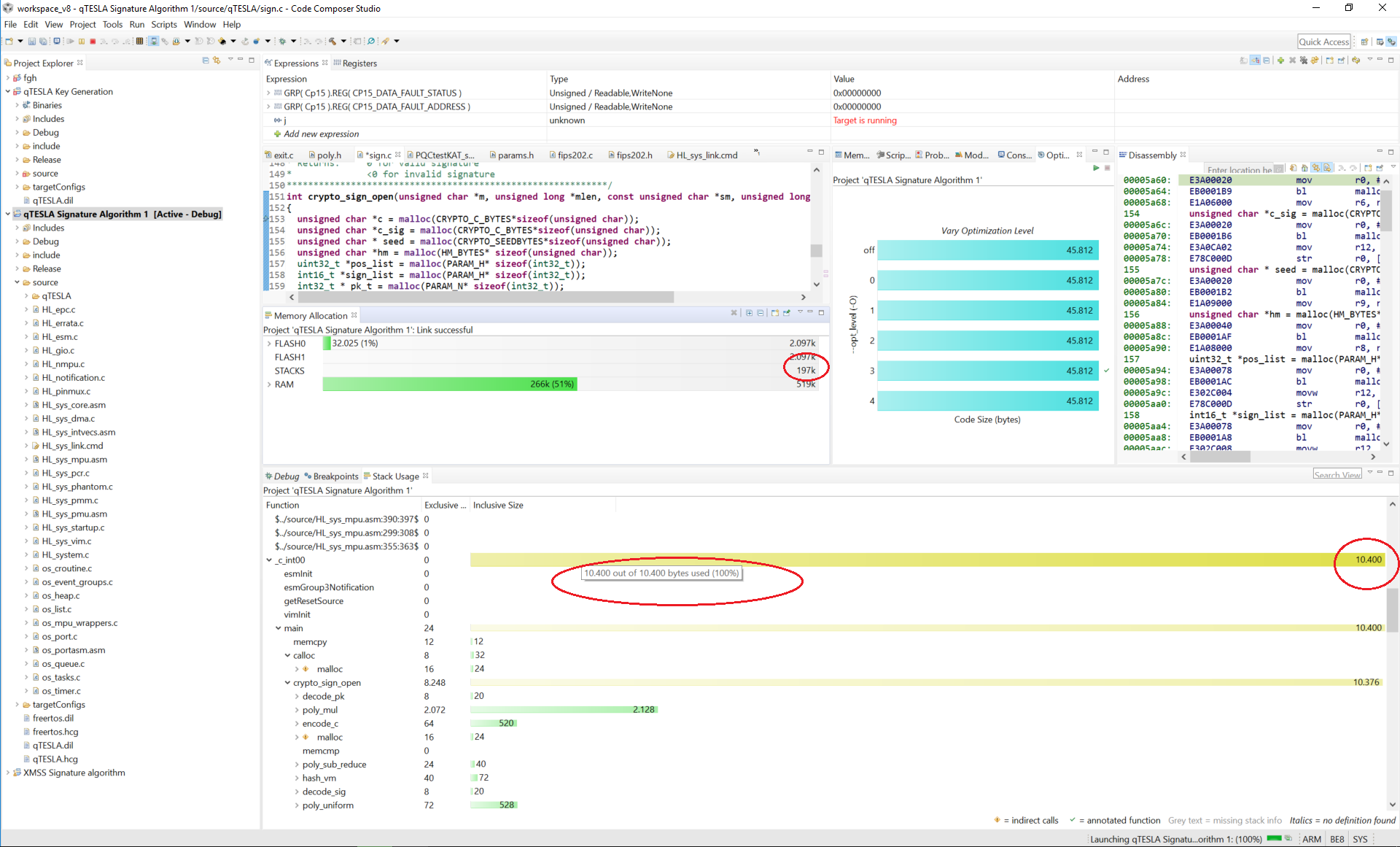
and I changed the stack in CSS by going to Project-> Properties-> ARM linker -> basic options and I put stack size 167kB which means 0x00030000.
The problem I get is that during the execution the program is pointing to a non-valid memory address. (during allocation of some char * arrays of size 1000).
I checked again the stack usage.
Here is my question: If I did give the stack 167 kB, why in the stack usage it is taking just 10400 Bytes ?
How can I convince this fabulous stack that he can use 167 kB from the RAM!!
(kB = kilo bytes)
Best regards,
Sounde Marzougui.
