This thread has been locked.

If you have a related question, please click the "Ask a related question" button in the top right corner. The newly created question will be automatically linked to this question.

Irregular circuit error that I can't resolve

Other Parts Discussed in Thread: TINA-TI

Apologies if this has been answered before, but my search has turned up no solution. I am modeling a 4-bridge circuit, including transformers, capacitors, and inductors. When I run the transient analysis I do not get any errors with the ERC, but I do get a pop-up error for "Irregular circuit." However, the text does not tell me anything, only that it has to do with pin 7. I have tried several things with pin 7, and nothing works. Can you please help me resolve this error? The file is attached below.

Schematic2.TSC

  • David,

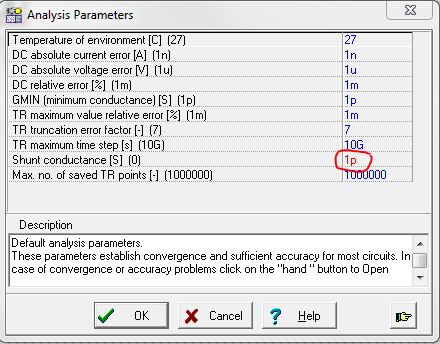
    The irregular circuit is due to the fact that there is no DC path to ground for that node. If you change the Analysis parameters (Analysis --> Set Analysis Parameters):

    The simulation will work correctly. I am not sure what you are trying to do, but I do know that simulating an 80 Mhz signal for 30ms is going to take a huge amount of data and quite some time to run. If you wish to speed up the simulation, I would turn off the option of saving all analysis results and not drawing the excitation (Transient analysis pop up).

    Britt


  • Thanks! That did the trick. Would you mind explaining why that worked a little bit more? I'm not entirely sure why a DC path to ground is required for every node. And how exactly did that "shunt conductance" do the trick? Much appreciated!

  • David,

    GMIN in TINA-TI is used as a very small conductance in parallel with any pn junctions (you will see this in every simulator).

    Shunt Conductance is a very small conductance connected from any node to ground. The irregular circuit flag is set whenever a node does not have some kind of path to ground (in a design, we would call this a floating node). By setting the shunt capacitance, any series capacitors (the node between them does not have a path to ground at the DC bias point calculation) can no be resolved properly. As long as the value is very small, the simulation is otherwise uneffected.

    It is really used as a convergence aid to help the matrix solve the nodal equations more easily.

    Britt