


Part Number: WL1837MOD
Other Parts Discussed in Thread: WL1271
Team,
See below from our WiLink8 WL1837MOD customer:
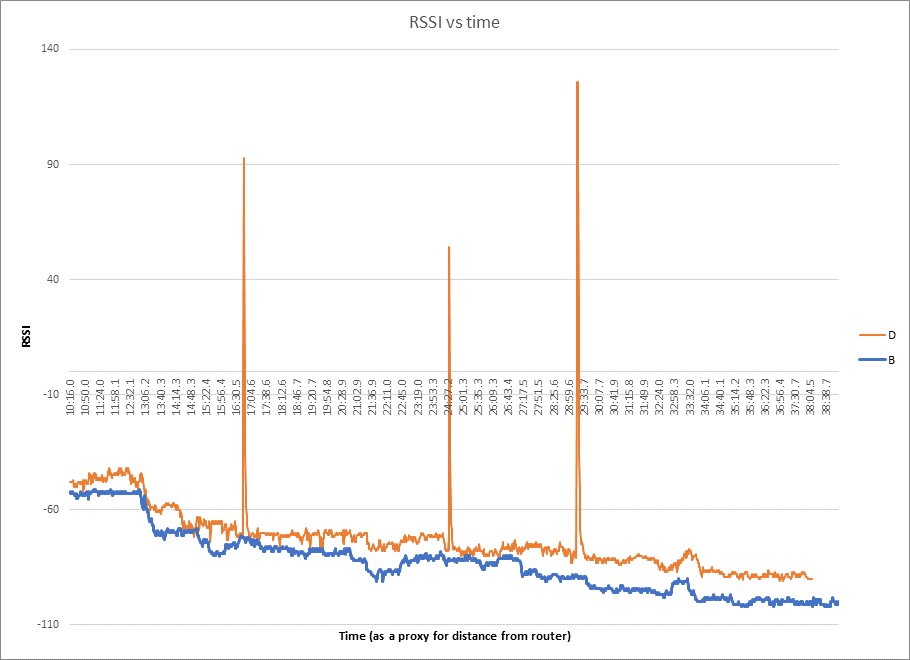
We’ve been comparing the performance of the Wi-Fi chipsets on the rev B and rev D eSOm3730 (which use WL1837MOD) and found that the RSSI value on the rev D board sometimes has large positive glitches in it. This graph shows the RSSI values captured from one of each hardware revision in a recent test run:
We are using the libmnl (https://git.netfilter.org/libmnl) and wifi-scan (https://github.com/bmegli/wifi-scan) libraries to measure the RSSI.
Our experimental setup was to have two of our VS100 devices – one rev B (old radio), one rev D (new TI radio) -- side by side on a roll cart, connected to a wireless router on our desk. Starting at a distance of about 3m from the router, we would walk slowly away from the desk, stopping approximately every 3m to note the number of signal strength bars on the devices’ GUI. Simultaneously, the wifi-scan-station test tool from the wifi-scan library was capturing the RSSI values into log files (see attached); we then extract the timestamp and RSSI value using:
awk -F'[][ ]' '/ec:1a:59:fb:37:ce/ {print $3 ",", $8}' logfile
During the test, we noticed that the rev D device would intermittently jump from 3, 2 or 1 bars to 4 bars (the maximum on our GUI) then slowly subside back to the original level. It appears the bumps are due to a spike in the recorded RSSI from the device with the TI chipset. Note that other than the spikes, there is fairly good correlation between the two sets of RSSI data.
Do you know if this is a known issue with the TI chipset? We have been considering putting in a filter to ignore sudden large positive changes in the RSSI value but would prefer to see consistent values being presented from the kernel that trying to work around the issue.
We are basically looking to know, “Do you see this RSSI spike on a TI EVM or not?” to help guide our troubleshooting with eSOM.
Thanks in advance,
Chris


