Other Parts Discussed in Thread: , CC2592, Z-STACK
Hello all,
what is the minimum supply voltage required for 22dbm TX power when cc2538-cc2592emk is powered by USB mode.
what can happen if the supply voltage is below minimum level?
This thread has been locked.
If you have a related question, please click the "Ask a related question" button in the top right corner. The newly created question will be automatically linked to this question.
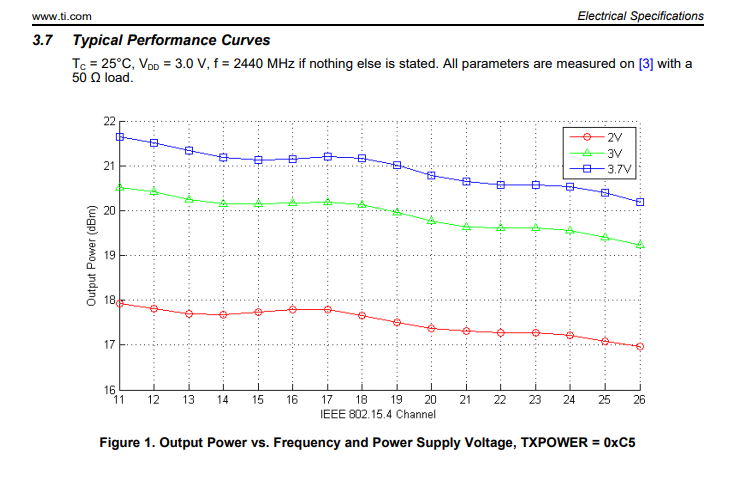
Does figure 1 in http://www.ti.com/lit/an/swra447/swra447.pdf answer your question?
Yes. Since the CC2592 PA is powered directly from VDD, the potential voltage swing will be lower when the supply voltage goes down and hence the max output power will have a VDD variation. If you see the datasheets for CC2538 and CC2592 you will see the allowed VDD range for these devices.
Any possibility ...in which ..mcu works but radio does not work???
plz refer the following thread - regarding the issue what I am facing -https://e2e.ti.com/support/wireless-connectivity/zigbee-and-thread/f/158/p/844419/3128205#3128205
Have you tried to debug this issue just sending a CW or similar to see if you actually have a hardware issue? SmartRF Studio should be possible to use for this.
Have you also measured the output of the LDO on the board (DVDD_USB)?
Hello TER,
I was doing testing and trying to recreate the issue in my development environment with one of the gateways which I got back from the deployment in question.
So during one of the experiments(as mentioned below), I am able to see somewhat similar symptoms consistently(i.e. > No link status and No MTO route request from ZNP)
> whenever I keep the gateway on the CPU of my desktop, it stops sending link status and MTO route request but at the same time, znp sends mac acknowledgment to the report command sent by the router. (Basically, in this case, I don't see any network layer or application layer packet from ZNP )
> if I remove the gateway from the top of my CPU and keep it 10 -15 cm or more away from the CPU, it starts sending link status and MTO route request.
So far I have tested this issue with only 1 gateway and the above-mentioned behavior is consistent.
Further, I will do this testing with multiple gateways.
you can see in below picture how I have placed the gateway on my CPU during testing.
Where is the antenna placed in your DUT? Since the PC cabinet is most likely of metal this will impact the antenna and the efficiency of the antenna.
If you do a simplified experiment: Use SmartRF Studio to send a CW (or program the DUT to send a CW). Place a receiver 1 m away (to have a fixed number) and measure the RSSI of the received signal in the case you place the DUT on top of the PC and when you place it at least 50 cm from any metal (but still 1 m from the receiver)
but then why the router is not getting affected, when I do the same test for a router.
and also in the znp why only network and higher layer pckets(link status, MTO route request) are getting affected .and why mac layer data is not getting affected(mac acknowledgment to report command )
First of all, did you do the test I suggested to see how many dB attenuation the antenna placement gives?
I don't know the Z-stack so I'm not able to cover those questions. I'm trying to look at this issue from a fundamental RF perspective.
Not sure if you have showed the placement of all the nodes in the network. Is the link budget required the same for all functions? I would assume a router could need less link budget or is the router actually in use (in the network) when you test?
TER,
Making sure you are aware of this parallel thread: https://e2e.ti.com/support/wireless-connectivity/zigbee-and-thread/f/158/p/844419/3138126#3138126
Regards,
Ryan
Ryan: Oh, I thought only https://e2e.ti.com/support/wireless-connectivity/zigbee-and-thread/f/158/p/844419/3128205#3128205 covered the issue.
Dhanraj: Please try not to have multiple posts covering the same topic. Also, I suspect that this is down to some RF fundamentals. Having the antenna close to metal is never a good idea. Also, I saw in the post that Ryan referred to that the distance between the nodes are fairly short. Do you see some difference if you back off some on the output power?
Hello TER,
Initially, I was not sure about ..what can be the problem ..hence I was exploring all the possibilities ..but then eventually both the discussion ended up in the same direction.
From next time I will avoid multiple posts for similar problems.
Please refer my recent reply in the other thread ...where I mentioned some missing definitions in z-stack for cc2592.