This thread has been locked.

If you have a related question, please click the "Ask a related question" button in the top right corner. The newly created question will be automatically linked to this question.

CC1310: how to activate DSSS mode?

Genius 3985 points

Other Parts Discussed in Thread: CC1310, CC1101

I would like to test DSSS mode in CC1310 DK.

As there is no documentation about it (beside errate which tells 'not supported yet') I asked some days ago in this forum how to test.
I understood I can activate it with SRF by choosing Long Range Mode, see picture.

But this seems to be nothing else than a normal 2FSK with 39kHz ChBW.
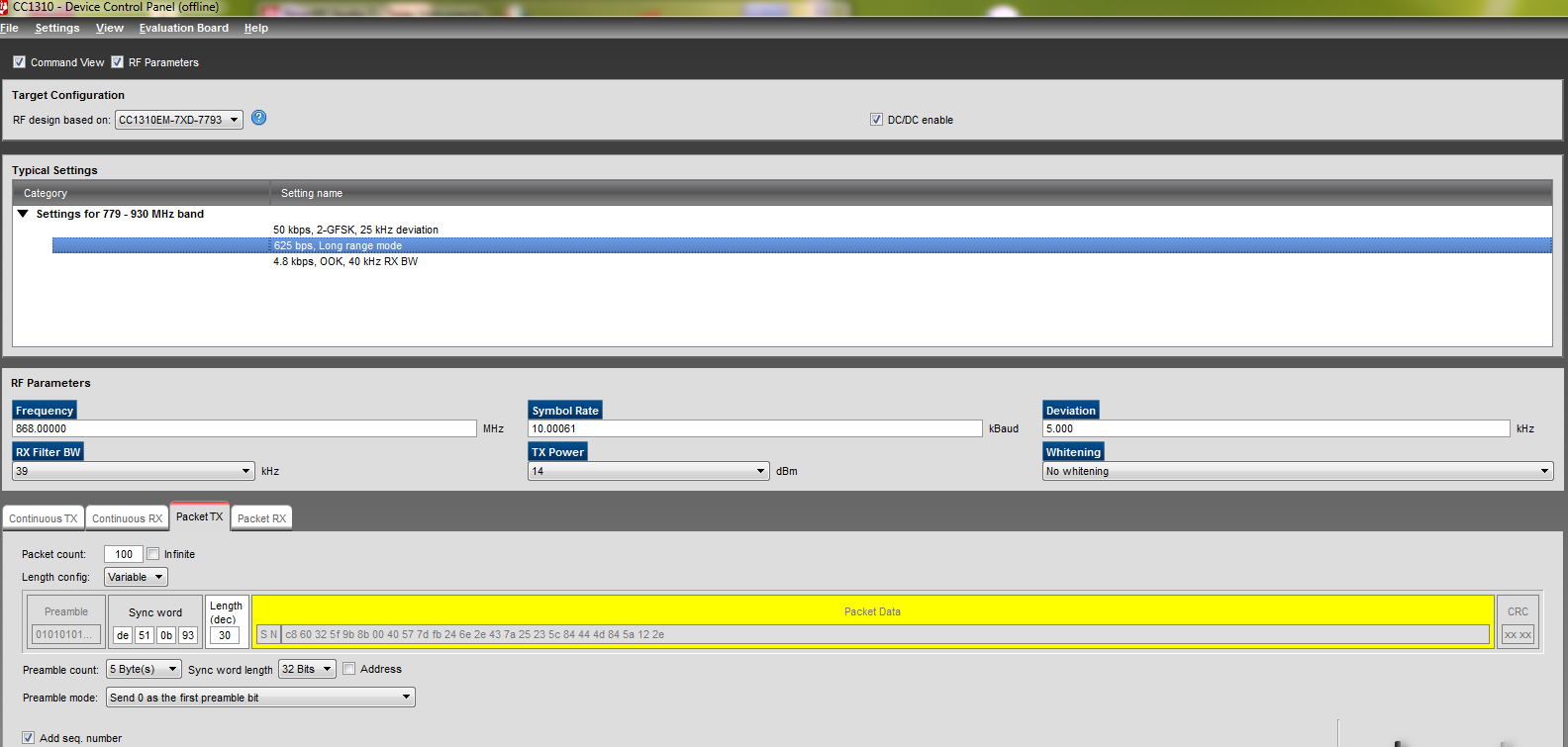
Pls. advice

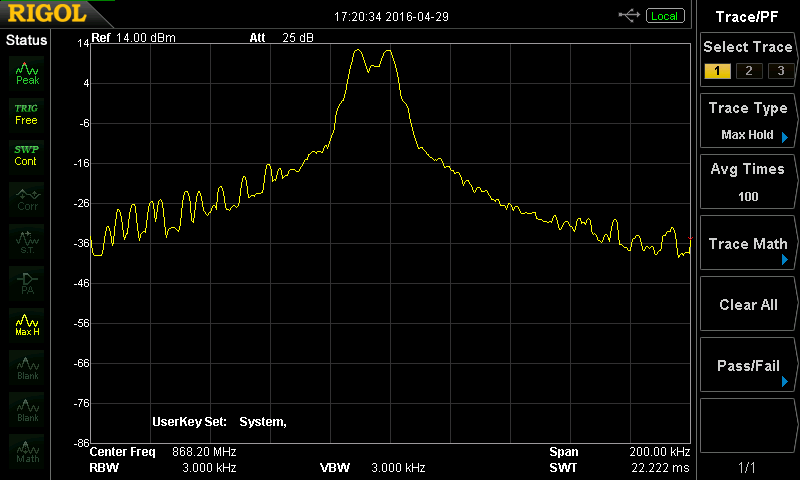
  • This should be correct, how did you expect the spectrum to look like?
  • This spectrum is not what DSSS should look like: it's normally a flat spectrum utilization over the wole occupied bandwidth.

    The spectrum above is typcial 2FSK.

    Furthermore sensivity represents ~-113dBm, not -122dBm as expected for DSSS.

  • DSSS does not automatically mean a flat spectrum. In this case every bit is spread by a know bit pattern causing a broader spectrum but not a flat spectrum.

    Not sure where you have the -113 from? According to the datasheet 625 bps gives -124 dBm sensitivity.
  • Hi GGA, Hi TER

    Interesting topic. I deal with the same issues in my CC1310 project...

    Interesting that you mention "In this case every bit is spread by a know bit pattern [...]".
    As I understood the Long Range Mode it is a narrow band transmission which would actually correspond to the small 39 kHz Ch. BW and 5kHz freq. deviation...

    According the data sheet the CC1310 has a IEEE 802.15.4g compliant (G)FSK radio. Actually the (G)FSK physical layer in IEEE 802.15.4g does not support DSSS at all. DSSS would be supported for O-QPSK modulation which is a phase modulation and not a frequency modulation...

    According to my understanding the CC1310 does not support DSSS!

    @TER: do you agree or disagree with my statement?

  • This whole DSSS thing is interesting as it's neither documented nor supported (outside the goodwill from guys like Torstein).

    So my enthusiasm is somehow limited - I was just curious how to bridge the time until TI comes with real narrowband AND low current successors of 112x.
    As I have some experience with Semtech-LoRa DSSS I expected/hoped TI did something similar, but looking at the spectrum obviously I'm wrong.

  • Lucky: CC1310 is a radio that supports different PHYs, including 802.15.4g. But it also supports DSSS.

    GGA: What is your practical experience with LoRa? The impression is that to get the really low sensitivity numbers the feed through is really low and due to the wide spectrum it's sensitive to interferers.
  • LoRa has up's and down's. I guess we have threads about it in this forum and guys from TI-Norway have dedicated white papers why LoRa is 'the evil' :-)
    In practice I used a one to one comparison with C1120 DK and LoRa DK. I walked around with a Laptop to figure out what reach I get (RF environment was clean). Low data rate, of course, LoRa at ~500bps and according air time, but the packets I used had ~10 bytes payload - enough for a typcial sensor.
    Outcome is that in this ideal world LoRa got significant better reach, so it's not pure marketing from Semtech. That's why I asked TI to come with something similar and let the customer choose case to case if we want to use DSSS or narrow band. But TI is not really interested yet.
  • You're right. In the CC1310 data sheet I found little information about DSSS in section  5.6 Receive(RX) Parameters for long-range mode ... DSSS = 8 ...

    In TRM there is no information about DSSS and only one sentence about "long-range mode" in section 23.7.5.2 Proprietary Mode Setup Command (p.1587): "The fecMode setting can be used to change the encoding of the transmitted or received signal. For long-range mode (fecMode = 8) [...]". However, fecMode is specified to be 0x0 or 0xA all others are reserved. Hence, fecMode = 8 seems to be a hidden feature...

    So I tried what fecMode is configured in SmartRF Studio:

    • normal mode (50 kbps, 2-GFSK, 25 kHz dev.) --> fecMode = 0x0
    • long-range mode (625 bps) --> fecMode = 0x8

    But I have no idea of what happens with the signal when enabling long-range mode. Is there any further information about long-range mode?

  • All,

    The LRM scheme in the CC1310 comprises of a convolutional encoder of rate ½ is followed by a direct sequence spreader (DSSS) with variable spreading length. The output of that module is finally fed to the 2-(G)FSK modulator. The modulation kernel (symbol rate, frequency deviation) can be user defined.

    So your measurements are correct, you should expect a normal FSK looking spectrum.

    Regards,
    /TA

  • got it.
    Put it in the data sheet to avoid further similar questions.
  • ok...then at higher data rates....say 500kbps with DSSS=8....can i expect a bandwidth around 4Mhz?
  • Thanks TA, that makes sense.

    Could you confirm exactly which radio settings in SmartRF Studio control the DSSS module?  e.g., if I wanted to use DSSS but with a higher data rate than the stock 625bps LRM, would it be sufficient to change only the symbolRate setting (e.g. to 40kbaud for 2.5kbps) and leave all the other LRM settings the same?

    Thank you.

  • If you want to double the datarate it is sufficient to double the symbol rate and the deviation. If you need even higher datarate you would also need to adjust the Rx Bw.
  • Got it, that makes sense. And regarding the radio command settings, which commands control the DSSS functionality? I see in SmartRF studio fecMode is 0x08 for LRM vs 0x00 for 50kbps 2-GFSK, are there any other parameters to be aware of?

    Thanks,
  • There are couple of extra overrides specific to LRM mode to choose the DSSS mode and MCE_RFE override. This setting can be copied from smartRF studio export as well .
  • TA, is the specification of the DSSS scheme available? Also, is the FEC scheme the same as the one in cc1101?

    Thanks, Sivan Toledo