This thread has been locked.

If you have a related question, please click the "Ask a related question" button in the top right corner. The newly created question will be automatically linked to this question.

Linux/WL1807MOD: DFS - radar signal not detected

Part Number: WL1807MOD

Tool/software: Linux

During the DFS testing with our device with the WL1807MOD we failed on  the radar signal 4 and 5. With the radar signal 4 was the probability ony 35% and with the radar signal 5 was the probabilty 0%. Is it in the module any debug mode to check what is happend?

We use driver and FW:

driver version: ol_r8.a9.22

PHY firmware version: Rev 8.2.0.0.240

firmware booted (Rev 8.9.0.0.76)

  • Hello,

    Did you make sure you have configured the regulatory domain correctly?
    There are some radars different between one domain to the other and we detect accordingly.

    Best Regards,
    Eyal
  • Hi Eyal,

    the WiFi was tested under EU condition.

    Host platform Sitara AM3352BZCZA100

    Module: TI WL1807MODGIMOC

  • Hi Eduard,

    Can you send us your device configuration (wlconf dump file of wl18xx-conf.bin)?
    In addition, can you provide the radar parameters used for the test?

    Best Regards,
    Eyal
  • Hi Eyal,

    wlconf dump and results from the testing are attached.  The results are the same for AU, EU country code.  it was tested on 11a mode 5260 MHz.

    Thanks

    BR

    Eduard

    wl1807_dfs.zip

  • Hi Eduard,

    As a debug step, can you limit the BW to 20MHz and see if it passes?

    Can you also please specify which spec exactly you referring to? It is not mentioned in your report

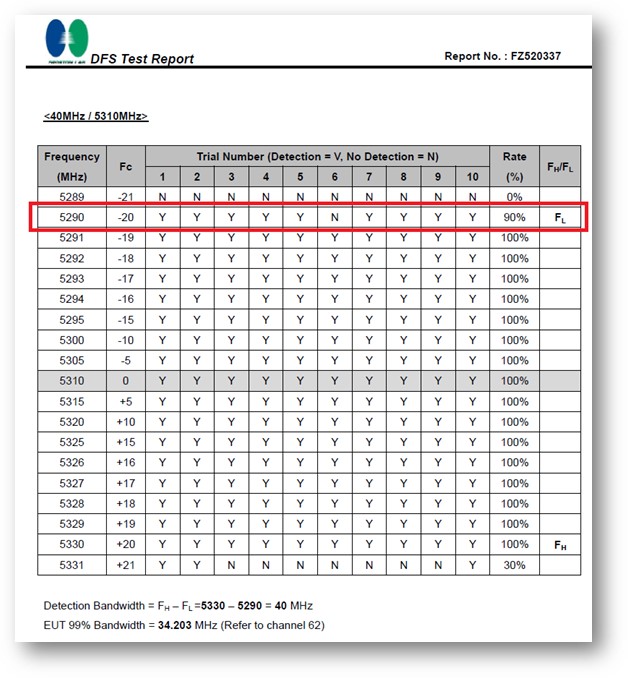
    Can you also share more detailed data and report similar to the one we share for the TI module with a similar table to the one below ?

    In addition, what is the radar frequency with respect to the DUT’s frequency?

    Best Regards,

    Eyal

  • Hi Eduard,

    Any update on this issue? Is it still open?

    BR,
    Eyal
  • Hi Eyal,
    it was tested with BW 20 MHz. It is still open and the additional details come soon.

    Thanks
    BR
    Eduard
  • 1/ Can you also please specify which spec exactly you referring to? It is not mentioned in your report.

    • For RCM DFS is followed AN-NZS 4268.

    2/ Can you also share more detailed data and report similar to the one we share for the TI module with a similar table to the one below ?

    3/ In addition, what is the radar frequency with respect to the DUT’s frequency?

    •  The center frequency of the receiver.
  • Hi Eyal,

    any news in the solving of our issue with DFS?

    Thanks

    Best regards

    Eduard

  • Hi Eyal, Rizwan,

    could you please have a look at Eduard's answer and help us moving forward?

    Thank you.

    Regards, Bartosz
  • Hi Eduard,

    My apologies, I was assuming that more data was going to be provided per the e2e thread dated on Jan 29 as it stats additional details to come.

    Did you pass with 20MHz BW?.

    Just so we are aligned, are you using the instructions as per the wiki below:

    processors.wiki.ti.com/.../AP_DFS_Master

    Thanks,
    Riz
  • No, we did not pass the 20 MHz BW in all radar pulse types as you can see in the table in the previous comment.

    BR

    Eduard

  • Hi Eduard,

    I consulted with our R&D team on this and we have a few follow questions / information that is needed:

    1) From the table you provided it shows the transmit frequency is at 5260MHz, but it is unclear as to the offset frequency of the tests. Is interferer signal being supplied at the same center frequency? What is the detection rate when it is offset as show in the table Eyal provided? What we expect to see is that you have 100% until around +/-20MHz from the TX frequency as there is an internal 40MHz BPF.
    2) What does your interferer signal look like. Can you provide this? do you have Matlab file perhaps were we can look at the signal closer?
    3) What is the power level of the interferer? Can you provide more details of the setup? IF you lower the power level, do you see an improvement in the passing percentage?
    4) We do not expect any issue as the latest FW has been verified to pass with no issues. Right now I think we need to consider the set up in more detail. Once we have a bit more of the information we can also see if it make sense to reproduce on our side.

    Thanks,
    Riz
  • Hi Eduard,

    I am closing this thread for now. If this is still an issue, feel free to reopen.

    Thanks,
    Riz
  • AFAIK, this has been handled directly.
    Closing this this thread.

    BR,
    Eyal
  •  Radar signal.zip1)     From the table you provided it shows the transmit frequency is at 5260MHz, but it is unclear as to the offset frequency of the tests. Is interferer signal being supplied at the same center frequency?

    ð Because the detection rate is very low, so we just pretested the 5260MHz.

    What is the detection rate when it is offset as show in the table Eyal provided? What we expect to see is that you have 100% until around +/-20MHz from the TX frequency as there is an internal 40MHz BPF.

    ð We just pretested the BW 20MHz now, if you wanna verify it under more conditions, it will be charged the testing fee.

    2)     What does your interferer signal look like. Can you provide this? do you have Matlab file perhaps where we can look at the signal closer?

    ð We don’t have the Matlab file but we’ve captured the signal PICs(Radar signal.zip) for your reference.

    3)     What is the power level of the interferer? Can you provide more details of the setup?

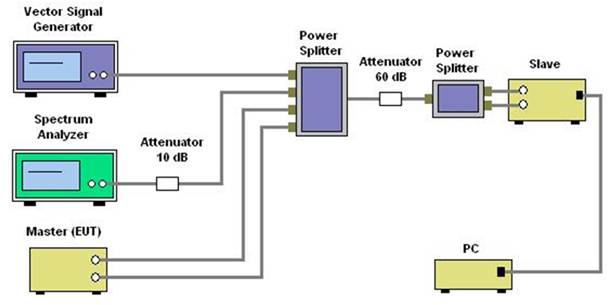
    ð The calculated signal level is -57dBm and test configuration

    4)     IF you lower the power level, do you see an improvement in the passing percentage?

    ð The result of the lower level is not better than before.  

  • Hi Eduard,

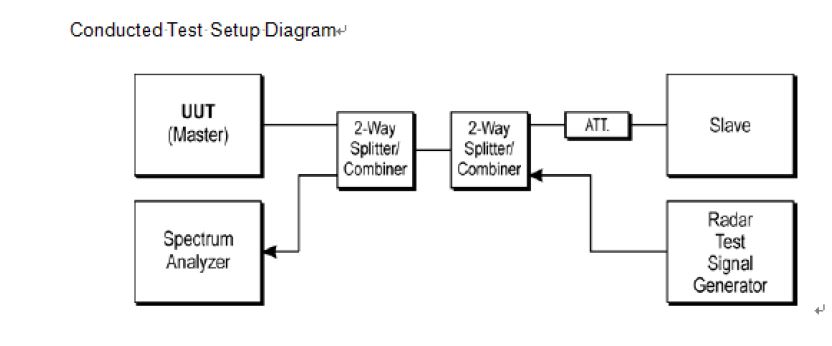
    I am not clear on your set up diagram. I assume that your VSG is creating the radar test signal? Then thru the 4-1 splitter/combiner, there will be an isolation between the ports. This will mean additional attenuation. Also I am not clear as to why there are 2 signals from the master and 2 signals from the slave going to the splitter/combiner.  The 5GHz signal should already be combined via a switch as part of the EUT (or am I missing something here. The correct setup should be as below:

    also the calibration procedure is as follows:

    and the test procedure should be as follows:

    Please help to validate this.

    Thanks,

    Riz