This thread has been locked.

If you have a related question, please click the "Ask a related question" button in the top right corner. The newly created question will be automatically linked to this question.

TPA3110D2 shutting down between tracks or silence

Other Parts Discussed in Thread: TPA3110D2

We have a TPA3110D2 amplifier board which is shutting down during the silence between the tracks or when there are any  in the music stream due to network congestion. This shut down problem also occurs when we hot plug the input jack. Sometimes without any reason within 4-5 seconds after power on. These issues do  not occur always but happening very frequently. Sometimes it plays fine without shutting down in all the above scenarios. The only way to bring it back is to disconnect and reconnect the power. As per the datasheet this seem to be DC offset problem but we have the input caps (1uf ceramic X7R) and also it plays absolutely fine sometimes. Any pointers on what to check for further?

Thanks

mahendra

  • Hi, Mahendra,

    If you cycle SD, does the error clear? If not, then it appears your assumption is correct that it is the DC detect (and that sounds like the problem, to me as well).

    If something happens to the source driving the part, it can trip the DC detect. 

    In order to prevent this from happening, you must assure that no signals are applied across the differential inputs that generate a large voltage for more than 420 ms. So, if you have a very slow charging going on, the detect circuitry will trip (even though it's not technically a DC signal).

    If you can, look at the inputs differentially with a scope, and you might see when the inputs see a large input voltage for > 420 ms. This should also result in a pop at the output if you have a speaker connected.

    -d2

  • Hi Don,

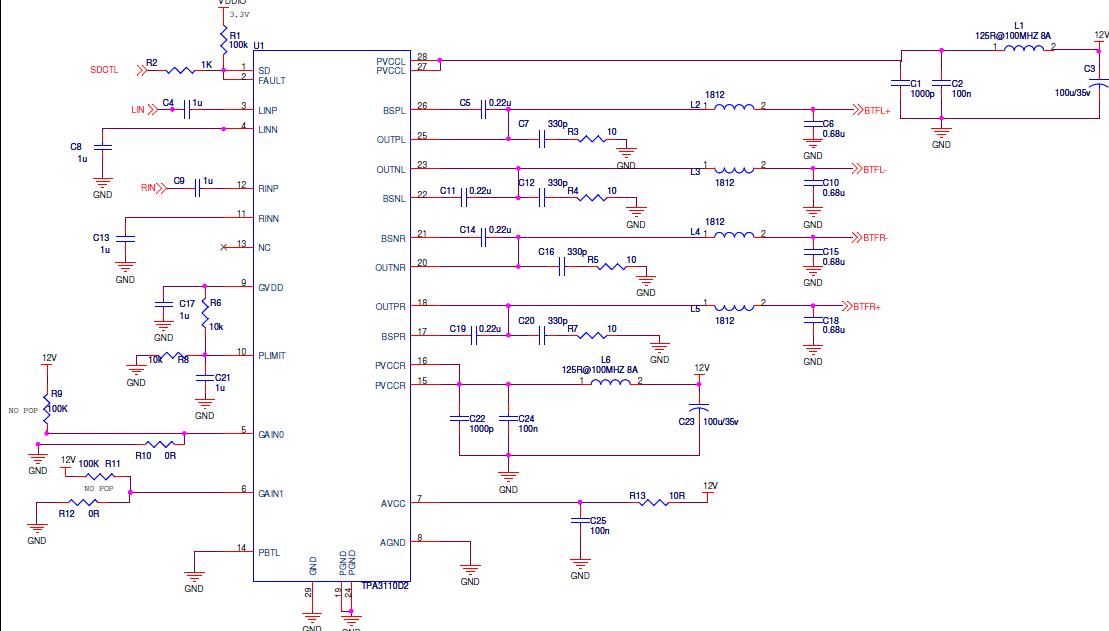
    Thanks. We are using single ended inputs. Cycling SD doesn't clear. Only disconnect-reconnect power will clear. Please take a look at the schematic. Gain is at minimum. So i/p impedance must be around 60K ohm. With i/p cap of 1uf 3db point is between 2-3Hz. Could that be a problem? 


    -mahendra

  • Mahendra,

    Most likely not. Remember, you are looking for differences between LINP and LINN, for example. IF they both have 1 uF, and both have 60k impedance, even though it may take them a while to chrage up, they will charge up together, so the differential voltage across them is zero the entire time.

    You need to look and see what LIN and RIN are doing...

    -d2

  • Hi,

    I tried to measure the DC level without the inputs connected but the IC is going into shut down if powered up without the inputs. I measured it anyway in the shutdown mode and It was 4.4 mv at RINP and RINN and 4.1mv at LINP and LINN. Are these in the expected range? 

    Mahendra

  • Mahendra,

    In SD, the inputs are not biased, so this is to be expected.

    During normal operation, the dc bias on these is 3V which is internally regulated.

    -d2

  • Hello Don,

    Thanks. We noticed some audible noise on the right channel and started isolating the problem. It found out to be damaged TPA3110D2. We replaced it and everything is working as expected. No more DC faults. 

    In our application amp is always powered by the battery with SD control when not in use. Since power cycling is required to clear DC faults we need to have a power MOSFET or similar thing as switch for power cycling in case of DC faults. This adds to cost and board space. Any alternate solution to clear DC faults?

    If we have input caps to block DC, do we still need to expect DC faults in production? If the caps are faulty we anyway need to change them and mere power cycling will not help. Is it worth additional cost and board space?

    Mahendra

  • Hi, Mehendra,

    Sorry for the delay.

    No, there is no way to clear a dc detect fault other than cycling the power.

    You need to understand WHY you are tripping the dc detect and fix that problem, rather than adding additional circuitry to deal with it once it's been tripped.

    What is the latest on your end?

    -d2