Tool/software:


This thread has been locked.
If you have a related question, please click the "Ask a related question" button in the top right corner. The newly created question will be automatically linked to this question.
Tool/software:


Hey,
Thank you for reaching out to TI with your questions regarding the UCC27537.
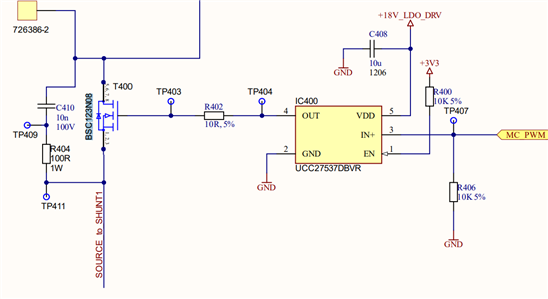
With regards to the schematic, I have a couple of suggestions.
1. We recommend placing an RC filter on the input pins placed closed to the gate driver. Typical ranges for the components are 0-100 Ohms and 10-100pF. This will help with the noise that is seen from the MCU on the input.
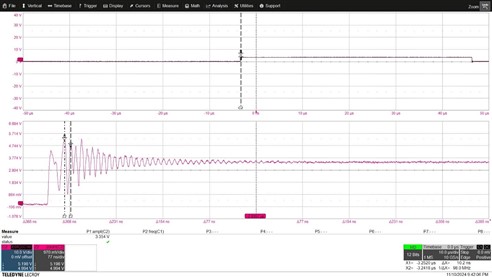
2. For the ripple seen on the output, this is largely a result of the noise on the input as the driver is receiving mixed signals due to that input noise.
3. Please ensure that C408 is placed as close to the driver as possible. You could also add a 100nF in parallel to C408 beside the driver for transient response.
4. Adjusting the gate resistance R402 will also affect the rising and falling edges of the output by limiting output current.
5. For EN enable, this could also be connected to the 18V supply rail as well.
6. Layout is also important for noise. The gate drive path to the MOSFET should be as short as possible and have a wide trace. The high current paths such as VDD and GND should also have wide traces.
Let me know if there are any further questions.
Thank you,
William Moore
Hey,
Are there any updates for resolving this issue or in response to my above questions?
Thank you,
William Moore
Hello,
I hope you are doing great.
Thank you for follow, you are very kind.
Actually, we found out that the rise time of the MIC5020YM is about 1us and the rise time for UCC27537DBVR is about 100ns.
So the MIC5020 is gradually slower and this made a better EMC.
The Mosfet in this circuit is BSC123N08.
I changed the Rgate from 10Ω to 511Ω. With the Near field probe the Radiation decreased much more, P dissipation of the mosfet = 1.4W and the PCB worked for more than 3 hours while the Mosfet is not hot at all. Today the PCB will be tested by the GTEM cell and I will do my tests in my office to have graph of the temperature with Picolog tool to proof that the Mosfet is not gonna burn.
Do you have any other recomendation?
Bests,
Hey,
Thank you for the update and it is good to hear that they have found a solution with increasing gate resistance.
An added note to a previous comment of mine, if EN is connected directly to VDD when VDD > 15V, a series 150 Ohm resistor should be added.

Another option that they have to limit the rise/fall time is to add a gate to source capacitance (Cgs) and then they could reduce Rgate some. So reducing the rise time to match the lower current driver can be a combination of Cgs and Rgate.
Let me know if there are any further questions.
Thank you,
William Moore
Hello again William,
Thanks for all support.
Actually, there is no they, I could solve it with your recommendations . Also with the new resistor, the P dissipation is only 1.4W and Mosfet temp is 33℃.
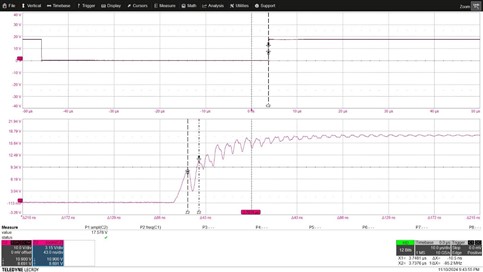
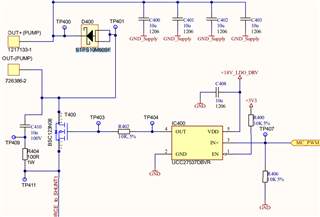
I now plan to make some modifications to the PCB to achieve better EMC results. I observed peaks at 71MHz and, upon further inspection with a near-field probe, detected radiation on the protection diode D400 (STPS10M60SF). Additionally, voltage measurements with an oscilloscope showed oscillations during the rise time.
The schematics below, shows the D400 where I have some radiation at 71MHz.
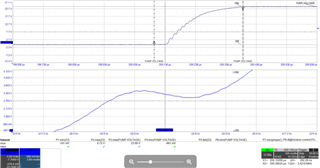
The screenshot below shows the rise time on the D400, exactly on the Motor and It shows a little bit oscillation.
Do you recommend me now to add Snubber for diode? or changing the diode type? Since I think increasing the gate resistor is not meaningful anymore :)
Best regards,
Hani
Hey Hani,
It is good to hear that you were able to correct this with my recommendations.
As for making recommendations regarding the diode selection for the powertrain, I do not have any advice there. I do agree that changing gate resistance is not going to provide much impact to the situation you are seeing. Potentially the snubber or a diode change could help the case you are seeing, but that is beyond the operation of the diode and beyond my area of expertise.
Thank you,
William Moore
Hey Hani,
You're welcome! I hope you have a good day as well. If anything further comes up, please feel free to reach out.
Thank you,
William Moore