This thread has been locked.

If you have a related question, please click the "Ask a related question" button in the top right corner. The newly created question will be automatically linked to this question.

TCA9802: Any negative impact on B side when A side pins are left floating

Part Number: TCA9802
Other Parts Discussed in Thread: TCA9511A

Tool/software:
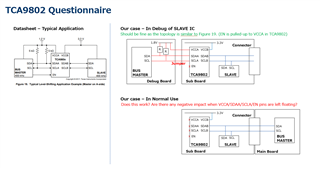


Please fined the attached figure.
I want to place TCA9802 on Sub Board with a slave IC mounted on B side.

In debug phase of the slave IC... Debug board will be connected on A side with jumpers.
This should be fine as the topology is similar to an example on the datasheet except EN is left floating (I expect EN is still pulled-up to VCCA in TCA9802) 

In normal use of the slave IC... Main board will be connected on B side whereas the debug board is disconnected.
My question is, does this concept work? Are there any negative impact when VCCA/SDAA/SCLA/EN pins are ally left floating?

  • When VCCA is < 0.3 V, then the buffer/level translator is disabled, but the current sources on the B pins continue to work (see section 9.3.5 of the datasheet).

    In theory, when VCCA is disconnected, it should be zero (because charging the decoupling capacitor(s) would require some energy). But if it is possible that the debug board gets disconnected without a following power-up reset, or if you are paranoid, add a weak pull-down resistor to VCCA to ensure that it is zero.

  • Hello Clemens

    Just to make sure, when VCCA gets connected to 1.8V, could I expect EN logic becomes "H" thanks to internal pull-up even if EN pin itself is left floating? 

  • When the EN pin is open, it does not float because of the pull-up resistor.

  • Hi Mitsuhiro,

    Yes, VCCA connecting to 1.8V means that EN pulls up internally to 1.8V. Technically no external pull-up is required on the EN pin. I do suggest to have an external 10k on EN since the internal pull-up is weak. 

    This scenario could work with VCCA floating as long as when VCCA floats it is somewhere close to 0V. Like Clemens was suggesting, having some weak pull-down resistance on VCCA could be an option here. 

    The worry is that if VCCA floats above 0.3V (UVLO(min)), the TCA9802 device might turn ON and the A-side could propagate a LOW to B-side if not careful. 

    Have you considered using a hot-swap buffer like TCA9511A? 

    Regards,

    Tyler

  • Hello Clemens, Tyler

    Thanks for your answers. To tell the truth we had already started production of the boards...
    We cannot put any extra components anymore like the pull-down resistances or the hot-swap buffer, however, even in the worst case still it should be possible to make VCCA and GND short by using a jumper or disconnect TCA9802 by removing 0-ohm resistances on SCL/SDA lines. I hope I would survive (^^

    I will improve our board next time by considering your fruitful comments!