Part Number: AM3359
Hey
At the moment I am trying to create a project for a stream socket communication. Therefor I used the NimuBasicExample (from PDK 1.0.6) as template.
I added some code for the socket comm. referring to the NDK Users/Reference Guide.
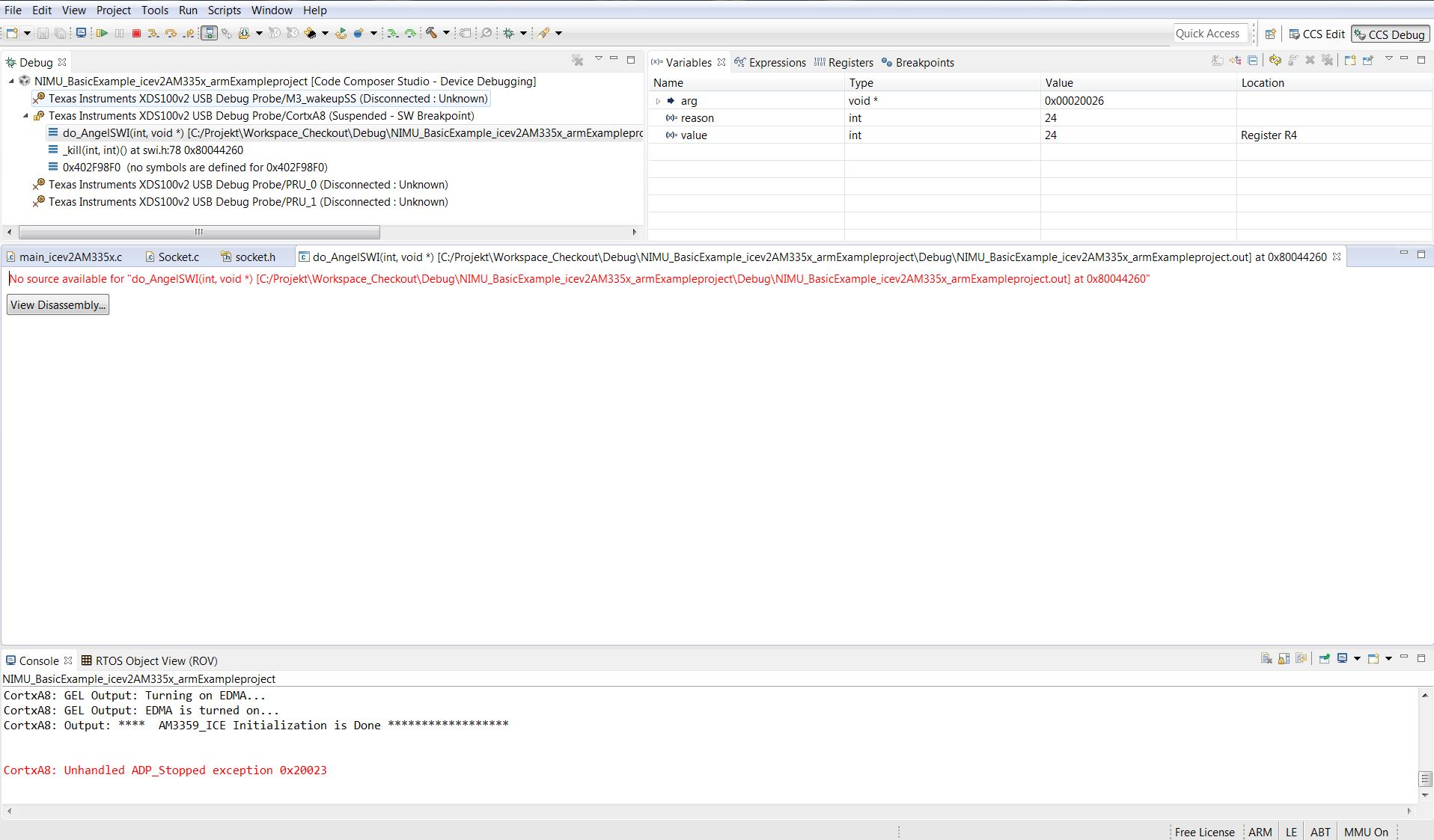
I can build the program without an error, but when I run it then an error/exception occurs.
Error: No source available for "do_AngelSWI(int, void *) [C:/Projekt\Workspace_Checkout\Debug\NIMU_BasicExample_icev2AM335x_armExampleproject\Debug\NIMU_BasicExample_icev2AM335x_armExampleproject.out] at 0x80044260"
I have debugged the program and the error occurs in the Socket.c (selfmade) File when the program tries to connect the socket (line 81).
I assume that the network interface is not ready, at this time is this correct?
If this is right, I have to wait until the network interface is ready. Can you suggest where to create the task and call the socket function so that the network interface is ready?
I will attach the main.c and the socket.c file.
CCS 6.2 / GNU v4.9.3 / EDMA3 2.12.3 / IPC 3.40.1.08 / NDK 2.25.1.11 / SYS/BIOS 6.46.4.53 / UIA 2.0.6.52 / PDK 1.0.6 / XDC 3.32.1.22
AM3359 on ICEV2
/*
 * Copyright (C) 2015 Texas Instruments Incorporated - http://www.ti.com/
 *
 *
 *  Redistribution and use in source and binary forms, with or without
 *  modification, are permitted provided that the following conditions
 *  are met:
 *
 *    Redistributions of source code must retain the above copyright
 *    notice, this list of conditions and the following disclaimer.
 *
 *    Redistributions in binary form must reproduce the above copyright
 *    notice, this list of conditions and the following disclaimer in the
 *    documentation and/or other materials provided with the
 *    distribution.
 *
 *    Neither the name of Texas Instruments Incorporated nor the names of
 *    its contributors may be used to endorse or promote products derived
 *    from this software without specific prior written permission.
 *
 *  THIS SOFTWARE IS PROVIDED BY THE COPYRIGHT HOLDERS AND CONTRIBUTORS
 *  "AS IS" AND ANY EXPRESS OR IMPLIED WARRANTIES, INCLUDING, BUT NOT
 *  LIMITED TO, THE IMPLIED WARRANTIES OF MERCHANTABILITY AND FITNESS FOR
 *  A PARTICULAR PURPOSE ARE DISCLAIMED. IN NO EVENT SHALL THE COPYRIGHT
 *  OWNER OR CONTRIBUTORS BE LIABLE FOR ANY DIRECT, INDIRECT, INCIDENTAL,
 *  SPECIAL, EXEMPLARY, OR CONSEQUENTIAL DAMAGES (INCLUDING, BUT NOT
 *  LIMITED TO, PROCUREMENT OF SUBSTITUTE GOODS OR SERVICES; LOSS OF USE,
 *  DATA, OR PROFITS; OR BUSINESS INTERRUPTION) HOWEVER CAUSED AND ON ANY
 *  THEORY OF LIABILITY, WHETHER IN CONTRACT, STRICT LIABILITY, OR TORT
 *  (INCLUDING NEGLIGENCE OR OTHERWISE) ARISING IN ANY WAY OUT OF THE USE
 *  OF THIS SOFTWARE, EVEN IF ADVISED OF THE POSSIBILITY OF SUCH DAMAGE.
 *
*/

/* ========================================================================== */
/*                             Include Files                                  */
/* ========================================================================== */

#include <stdio.h>
#include <string.h>
#include <stdlib.h>
#include <xdc/std.h>
#include <xdc/runtime/Error.h>
#include <xdc/runtime/System.h>
#include <ti/sysbios/BIOS.h>
#include <ti/sysbios/knl/Task.h>
#include <ti/sysbios/family/arm/a8/Mmu.h>
#include <ti/sysbios/knl/swi.h>

#include <ti/ndk/inc/stkmain.h>

#include <ti/drv/emac/emac_drv.h>
#include <ti/drv/emac/src/v4/emac_drv_v4.h>

#include <ti/starterware/include/types.h>
#include <ti/starterware/include/hw/hw_types.h>
#include <ti/starterware/include/hw/hw_control_am335x.h>
#include <ti/starterware/include/hw/soc_am335x.h>
#include <ti/starterware/include/ethernet.h>
#include <ti/starterware/include/soc_control.h>

#include <ti/board/board.h>

/* TI-RTOS Header files */
#include <ti/drv/i2c/I2C.h>
#include <ti/drv/i2c/soc/I2C_v1.h>

/* UART Header files */
#include <ti/drv/uart/UART.h>
#include <ti/drv/uart/UART_stdio.h>

#include <ti/drv/gpio/GPIO.h>
#include <ti/drv/gpio/soc/GPIO_v1.h>

/* Header Files added for Display control */
#include "osdrv_uart.h"
#include "osdrv_version.h"
#include "osdrv_oledlcd.h"
#include "osdrv_mmu.h"
#include "plat_led.h"
#include "plat_utils.h"
#include "plat_mux.h"

/* Header Files for socket comm. */
#include <ti/ndk/inc/nettools/inc/inet.h>
// #include <ti/ndk/inc/bsd/sys/socket.h> in conflict with usertype.h
#include <Socket.h>


unsigned char uartInstance = 0;
unsigned char boardType = 0;
extern char *LocalIPAddr;

/* ========================================================================== */
/*                             MUX_CONFIG [PIM 20170516]                       */
/* ========================================================================== */
MUX_CONFIG icev2Mux[] = {
    { 0x0920 , 7 , AM335X_PIN_OUTPUT },	//	mii1_txd2 -> LED_1
    { 0x091C , 7 , AM335X_PIN_OUTPUT },	//	mii1_txd3 -> LED_2
    { 0x092C , 7 , AM335X_PIN_OUTPUT }, //  MII1_TXCLK -> LED_3
    { 0x0880 , 7 , AM335X_PIN_OUTPUT },	//	GPMC_CSN(1) -> LED_4
    { 0x09B0 , 7 , AM335X_PIN_OUTPUT }, //  XDMA_EVENT_INTR(0) -> LED_5
    { 0x09B4 , 7 , AM335X_PIN_OUTPUT }, //  XDMA_EVENT_INTR(1) -> LED_6

    { 0x0988 , 0 , AM335X_PIN_INPUT_PULLUP }, 	//	I2C0_SCL
    { 0x098c , 0 , AM335X_PIN_INPUT_PULLUP },	//	I2C0_SDA
    {0xFFFFFFFF,0,0}
};
SYS_MMU_ENTRY applMmuEntries[] = {

    {(void*)0x48300000,0},  //PWM - Non bufferable| Non Cacheable
    {(void*)0x48200000,0},  //INTCPS,MPUSS - Non bufferable| Non Cacheable
    {(void*)0x48100000,0},  //I2C2,McSPI1,UART3,UART4,UART5, GPIO2,GPIO3,MMC1 - Non bufferable| Non Cacheable
    {(void*)0x48000000,0},  //UART1,UART2,I2C1,McSPI0,McASP0 CFG,McASP1 CFG,DMTIMER,GPIO1 -Non bufferable| Non Cacheable
    {(void*)0x44E00000,0},  //Clock Module, PRM, GPIO0, UART0, I2C0, - Non bufferable| Non Cacheable
    {(void*)0x4A300000,0},  //PRUSS1 - Non bufferable| Non Cacheable
    {(void*)0x49000000,0},  //EDMA3 - Non bufferable| Non Cacheable
    {(void*)0x4A100000,0},  //CPSW - Non bufferable| Non Cacheable
    {(void*)0xFFFFFFFF,0xFFFFFFFF}
};

/* Enable the below macro to have prints on the IO Console */
//#define IO_CONSOLE

#ifndef IO_CONSOLE
#define NIMU_log                UART_printf
#else
#define NIMU_log                printf
#endif

/* ========================================================================== */
/*                             Macros                                  */
/* ========================================================================== */

/**Phy address of the CPSW port 1*/
#define EMAC_CPSW_PORT0_PHY_ADDR_ICE2    1
/**Phy address of the CPSW port 1*/
#define EMAC_CPSW_PORT1_PHY_ADDR_ICE2    3


#define MAX_TABLE_ENTRIES   3

/* ========================================================================== */
/*                            Global Variables                                */
/* ========================================================================== */

/* GPIO pin value definitions */
#define GPIO_PIN_VAL_LOW     (0U)
#define GPIO_PIN_VAL_HIGH    (1U)

/* Port and pin number mask for GPIO Load pin.
   Bits 7-0: Pin number  and Bits 15-8: (Port number + 1) */
#define GPIO_PR1_MII_CTRL_PIN_NUM       (0x04)
#define GPIO_MUX_MII_CTRL_PIN_NUM       (0x0A)
#define GPIO_FET_SWITCH_CTRL_PIN_NUM    (0x07)
#define GPIO_DDR_VTT_EN_PIN_NUM         (0x12)
#define GPIO_PHY_0_1_RST_PIN_NUM        (0x05)
#define GPIO_PR1_MII_CTRL_PORT_NUM      (0x03)
#define GPIO_MUX_MII_CTRL_PORT_NUM      (0x03)
#define GPIO_FET_SWITCH_CTRL_PORT_NUM   (0x00)
#define GPIO_DDR_VTT_EN_PORT_NUM        (0x00)
#define GPIO_PHY_0_1_RST_PORT_NUM       (0x02)

/* ON Board LED pins which are connected to GPIO pins. */
typedef enum GPIO_PIN {
    GPIO_PIN_PR1_MII_CTRL      = 0U,
    GPIO_PIN_MUX_MII_CTRL      = 1U,
    GPIO_PIN_FET_SWITCH_CTRL   = 2U,
    GPIO_PIN_DDR_VTT_EN        = 3U,
    GPIO_PIN_PHY_0_1_RST       = 4U,
    GPIO_PIN_COUNT
}GPIO_PIN;

/* GPIO Driver board specific pin configuration structure */
GPIO_PinConfig gpioPinConfigs[] = {
    /* Output pin : AM335X_ICE V2_LD_PIN */
    GPIO_DEVICE_CONFIG((GPIO_PR1_MII_CTRL_PORT_NUM + 1), GPIO_PR1_MII_CTRL_PIN_NUM)      | GPIO_CFG_OUTPUT,
    GPIO_DEVICE_CONFIG((GPIO_MUX_MII_CTRL_PORT_NUM + 1), GPIO_MUX_MII_CTRL_PIN_NUM)      | GPIO_CFG_OUTPUT,
    GPIO_DEVICE_CONFIG((GPIO_FET_SWITCH_CTRL_PORT_NUM + 1), GPIO_FET_SWITCH_CTRL_PIN_NUM)| GPIO_CFG_OUTPUT,
    GPIO_DEVICE_CONFIG((GPIO_DDR_VTT_EN_PORT_NUM + 1), GPIO_DDR_VTT_EN_PIN_NUM)          | GPIO_CFG_OUTPUT,
    GPIO_DEVICE_CONFIG((GPIO_PHY_0_1_RST_PORT_NUM + 1), GPIO_PHY_0_1_RST_PIN_NUM)        | GPIO_CFG_OUTPUT,
};

/* GPIO Driver call back functions */
GPIO_CallbackFxn gpioCallbackFunctions[] = {
    NULL,
    NULL,
    NULL,
    NULL,
    NULL
};

/* GPIO Driver configuration structure */
GPIO_v1_Config GPIO_v1_config = {
    gpioPinConfigs,
    gpioCallbackFunctions,
    sizeof(gpioPinConfigs) / sizeof(GPIO_PinConfig),
    sizeof(gpioCallbackFunctions) / sizeof(GPIO_CallbackFxn),
    0,
};

/**Task handle for EIP*/
Task_Handle main_task;

static int nimu_device_index = 0U;

//MAC_CONFIG mac_configuration;

NIMU_DEVICE_TABLE_ENTRY NIMUDeviceTable[MAX_TABLE_ENTRIES];

/** \brief Macro indicating the i2c time out value. */
#define I2C_TIMEOUT_VAL           (100U)

/* ========================================================================== */
/*                            Constructors	                                  */
/* ========================================================================== */
/* Delay function */
void delay(unsigned int delayValue);
/* TaskFxn function */
void TaskFxn(UArg a0, UArg a1);
/* TaskSocket function */
void TaskSocket (UArg a0, UArg a1);

uint32_t ClockSynthesizerSetup(void);
extern int CpswEmacInit (STKEVENT_Handle hEvent);
extern const I2C_Config I2C_config[];
extern void SOCCtrlGetPortMacAddr(uint32_t portNum, uint8_t *pMacAddr);

extern void PhySetupAndReset(void);


/**
 *  \name main
 *  \brief Main Function
 *  \param none
 *  \return none
 *
 */
int main()
{
	// variables
	int32_t ret;


	// MMU Init
    MMUInit(applMmuEntries);

    // Check board type and set uart instance
    boardType = UTILsGetBoardType();
    if(AM335X_BOARD_TYPE_ICE  == boardType)
        {
        	uartInstance = 5;
        }else if(AM335X_BOARD_TYPE_IDK  == boardType)
        {
        	uartInstance = 3;
        }else if(AM335X_BOARD_TYPE_ICE_V2 == boardType)
        {
    		uartInstance = 3;
    		PinMuxConfig(icev2Mux);
        }
    // open UART interface --> after opening Uart the programm stops with an exception
    //UartOpen(uartInstance,NULL);

    /* Call board init functions */
    Board_initCfg boardCfg;
    Task_Params taskParams;
    EMAC_HwAttrs_V4 cfg;
    nimu_device_index = 0U;

    boardCfg = BOARD_INIT_PINMUX_CONFIG |
        BOARD_INIT_MODULE_CLOCK | BOARD_INIT_UART_STDIO;
    ret = Board_init(boardCfg);
    if (ret != BOARD_SOK)
    {
        UART_printf("main: Board_init returned error code: %d\n", ret);
        return -2;
    }

	ClockSynthesizerSetup();

    /* Init GPIO driver */
    GPIO_init();

	/* Chip configuration MII/RMII selection */
    PhySetupAndReset();

    SOCCtrlCpswPortMacModeSelect(1, ETHERNET_MAC_TYPE_RMII);
    SOCCtrlCpswPortMacModeSelect(2, ETHERNET_MAC_TYPE_RMII);

    EMAC_socGetInitCfg(0, &cfg);
    cfg.port[0].phy_addr = EMAC_CPSW_PORT0_PHY_ADDR_ICE2;
    cfg.port[1].phy_addr = EMAC_CPSW_PORT1_PHY_ADDR_ICE2;
    cfg.macModeFlags = EMAC_CPSW_CONFIG_MODEFLG_FULLDUPLEX| EMAC_CPSW_CONFIG_MODEFLG_IFCTLA;
    EMAC_socSetInitCfg(0, &cfg);

    Task_Params_init(&taskParams);
    taskParams.priority = 1;
    taskParams.stackSize = 0x1400;
    main_task = Task_create (TaskFxn, &taskParams, NULL);

    NIMUDeviceTable[nimu_device_index++].init =  &CpswEmacInit ;
    NIMUDeviceTable[nimu_device_index].init =  NULL ;


    // create task for socket
    Task_Handle hMyTask;
    Error_Block eb;
    Error_init(&eb);

    //
    // Create a Task with priority 5;
    // Task priority must be within the configured range of NDK priorities
    // and lower priority than kernel priority NDK tasks
    //

    Task_Params_init(&taskParams);
    taskParams.stackSize = 4096;
    taskParams.priority = 5;
    hMyTask = Task_create (TaskSocket , &taskParams, &eb);
    //hMyTask = Task_create((Task_FuncPtr)entrypoint, &taskParams, &eb);
    if (hMyTask == NULL) {
    	System_abort("Task create failed");
    }


    BIOS_start();

    return -1;
}

/**
 *  \name TaskFxn
 *  \brief Task which do EIP initialization
 *  \show information on display [PIM 20170516]
 *  \param a0
 *  \param a1
 *  \return none
 *
 */
void TaskFxn(UArg a0, UArg a1)
{
	NIMU_log("\n\rSYS/BIOS Ethernet/IP (CPSW) Sample application, EVM IP address: %s\n\r", LocalIPAddr);

	// LED example
	unsigned int RunLed = 0;
    unsigned char led_val = 0xff;
    char t_str[8];

    System_printf("enter taskFxn()\n");
    UARTPutString(uartInstance,"\nTI Industrial SDK Version - ");
    UARTPutString(uartInstance,IND_SDK_VERSION);

    UARTPutString(uartInstance,"\n\rDevice name \t: ");
    UARTPutString(uartInstance,UTILsGetDevName());

    UARTPutString(uartInstance,"\n\rChip Revision \t: ");
    UARTPutString(uartInstance,UTILsGetChipRevision());

    sprintf(t_str,"%d",UTILsGetArmClockRate());
    UARTPutString(uartInstance,"\n\rARM Clock rate \t: ");
    UARTPutString(uartInstance,t_str);

    System_printf("write to Display \n");
    UARTPutString(uartInstance,"\n\rSYS/BIOS LED Sample application running on ");
    if(AM335X_BOARD_TYPE_ICE  == boardType)
    {
    	UARTPutString(uartInstance,"ICE \n\r");
    }else if(AM335X_BOARD_TYPE_IDK  == boardType)
    {
    	UARTPutString(uartInstance,"IDK \n\r");
    }
	else if(AM335X_BOARD_TYPE_ICE_V2 == boardType)
	{
		char *lcd_str1 = IND_SDK_VERSION;
		char lcd_str2[]={"i2c led App"};

		UARTPutString(uartInstance,"ICE V2\n\r");

		OLEDInit();
		OLEDShowString(1,(unsigned char *)lcd_str1,0,0);
		OLEDShowString(1,(unsigned char *)lcd_str2,1,0);
		OLEDDeactivateScroll();
		OLEDContinuousScroll(0x01,0x01,Max_Column,0x00,0x00,0x01,0x06,0x01);
    }

	LEDInit();

    LEDDIGOUTSetVal(led_val);
    Task_sleep(2000);
    led_val = 0;
    LEDDIGOUTSetVal(led_val);
    Task_sleep(1000);

	if(AM335X_BOARD_TYPE_ICE_V2 == boardType)
	{
		LEDGPIOSetVal(0,16 ,0);
		LEDGPIOSetVal(0,17 ,0);
		LEDGPIOSetVal(0,19 ,0);
		LEDGPIOSetVal(0,20 ,0);
		LEDGPIOSetVal(1,30 ,0);
		LEDGPIOSetVal(3,9 ,0);
	}
	else
	{
		LEDGPIOSetVal(0,0 ,0);
		LEDGPIOSetVal(0,1 ,0);
		LEDGPIOSetVal(0,12 ,0);
		LEDGPIOSetVal(0,13 ,0);
		LEDGPIOSetVal(0,16 ,0);
		LEDGPIOSetVal(0,17 ,0);

		LEDGPIOSetVal(0, 0,1);
		LEDGPIOSetVal(0, 1,1);
		LEDGPIOSetVal(0, 12,1);
		LEDGPIOSetVal(0, 13,1);
		LEDGPIOSetVal(0, 16,1);
		LEDGPIOSetVal(0, 17,1);
	}
    while(1)
    {
    	LEDDIGOUTOff(led_val);
    	led_val = (led_val+1)%9;
    	LEDDIGOUTOn(led_val);
    	Task_sleep(300);

  	    if (RunLed > 0)
  	    {
			if(AM335X_BOARD_TYPE_ICE_V2 != boardType)
			{
				LEDDriveACT0(1);
				LEDDriveACT1(0);
			}
			LEDDriveRun(1);
			LEDDriveError(0);
  	    }
  	    else
  	    {
			if(AM335X_BOARD_TYPE_ICE_V2 != boardType)
			{
				LEDDriveACT1(1);
				LEDDriveACT0(0);
			}
			LEDDriveError(1);
			LEDDriveRun(0);
  	    }
 	    RunLed ^= 1;
    }
}

/*
 *  ======== Delay function ========
 */
void delay(unsigned int delayValue)
{
    volatile uint32_t delay1 = delayValue*10000;
    while (delay1--) ;
}

/* I2C Instance Controlling Clock Synthesizer */
#define CLOCK_SYNTHESIZER_I2C_INST_NUM  0

/* Clock Synthesizer Device Address */
#define CLOCK_SYNTHESIZER_I2C_ADDR      0x65

#define CLOCK_SYNTHESIZER_ID_REG        0

/* Crystal load capacitor selection */
#define CLOCK_SYNTHESIZER_XCSEL         0x05

/* PLL1 Configuration Register */
#define CLOCK_SYNTHESIZER_MUX_REG       0x14

/* PDIV2 */
#define CLOCK_SYNTHESIZER_PDIV2_REG     0x16

/* PDIV3 */
#define CLOCK_SYNTHESIZER_PDIV3_REG     0x17

#define TX_LENGTH              (2U)
#define RX_LENGTH              (10U)

uint32_t ClockSynthesizerSetup(void)
{
    uint32_t status = TRUE;
	uint32_t regValue = 0U;
    I2C_Params i2cParams;
    I2C_Handle handle = NULL;
    I2C_Transaction i2cTransaction;
    char txBuf[TX_LENGTH] = {0x00, 0x01};
    char rxBuf[RX_LENGTH] = {0x00, 0x00, 0x00, 0x00, 0x00, 0x00, 0x00, 0x00,
                             0x00, 0x00};

    I2C_init();

    I2C_Params_init(&i2cParams);

    ((I2C_HwAttrs *) I2C_config[CLOCK_SYNTHESIZER_I2C_INST_NUM].hwAttrs)->enableIntr = false;
    handle = I2C_open(CLOCK_SYNTHESIZER_I2C_INST_NUM, &i2cParams);

/* Read - CLOCK_SYNTHESIZER_ID_REG */

    if (FALSE != status)
	{
	    txBuf[0] = CLOCK_SYNTHESIZER_ID_REG | 0x80U;
	    i2cTransaction.slaveAddress = CLOCK_SYNTHESIZER_I2C_ADDR;
	    i2cTransaction.writeBuf = (uint8_t *)&txBuf[0];
	    i2cTransaction.writeCount = 1U;
	    i2cTransaction.readBuf = (uint8_t *)&rxBuf[0];
	    i2cTransaction.readCount = 0U;
	    status = I2C_transfer(handle, &i2cTransaction);

	    if(FALSE == status)
	    {
	        NIMU_log("\n CLOCK_SYNTHESIZER_ID_REG: Data Write failed. \n");
	    }
	}

    delay(I2C_TIMEOUT_VAL);

    if (FALSE != status)
	{
	    i2cTransaction.slaveAddress = CLOCK_SYNTHESIZER_I2C_ADDR;
	    i2cTransaction.writeBuf = (uint8_t *)&txBuf[0];
	    i2cTransaction.writeCount = 0U;
	    i2cTransaction.readBuf = (uint8_t *)&rxBuf[0];
	    i2cTransaction.readCount = 1U;
	    status = I2C_transfer(handle, &i2cTransaction);

	    if(FALSE == status)
	    {
	        NIMU_log("\n CLOCK_SYNTHESIZER_ID_REG: Data Read failed. \n");
	    }
		else
		{
			regValue = rxBuf[0];
		}
	}

    delay(I2C_TIMEOUT_VAL);

    if((regValue & 0x81U)!= 0x81U)
    {
        NIMU_log("\n Clock synthesizer: Read: Failed");
        status = FALSE;
    }

    /** CDCE913 Clock Synthesizer configuration for RMII Clock = 50 MHz
     * fout = fin/Pdiv x N/M
     * fout = 50 MHz
     * fin  = 25 MHz
     * Pdiv = 2
     * N    = 4
     * M    = 1
     */

    /* Crystal load Capacitor Selection - 18pF: 0x12h(bits 7:3) */

/* Write - CLOCK_SYNTHESIZER_XCSEL */

    if (FALSE != status)
	{
	    txBuf[0] = CLOCK_SYNTHESIZER_XCSEL | 0x80U;
	    txBuf[1] = 0x90U;
	    i2cTransaction.slaveAddress = CLOCK_SYNTHESIZER_I2C_ADDR;
	    i2cTransaction.writeBuf = (uint8_t *)&txBuf[0];
	    i2cTransaction.writeCount = 2U;
	    i2cTransaction.readBuf = (uint8_t *)&rxBuf[0];
	    i2cTransaction.readCount = 0U;
	    status = I2C_transfer(handle, &i2cTransaction);

	    if(FALSE == status)
	    {
	        NIMU_log("\n CLOCK_SYNTHESIZER_XCSEL: Data Write failed. \n");
	    }
	}

    delay(I2C_TIMEOUT_VAL);

    if (FALSE == status)
    {
        NIMU_log("\n Clock synthesizer: Write: Failed");
    }

    /* PLL1 Multiplexer b7:0 (PLL1) */

/* Write - CLOCK_SYNTHESIZER_MUX_REG */

    if (FALSE != status)
	{
	    txBuf[0] = CLOCK_SYNTHESIZER_MUX_REG | 0x80U;
	    txBuf[1] = 0x6DU;
	    i2cTransaction.slaveAddress = CLOCK_SYNTHESIZER_I2C_ADDR;
	    i2cTransaction.writeBuf = (uint8_t *)&txBuf[0];
	    i2cTransaction.writeCount = 2U;
	    i2cTransaction.readBuf = (uint8_t *)&rxBuf[0];
	    i2cTransaction.readCount = 0U;
	    status = I2C_transfer(handle, &i2cTransaction);

	    if(FALSE == status)
	    {
	        NIMU_log("\n CLOCK_SYNTHESIZER_MUX_REG: Data Write failed. \n");
	    }
	}

    delay(I2C_TIMEOUT_VAL);

    if (FALSE == status)
    {
        NIMU_log("\n Clock synthesizer: Write: Failed");
    }

    /** b7-0(PLL1 SSC down selection by default),
     *  b6:0-0x02h(7-bit Y2-Output-Divider Pdiv2)
     */

/* Write - CLOCK_SYNTHESIZER_PDIV2_REG */

    if (FALSE != status)
	{
	    txBuf[0] = CLOCK_SYNTHESIZER_PDIV2_REG | 0x80U;
	    txBuf[1] = 0x02U;
	    i2cTransaction.slaveAddress = CLOCK_SYNTHESIZER_I2C_ADDR;
	    i2cTransaction.writeBuf = (uint8_t *)&txBuf[0];
	    i2cTransaction.writeCount = 2U;
	    i2cTransaction.readBuf = (uint8_t *)&rxBuf[0];
	    i2cTransaction.readCount = 0U;
	    status = I2C_transfer(handle, &i2cTransaction);

	    if(FALSE == status)
	    {
	        NIMU_log("\n CLOCK_SYNTHESIZER_PDIV2_REG: Data Write failed. \n");
	    }
	}

    delay(I2C_TIMEOUT_VAL);

    if (FALSE == status)
    {
        NIMU_log("\n Clock synthesizer: Write: Failed");
    }

    /* b6:0-0x02h(7-bit Y3-Output-Divider Pdiv3) */

/* Write - CLOCK_SYNTHESIZER_PDIV3_REG */

    if (FALSE != status)
	{
	    txBuf[0] = CLOCK_SYNTHESIZER_PDIV3_REG | 0x80U;
	    txBuf[1] = 0x02U;
	    i2cTransaction.slaveAddress = CLOCK_SYNTHESIZER_I2C_ADDR;
	    i2cTransaction.writeBuf = (uint8_t *)&txBuf[0];
	    i2cTransaction.writeCount = 2U;
	    i2cTransaction.readBuf = (uint8_t *)&rxBuf[0];
	    i2cTransaction.readCount = 0U;
	    status = I2C_transfer(handle, &i2cTransaction);

	    if(FALSE == status)
	    {
	        NIMU_log("\n CLOCK_SYNTHESIZER_PDIV3_REG: Data Write failed. \n");
	    }
	}

    delay(I2C_TIMEOUT_VAL);

    if (FALSE == status)
    {
        NIMU_log("\n Clock synthesizer: Write: Failed");
    }

    I2C_close(handle);

    return status;
}

void PhySetupAndReset(void)
{
    /* PR1_MII_CTL */
    GPIO_write(GPIO_PIN_PR1_MII_CTRL, GPIO_PIN_VAL_HIGH);

    /* MUX MII CONTROL */
    GPIO_write(GPIO_PIN_MUX_MII_CTRL, GPIO_PIN_VAL_HIGH);

    /* FET SWITCH CONTROL */
    GPIO_write(GPIO_PIN_FET_SWITCH_CTRL, GPIO_PIN_VAL_HIGH);

    /* DDR VTT ENABLE */
    GPIO_write(GPIO_PIN_DDR_VTT_EN, GPIO_PIN_VAL_HIGH);

    /* Phy 0 & 1 reset */
    GPIO_write(GPIO_PIN_PHY_0_1_RST, GPIO_PIN_VAL_LOW);
    delay(100);
    GPIO_write(GPIO_PIN_PHY_0_1_RST, GPIO_PIN_VAL_HIGH);
    delay(100);
}

/**
 *  \name TaskSocket
 *  \Task to call the socket function in Socket.c
 *  \param a0
 *  \param a1
 *  \return none
 *
 */
void TaskSocket (UArg a0, UArg a1)
{
    System_printf("enter taskSocket()\n");

	// define IP-Addr.
    IPN IPAddr;
    IPAddr = inet_addr("192.168.1.4");

    // call function
    EchoTcp(IPAddr);

    Task_exit();
}
/*
 * Socket.c
 *
 *  Created on: 17. Mai 2017
 *      Author: PirklbauerMa
 */

/* ========================================================================== */
/*                            Includes		                                  */
/* ========================================================================== */
#include <xdc/std.h>
#include <xdc/runtime/System.h>
#include <ti/sysbios/knl/Task.h>
#include <ti/ndk/inc/bsd/sys/socket.h>
#include "ti/ndk/inc/bsd/socketndk.h"


// The following header should not be included referring to the NDK Reference Guide
// No header of the ti/ndk/inc should be included
/*
#include "ti/ndk/inc/socketndk.h"
#include "ti/ndk//inc/os/osif.h"
#include "ti/ndk/inc/usertype.h"
*/


/* ========================================================================== */
/*                            Constructors	                                  */
/* ========================================================================== */
// void socket_task(int IPAddr, int TcpPort);

// Example for file descriptor
/*
void socket_task(int IPAddr, int TcpPort)
{
	SOCKET s;
	// Open the file session
	fdOpenSession(TaskSelf());


	// < socket application code >

	// Close the file session
	fdCloseSession(TaskSelf());
}
*/

void EchoTcp( IPN IPAddr )
{
	SOCKET s = INVALID_SOCKET;
	struct sockaddr_in sin1;
	int i;
	char *pBuf = 0;
	struct timeval timeout;
	char test[4096];

	// Allocate the file descriptor environment for this Task
	fdOpenSession( (HANDLE)Task_self() );
	System_printf("\n== Start TCP Echo Client Test ==\n");
	// Create test socket
	s = socket(AF_INET, SOCK_STREAM, IPPROTO_TCP);	// returns a file descriptor representing the socket
	if( s == INVALID_SOCKET ) // INVALID_SOCKET stands for -1
	{
		System_printf("failed socket create (%d)\n",fdError());
		goto leave;
	}
	// Prepare address for connect
	bzero( &sin1, sizeof(struct sockaddr_in) );
	sin1.sin_family = AF_INET;
	sin1.sin_addr.s_addr = IPAddr;
	sin1.sin_port = htons(7);

	// Configure our Tx and Rx timeout to be 5 seconds
	timeout.tv_sec = 5;
	timeout.tv_usec = 0;
	setsockopt( s, SOL_SOCKET, SO_SNDTIMEO, &timeout, sizeof( timeout ) );
	setsockopt( s, SOL_SOCKET, SO_RCVTIMEO, &timeout, sizeof( timeout ) );


	// Connect socket - &sin1 is the pointer to the serv_addr
	if( connect( s, (PSA) &sin1, sizeof(sin1) ) < 0 )
	{
		System_printf("failed connect (%d)\n",fdError());
		goto leave;
	}
	// Allocate a working buffer
	if( !(pBuf = malloc( 4096 )) )
	{
		System_printf("failed temp buffer allocation\n");
		goto leave;
	}
	// Fill buffer with a test pattern + Fill also test array for comparison
	for(i=0; i<4096; i++)
		*(pBuf+i) = (char)i;
		test[1] = (char)i;
	// Send the buffer - return is the amount of successfully sent bytes
	if( send( s, pBuf, 4096, 0 ) < 0 )
	{
		System_printf("send failed (%d)\n",fdError());
		goto leave;
	}
	// Try and receive the test pattern back - returns the number of bytes received .. data is in Buffer in pBuf
	i = recv( s, pBuf, 4096, MSG_WAITALL );
	if( i < 0 )
	{
		System_printf("recv failed (%d)\n",fdError());
		goto leave;
	}
	// Verify reception size and pattern
	if( i != test )
	{
		System_printf("received %d (not %d) bytes\n",i, test);
		goto leave;
	}
	for(i=0; i<test; i++)
		if( *(pBuf+i) != (char)i )
		{
			System_printf("verify failed at byte %d\n",i);
			break;
		}
	// If here, the test passed
	if( i==test )
		System_printf("passed\n");

leave:
	if( pBuf )
		free( pBuf );
	if( s != INVALID_SOCKET )
		fdClose( s );
	System_printf("== End TCP Echo Client Test ==\n\n");

	// Free the file descriptor environment for this Task
	fdCloseSession( (HANDLE)Task_self() );

	Task_exit();
}