This thread has been locked.

If you have a related question, please click the "Ask a related question" button in the top right corner. The newly created question will be automatically linked to this question.

TAS2563: problems with characterisation

Part Number: TAS2563
Other Parts Discussed in Thread: PP-SALB2-EVM

Hello,

I’m developing a portable music device with wireless connectivity and we’re using the TAS2563 smart amp. The smart amp will be powering a 4 cm, 5W rated power loudspeaker in combination with a tuned passive membrane for bass extension. So, the TAS2563 runs in mono mode.

I’m in the possession of the TAS2X63 EVM module and the PP-SALB2-EVM module in combination with the Pure Path Software 3. I also have access to an anechoic chamber and a high-quality measurement chain to obtain all relevant loudspeaker data (frequency and impedance response, TSP Data, etc.).

In the process of tuning the smart amp, I’ve encountered some questions and problems:

1. Different EVM version:

I got the warning message, that my EVM have a different version (I got: TAS2X63EVM). But it seems to work anyway. Any sugguestions why I got this message? See picture below:

2. Characterisation: preparation:

I've build up everything as it is described in the preparation window, but it seems that the microphone is never used to determine any parameter. Is that correct in this case? Also, the playback never works in the hardwarecheck.

3. Characterisation: speaker selection:

I can only select a microspeaker (single driver closed box). Why is that so? I suspect that the tas2563 amp is only provided for this purpose, even if it is not stated in the datasheet (revision 03.21 of the datasheet). Can someone explain it to me? Because I do not use a microspeaker in a closed box, I use a "normal" speaker in combination with a passive membrane.

4. Characterisation: speaker model:

Works as expectet, the determined TSP data is nearly identical to my own measurement in the housing with passive membrane.

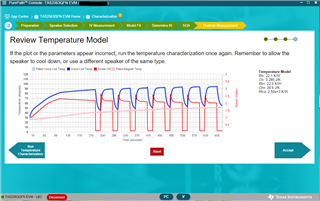
5. Characterisation: thermal measurement:

The characterisation works as expected as far as I can tell. But I don't know if the values are meaningfull, because the verification window shows false values (see below).
6. Smart Amp processing:

With all these evaluated data, the speaker protection seems to be very strict. The loudspeaker is capable of producing more bass without being damaged. How can I "ease up" the protection? I've tried all different examples that are mentioned in the slaa751, slaa857, slaa952 and slaa936a, but the heavy limiting persits.

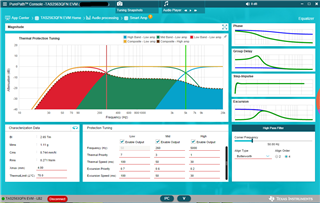
Also, the evaluated thermal and excursion protection data leads to unrealistic verification data. Thermal data shows allways 255°C, and excursion is allways limited to +-1mm even if the limit is set to +-2mm. Both values are obviously incorect and affecting the peformace. Without the smart amp and connected to a normal amp, the peformance is much better at umax. How do I solve this issue?

I'm out of ideas here and could use some assistance. Thank you.

  • Hi Jens,

    I'm adding some comments on each question below:

    • Warning message should be OK, you can ignore this.
    • I would not expect playback error, if you configure the device, default settings are OK, are you able to play audio through the EVM? You can try the following:
      • Connect EVM to USB
      • Power up EVM
      • Open PPC3 and start TAS2x63EVM plugin
      • Click on Tuning and Audio Processing panel
      • Once it completes the initialization process, try to play something through the EVM
      • Is it playing?
    • Speaker + Passive resonator would require a different algorithm. The default one we provide is for mircospeakers as this is the end application historically, I'll reach out in private discussion with further details in getting custom algorithms.
    • As the model is based on microspeaker in closed box, the actual characterization is not realistic, this is most likely the reason why validation is not working as expected. Let me also follow up in private discussion, I'll reach out to start discussion over email.

    Best regards,
    -Ivan Salazar
    Applications Engineer

  • Hello Ivan,

    thank you for your quick reply, it is appreciated. I'll answer to your remarks:

    • I'll ignore the warning message like I did in the past, since it has no effect on the software.
    • The playback error only occures in this step of the characterisation. It seems like the hardware does not get un-muted or something. But under normal operation (tuning mode), everything works fine, playback is possible. I was just worried that this could have an effect on the characterisation. But if it is not the case, I just ignore this error.
    • Ok, this is an important information, since we're only month away from mass production. I'm looking forward to receiving further instructions via email, thank you!
    • I would recommend to add this information in the datasheet, maybe we would have selected a different smart amp with this information in the first place. Or a hint that if a different characterisation model is needed, you have to get in touch with TI directly.

    I'm looking forward to receiving furter instructions to solve this issue via email.

    Edit 20.09.21: I'm still waiting for a direct reply via email.

  • Hi Jens,

    Sorry for the delayed response, I'm sending friend request to share contact details in private message, I'll you the details.

    Best regards,
    -Ivan Salazar
    Applications Engineer

  • Hello Ivan,

    I'm still waiting for your reply via DM or email. Please reply soon thank you.

  • Hi Jens,

    I have reach out through email, I apologize for the delayed response.

    Best regards,
    -Ivan Salazar
    Applications Engineer