This thread has been locked.

If you have a related question, please click the "Ask a related question" button in the top right corner. The newly created question will be automatically linked to this question.

TPA3255: Fault Shutdown

Part Number: TPA3255
Other Parts Discussed in Thread: TPA3116D2

I'm using a TPA3255 in BTL mode (woofer/tweeter) and I'm seeing the woofer channel shut down at varying levels and temperatures. It is very inconsistent and hard to figure out. Some days it takes a lot of signal to shut it down, some days it is the very first note at a low level. There doesn't seem to be any pattern that I can see. Stranger than that, sometimes it plays at full volume for hours on end with no problems. The woofer is 4 ohms, power supply is +50V. I've checked the heat sink connection...which doesn't seem like a likely issue since I've seen it fail on the first note on a cold start-up. I've looked at the output current and I don't see any saturation. We've verified the speaker impedance...everything I can think of. It almost seems like a false over current fault.

My schematic is similar to the EVM...so I'm not sure where else to look.

When it shuts down, the fault pin is low and the clip pin is high.

The OC_ADJ resistor is 22k.

  • Hi Jim

    As the fault pin and clip shown a overload or undervoltage error happen. It seems a fake overcurrent, you can increase the BST capacitor value. We recommend BST cap 0.033uF~0.22uF, the EVM only designed for typical application.

  • Interesting...I don't see this information in any of the documentation. I do see this value being used with the TPA3116D2.  When would I use a smaller cap and what criteria would make me increase the cap value?

  • Hi Jim

    You can refer to this file to get more information about why fake OC is influenced by BST cap.

    https://www.ti.com.cn/cn/lit/pdf/sloa259

    The OC protection detection of our device is to sample the voltage across the MOS when it is turned on, and then divide it by RDS(on) to obtain the current flowing through the MOS. If the capacitance of the BST capacitor is not large enough, the MOS will not be fully turned on, resulting in a large voltage across the measured MOS triggering a false OC.

  • I have to admit, we are pushing this IC, trying to get all we can out of it. In the app note, it mentions going as high as 0.47uF if you are switching at 400kHz...we are switching at 450kHz. Can I make it that big or can this cause other problems?

    From what I am seeing, there also seems to be a thermal element. If we leave them running with no signal for  an hour or so, then hit it with a large bass transient, it will easily trip the fault condition. At this point the heat sink is a little warm to the touch, but can be held with no trouble. Maybe 45C or so.

  • I tried increasing the BST caps to 200nF, same problem.

  • Hi Jim

    As your describe, it'd hard to locate the problem, I have some conjectures and questions 

    1. If this is is a fake OC issue, maybe the temperature influence the value of BST cap, you can try to increase the BST cap to 0.47uF, but a large BST capacitor will affect the startup of the device. 

    2. Maybe it's a real OC issue. could you please share  the current wave while fault happen and your schematic? What the output power while the issue happen?

    3. " In the app note, it mentions going as high as 0.47uF if you are switching at 400kHz.." could you please share me the link of this application note, I want to check it.

  • 1. Ok

    2. I don't think we are getting any where near the 17 Amp current ...experimenting today, it looks like our DSP limiter is keeping the output current below 12 Amps. I saw it trip well below the 12 Amp level.

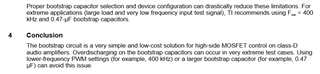
    3. It is in the app note you referenced me to, they mention it twice:

    The app note is written for the TPA31xx series, so that could be specific to that series.

    One thing I noticed today, the coupling caps going to the inputs are polarized electrolytics and they are reversed from how they should be installed. I replaced them with non-polarized caps on two of the modules and the fault has stopped. I need to test more before I declare that the issue, but it looks promising. Do you think this could be the root cause of the faults?

  • Hi Jim

    If you use the wrong coupling caps, and the positive connect to our device, it can be work, because we have DC bias. However, if the negative connect to our device, if the input is higher than our device input pin, you know it has the rick of damage cap, maybe it's the reason of overcurrent. Maybe you can try to reappear the  error to ensure it.

  • I have modified about 15 speakers now and the reversed input caps are definitely the issue. I consider this resolved.