This thread has been locked.

If you have a related question, please click the "Ask a related question" button in the top right corner. The newly created question will be automatically linked to this question.

TAS2562: TAS2562

Part Number: TAS2562


Hi TI Team,

     I'm using TAS2562 Speaker amplifier and 10mW speaker connected to it.

    Issue is at some particular sound the sound get saturated .output from speaker didnt get .

   Could you explain what can be the reason for it.
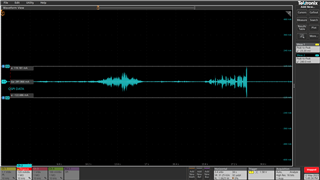
In second set you can observe there is peak in current after that sound not coming. Again the MCU power reset speaker amplifier sound should processed.  

  • Hi Pooja, 

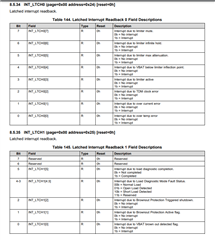
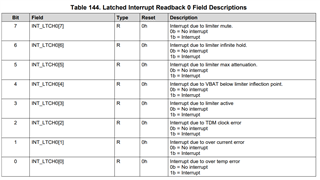
    It looks like the amplifier is having an interrupt and the device is shutting down. Can you read the latched interrupts from registers 0x24 0x25 to see if the device is reporting a fault?

    Can you share more details on the speaker? 10mW seems like a very small speaker.

    Can you also test with the speaker disconnected and see if the issue occurs?

    Can you test with a resistive load(4Ohm) and see if the issue still occurs?

    Regards,

    Arthur

  • Hi Arthur,

      Thanks for the response.

       I think wattage of the speaker is not an issue since speaker amplifier wattage capacity is greater multiple times of speakers wattage capacity.

       And used speaker resistance is around 35ohms.


    In table 144, except 0 and 1 , INT_LTCH0[2]  to INT_LTCH0[7] gets interrupt.

    could you suggest anything.?

    Thanks in advance.

  • Hi Pooja, 

    Understood the speaker is higher impedance, and the device is not reporting over current.

    I am most suspicious of the TDM clock error. Are you using the TI EVM? or is this a custom board. 

    If it is the EVM there is a known issue where the USB communication can fail causing the audio to stop.

    Regards,

    Arthur

  • Hi Arthur,

    Using Custom board.

    Regards,

    Pooja.

  • What is the register settings and I2S clock configuration you are using?

    Do you see any droop on the power supplies when the issue occurs? I ask because the interrupts seem to indicate VBAT could be sagging.

    Regards,
    Arthur

  • Hey Arthur,

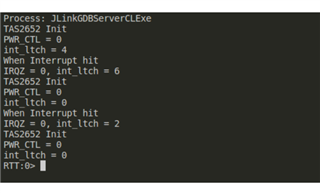
    We read the INT_LTCH0 and INT_LTCH1. Found that when the interrupt hits the OVERCURRENT latch is enabled, and at start the TDM clock error latch hits and continues without error. When high sound is played then only the over current latch is enable. Please refer the below image.

    Below Code is the initialization set for TAS2652.

    i2cWrite(PAGE, PAGE_SET0, 2);
    i2cWrite(BOOK, BOOK_SET, 2);
    i2cWrite(SW_RESET, SWRE_SET, 2);
    HAL_Delay(10);
    
    i2cWrite(PB_CFG1, PB_CFG0_SET, 2);
    i2cWrite(TDM_CFG0, TDM_CFG0_SET, 2);
    i2cWrite(TDM_CFG1, TDM_CFG1_SET, 2);
    i2cWrite(TDM_CFG2, TDM_CFG2_SET, 2);
    i2cWrite(PWR_CTL, PWR_CTL_RESET, 2);
    
    //To know whether the pwr_ctl is set properly
    i2cRead(PWR_CTL,1);
    SEGGER_RTT_printf(0,"TAS2652 Init \nPWR_CTL = %d\n",Rx_Data[0]);
    
    //To know what latch is enabled
    i2cRead(INT_LTCH0, 1);
    SEGGER_RTT_printf(0,"int_ltch = %d\n",Rx_Data[0]);

    Address Set for the above init

    constexpr uint8_t PAGE{0x00U};
    constexpr uint8_t BOOK{0x7FU};
    constexpr uint8_t SW_RESET{0x01U};
    constexpr uint8_t PWR_CTL{0x02U};
    constexpr uint8_t PB_CFG1{0x03U};
    constexpr uint8_t TDM_CFG0{0x06U};
    constexpr uint8_t TDM_CFG1{0x07U};
    constexpr uint8_t TDM_CFG2{0x08U};
    
    constexpr uint8_t PAGE_SET0{0x00U};
    constexpr uint8_t BOOK_SET{0x00U};
    constexpr uint8_t SWRE_SET{0x01U};
    constexpr uint8_t PB_CFG0_SET{0x01U};
    constexpr uint8_t TDM_CFG0_SET{0x00U};
    constexpr uint8_t TDM_CFG1_SET{0x03U};
    constexpr uint8_t TDM_CFG2_SET{0x30U};
    constexpr uint8_t PWR_CTL_RESET{0x00U};

  • Do you have any decoupling capacitors on the amplifier outputs? since the device is Class-D the output switching can cause an overcurrent is too much capacitance is on the output. 

    Have you tested this without the speaker connected?

    Regards,
    Arthur

  • Hey Arthur,

           Thank you. Issue got resolved by removing the diode which is present in between speaker amplifier and speaker. I think the diode what we kept in between that is the reason for over current.

    Regards,

    Pooja.