This thread has been locked.

If you have a related question, please click the "Ask a related question" button in the top right corner. The newly created question will be automatically linked to this question.

TLV320AIC3263: Class-D Amp. short-circuit protection false trigger

Part Number: TLV320AIC3263


Hi everyone

This is our test-setup:

  1. TLV320AIC3263EVM-U
  2. Audio coming from PC through USB
    1. 0dBFS
  3. Class D amp
    1. 8Ω 0.5W or 3W speakers to SPKP/SPKM
    2. Output filter (JP1 & JP2) enabled
    3. Power by USB/board or external(J16)
  4. Class-D playback example configuration

When testing the "Class-D playback" example configuration on CodecControl, we see that anytime we silence the incoming audio, the short-circuit self-protection kicks in, and we can only reset it by reloading the configuration or by power cycling the board, turning on/off the speaker Amp does not reset the protection.

We have seen this happen with the amp powered by either board/USB or external power(J16), 0.5W or 3W speaker.

Is there any relationship between the short-circuit protection and the audio?

  • Hi Martin,

    How are you silencing the incoming audio? Have you measured the current on the output to see if a pop when silencing the audio may be triggering the protection?

    Also have you confirmed that the short circuit protection is the issue by reading back the flag, B0_P0_R44_D7 for RECP and on B0_P0_R44_D6 for RECM?

    Best regards,
    Jeff McPherson

  • Hi Jeff, thanks for your response.

    We are silencing the audio(1kHz tone) by pausing it in Audacity, we do see the flag rise in B0_P0_R44_D7, also we are using the SPKP output, the RECM is disabled by the example default.

    What do you mean by a pop?

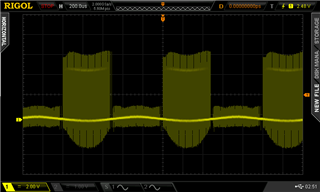
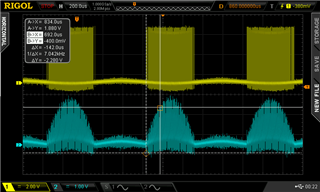
    We have faced some trouble when trying to measure the delivered power, a multimeter measured too little current to make sense, and when we placed the oscilloscope leads to SPKP/SPKM, the speaker started giving a cracking sound (imagine a Geiger counter), and in the oscilloscope sees this:


    any help is much appreciated

  • Hi Martin,

    By pop I mean a transient in the current that may be a result of the audio being paused. Do you get the same issue if you replace the speaker with a load?

    Due to the switching nature of the amplifier, the signal needs to be low pass filtered first before power measurements can be taken.

    Best regards,
    Jeff McPherson

  • Jeff

    We got to solve the silence triggering by setting the Debounce to max, however the protection is randomly triggering after some minutes with 1kHz and connected to the speaker

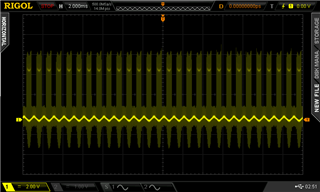
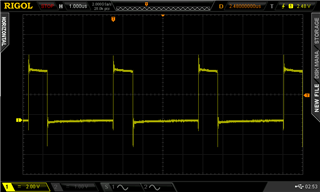
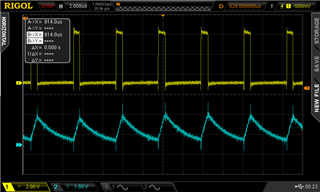
    Here is what we see at the SPK filter(the one on the EVM board) terminals (speaker still connected):


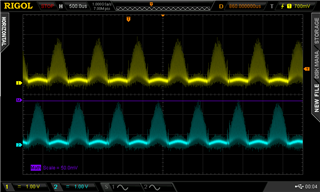
    Here before and after the filter:


    Regards
    Martin B.

  • Hi Martin,

    Would you be able to share a schematic of your set up? Also were you able to replace the speaker with a resistive + inductor load? I want to see if eliminating the speaker variable will improve anything.

    Best regards,
    Jeff McPherson

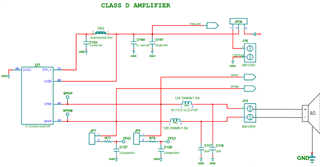
  • we are just simply connecting the speaker to the SPK screw terminal:


    We haven't test with an equivalent load+inductor but we just confirmed that even without a load the short-circuit protection triggers after some time (around 3min)

  • Hi Martin,

    Are JP1 and JP2 disconnected? Also are you disconnecting the speaker entirely or is that GND path still connected? Honestly it's strange to see a speaker that requires a GND connection like that. I'm hoping to ensure there is no possible current loop or GND issue that could be setting off the detection.

    Best regards,
    Jeff McPherson

  • Hi Jeff,

    The displayed speaker ground connection was to its chassis and it made no difference.

    Both JP1 and JP2 were disconnected. The EVM is only connected to the PC through USB, and the protection triggers even with nothing connected to SPKP/SPKM
    Aside that we tested with 8Ω connected to SPKP/SPKM and it triggers the protection immediately.

  • Hi Martin,

    Do you happen to have another EVM to compare if this happens across different devices/boards? The behavior of it triggering even when open makes me wonder if the part is damaged in anyway.

    Best regards,
    Jeff McPherson