This thread has been locked.

If you have a related question, please click the "Ask a related question" button in the top right corner. The newly created question will be automatically linked to this question.

TPA3250: TPA3250EVM design query

Part Number: TPA3250


 Could you please help with below queries:

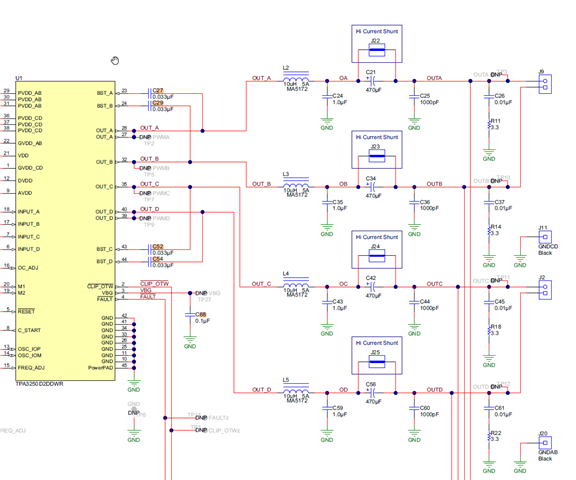
1.The TPA3250 has some short detection and protection of the outputs to ground. How does this work in combination with the 470uF in series? With the 470uF in series, DC on the output can be prevented.

2.Selection of R11 resistor Resistor power ratting for 60 and 120W application.

C26+R11 is used as an load of the class D filter when the loudspeaker load is higher than 120W. This circuit dampens the resonance of the filter around the cut-off frequency.
How is overloading, overheating and breakdown of the 0.5W resistor prevented when the amplifier is driven with high frequency signals in an unloaded condition?

3.  whether a high resistive path (e.g. 47k) on both sides of the capacitor to a defined DC value (e.g. GND and a small DC level) is required?
    a: For the leakage current of the elcap C21, C34, C42, C56) preventing DC voltage creation on the primary side of the transformer.
    b: The elcaps need a (small) DC voltage during usage.

4.Why supply for the TPA3250EVM board divided over two circuits? L1 and L2.
  • Hello Team,

    We are awaiting for your reply

  • Hi Pavan

    1.The TPA3250 has some short detection and protection of the outputs to ground. How does this work in combination with the 470uF in series? With the 470uF in series, DC on the output can be prevented.

    This protection is realized by overcurrent detection at MOSFET side, both high side and low side MOSFET will all monitor the current and protect when it goes too large. With the 470uF capacitor, maybe under some static situation it will totally block the voltage, but it's safe situation because all the voltage is dropped on the capacitor. But when normally Play very large output power, the high side and low side MOSFET is keep switching, capacitor won't able to block voltage all the time.

    How is overloading, overheating and breakdown of the 0.5W resistor prevented when the amplifier is driven with high frequency signals in an unloaded condition?

    This RC snubber is not necessary, we could remove it from the board.

    whether a high resistive path (e.g. 47k) on both sides of the capacitor to a defined DC value (e.g. GND and a small DC level) is required?

    The DC offset at the E-cap would be generated during start up. About the leakage and transformer using, I'm sorry that we don't have much experience. And maybe better to use BD modulation when connect with transformer.

    4.Why supply for the TPA3250EVM board divided over two circuits? L1 and L2.
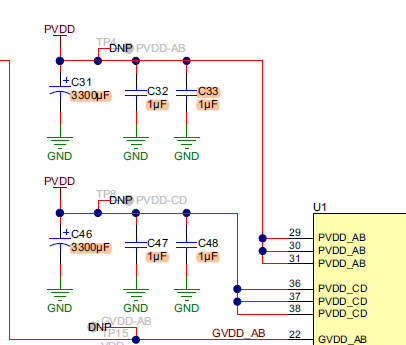
    Sorry that not fully get your point. The L2 seems the output inductor of the device.

  • Thank you for your response,

    I like add some points as below,

    1. This has solved my query.

    2. In case if we are using in our circuit how to select the wattage of R11, In case of overloading, overheating and breakdown of the  resistor prevented when the amplifier is driven with high frequency signals in an unloaded condition.

    3.If possible could provide more details on this.

    4. Why is power section PVDD AB and PVDD CD is separated using two different EL CAP, is to split the power in path?

  • Hi Pavan

    In case if we are using in our circuit how to select the wattage of R11

    Could use the RC snubber power loss on the resistor, it's C × V^2 × f. V could use your maximum voltage, f could use the max audio frequency 20KHz. And that formula is for square waveform, for a sinewave, another 0.3 to 0.5 factor could be added into the final value. Maybe using simulation too would be easier to get the value.

    If possible could provide more details on this.

    The large E-cap is only needed in SE output. If we could use BD modulation, which we recommended, needn't to put any E-cap at the output, should be no problem to connect transformer.

    Why is power section PVDD AB and PVDD CD is separated using two different EL CAP, is to split the power in path?

    It's mainly want to guarantee at each channel side, there's a E-Cap could be put close enough. From the pin sequence, you could see the power supply AB and CD is at the bottom and top of device. Also put two group of cap at two sides would be recommended.