This thread has been locked.

If you have a related question, please click the "Ask a related question" button in the top right corner. The newly created question will be automatically linked to this question.

TAC5112: Configuration for mono output

Part Number: TAC5112
Other Parts Discussed in Thread: TPA2011D1,

Tool/software:

Hello,

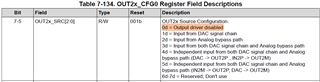
My customer is considering to connect an external mono Class-D AMP like TPA2011D1.  I'd like to know how to configure TAC5112 for that case.  If I look at the application note of TAC5112EVM, I see some configuration examples and the page 34 shows the mono playback, but it uses both DACs as single-ended output.  Is it recommendation?  Can my customer use one DAC with the other disabled like by the following register?  Will it have mono output from OUT1x pins even if TAC5112 receives stereo I2S data and TPA2011D1 can be connected to OUT1x pins?
Best Regards,

Yoshikazu Kawasaki

  • Hi Kawasaki-san,

    It looks like the TPA2011D1 takes a differential mono input. You can configure the TAC5112 to have a differential mono output on pins OUT1P and OUT1M with the OUT1x_CFG register. Yes, you could disable the OUT2x output, or just leave it unconnected.

    Let me know if you need more help.

    Best,
    Mir Jeffres

  • Hello Mir-san,

    Thank you very much for your quick reply. I understand.

    My additional question isn't related to this thread, but some devices have a register showing the silicon revision, but do you have such one in TAC5112?  I don't see such one in the datasheet, but I'd like to confirm if the DUT I use is the latest silicon.  What would you suggest me to do to know the silicon revision?

    Best Regards,

    Yoshikazu Kawasaki

  • Kawasaki-san,

    All shipped EVMs will have the first version of the silicon pre-revision, and the datasheets published are not the final datasheets. So, you will be able to use pre-revision data from the datasheets on your EVM, but once the device is fully released you will want to use the revised registers.

    Best,
    Mir

  • Hello Mir-san,

    Thank you very much for your quick reply again.  I understand there is no register to know the silicon revision anyway.

    Best Regards,

    Yoshikazu Kawasaki