This thread has been locked.

If you have a related question, please click the "Ask a related question" button in the top right corner. The newly created question will be automatically linked to this question.

TAS5825M: OK to use larger caps?

Part Number: TAS5825M


Tool/software:

Hi, 

Due to a BOM limitation it would be nice if we could use 1uF caps for the bootstrap on TAS5825M, e.g. TDK C1608X6S1H105K080AC.
Will this be OK for the device or will the extra capacitance overload the internal diode?
Would we need to do other changes, like increasing GVDD decoupling to accommodate using 1uF caps for the bootstraps? 

Best regards,
Kristian Bergh

  • Hi Kristian,

    You should not decrease the bootstrap cap value. They act as a temporary power supply for the high side FETs when they need to turn on. The device was designed for this 2.2uF and changes to this value could result in the high side FETs not being able to turn on fully.

    Regards,

    Ramsey

  • Hi Ramsey,

    Thanks for the quick response. However, I think you might be talking about a different product perhaps.
    I'll try to specify better what capacitors I'm talking about.
    Ref. the related post https://e2e.ti.com/support/audio-group/audio/f/audio-forum/858609/tas5825m-capacitor-change-from-0-22uf-to-0-47uf
    and the change log from Revision F (October 2019) to Revision G (July 2020) in the TAS5825M datasheet:
    "Changed capacitor values from 0.22 µF to 0.47 µF in the Bootstrap Capacitors section ................................84"
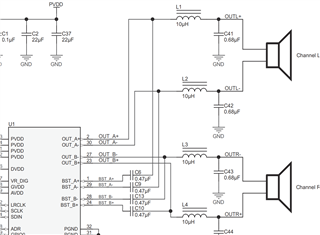
    where the bootstrap capacitors (C6, C9, C13 & C10 in the image below) were increased from 0.22uF to 0.47uF,
    I was wondering if these capacitors can be increased to 1uF without any detriment to the device (TAS5825M)?
    I'm specifically thinking of using the TDK C1608X6S1H105K080AC in place of C6, C9, C13 & C10 in the image below.

    Would this be OK for the TAS5825M?
    Would other changes be needed, like increasing the capacitor value for GVDD decoupling? 

    Best regards,
    Kristian Bergh

  • Hi Kristian,

    My apologies, you are right that the caps should be 0.47uF. While this value is different from my original response the reasoning is the same. Increasing the capacitance means that the capacitor needs more charge to get to the required voltage. While 1uF may still work since the increase is not too large, the device was not designed nor validated with this value.

    Regard,

    Ramsey

  • Hi Ramsey,

    I understand. Thanks for the information!

    Best regards,
    Kristian